Choking to death
 |
|
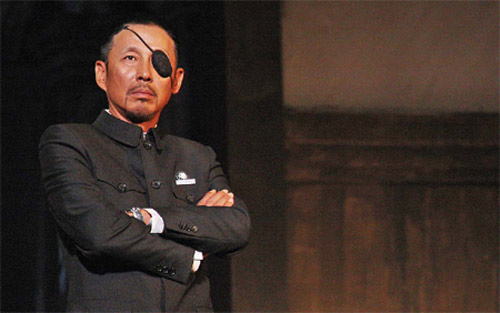
Chinese actor Chen Daoming stars in Beijing People's Art Theater's drama Sorrows of Comedy. Provided to China Daily |
A runaway hit on Beijing's stage highlights the plight of China's creative industry under the yoke of nonsensical censorship and the hopelessness of its struggle for more breathing room.
A comedy writer encounters a military officer who has just returned from the battleground, with one eye covered by a patch.
He needs the latter to give the green light to his latest project so that his troupe of stage actors can perform. But he is facing someone who has no love for the genre.
"People have no need for laughter during a time of war," argues the censor, who in the next seven days picks apart the script and pushes for hilarious changes.
This is the plot of Sorrows of Comedy, which recently completed its 18-day run at Beijing People's Art Theater. The obvious draw - no doubt about it - was Chen Daoming, whose first stage appearance after a superstar career on the screen was widely anticipated. If people came for the star, they stayed for the play, making it the biggest hit in the theater's history.
Actually, it is a Japanese work, set in World War II. But the translator moves the action to China, more specifically to Chongqing in 1941, between a Kuomintang official and the leader of a private performance group. The parallels with the current era are so striking it is hard for anyone to miss them.
The resonance was such that Feng Xiaogang, China's best-known filmmaker of comedy, lost control of himself after watching the stage production. In a post-show party with friends, he was so agitated the glass he was holding slipped from his hand and crashed into the glass table. His wife, actress Xu Fan and star of many of his blockbusters, broke down sobbing.
"We turned a comedy into a tragedy," he wrote later on his micro blog.
Anyone with even scant knowledge of the creative process of China's filmmaking can empathize with Feng. We have a censorship system so inane and so completely out of touch with reality that it is a miracle any good work survives relatively unscathed.
Take Ning Hao's No Man's Land, still in limbo after several years. One of the committee members who shot down the dark comedy revealed the reason: It had too many bad guys and the tone was too dark. This could be an apt description of Ning's early masterpieces, Crazy Stone and Crazy Racer as well, which probably barely survived the censor's kiss of death.
By the same token, film noir as a genre would not have existed if the same thou-shalt-not standards had been applied in Hollywood.
As a matter of fact, I did a little research and studied all Oscar winners in the Best Picture category since 1970. I found that, when put to the litmus test of China's moral arbiters, only three movies could have seen the light of day without substantial trimming or change - and they are Rocky, Dance with Wolves and Driving Miss Daisy. By extension, there would have been no Hollywood to speak of in the first place because an overwhelming number of its projects would be killed by someone 100 times more powerful than Will H. Hays, creator of the Hays Code, a self-regulatory code of ethics adopted in 1930 by the Motion Picture Producers and Distributors of America.
According to a recent Los Angeles Times article, "China's censorship rules discourage racy scenes and push screenwriters toward politically safer period pieces (which Western audiences may find difficult to follow) and romantic comedies. Instead of a global-cinema powerhouse, some worry China is at risk of turning into another Bollywood: healthy on its home continent but limp abroad."
If you think only "racy scenes" are the target, think again. China's film censorship is designed to safeguard the sensibilities of every group, ethnic or otherwise. You can praise its honorable intentions. But the way it works out provides fertile ground for black comedy.
If the plot involves cops, the Ministry of Public Security has to approve the film, up to three times, first the script, then the rough cut and final cut. Naturally, the police would not want the image of its people tarnished. That essentially rules out the existence of heist movies as they are built on the premise of incompetent cops.
If your movie deals with ethnic minorities, the same vetting process takes place - in another government agency. If part of your story happens in a neighboring country, the Foreign Ministry has to ensure that it will not be offensive and induce protests from that country.
Forget about fantasy or science fiction. Audiences in less developed parts of the country may take it at face value, some say. But more leeway is usually given to imported films.
Now you can understand why so many of China's big-budget films are costume dramas. Emperors and warriors of yore will not come back to call for a boycott of your film, upon which you have probably staked so much money that, were you to fail, you would have to go back to mining or real estate. (There are stories of descendents of semi-fictional characters filing lawsuits against film companies that allegedly "defamed" their late-19th-century ancestors.)
I'm sometimes consulted by film people from other countries about the possibilities of entering the expanding China market through co-productions or other channels. I usually warn them about setting the story in China. "You may think you're doing us a favor, but you could be slighting us left and right," I say.
"You should not even reserve a token bad guy for the Chinese, historical or fictional. Things you consider cute and representative of China could be viewed as backward by people here, such as the passing glimpse of Shanghai windows with laundry hanging out in Mission Impossible 3."
Censors want everything to be postcard pretty and every detail to be agreeable to every segment of society. This runs counter to story-telling where you have to have bad guys, or at least less-than-perfect situations, to kick the story into action. If censorship rules are implemented to the letter, the only genre of filmmaking that can survive is promotional films for tourism.
Censorship is the nemesis of art and creativity. Art, filmmaking included, pushes the boundary while censorship sets it. Art strives for freedom while censorship clips the wings of imagination.
I've often heard artists here describe themselves as "dancers with shackles on their hands and feet". It is an irony that some people find these restrictions useful because they set parameters for the formless ideas of those unskilled or undisciplined, as in the case of Sorrows of Comedy where the censor inadvertently improves the script with his implausible suggestions.
In reality, censors are human beings with varying degrees of sophistication, or lack thereof. Very often, they are near retirement authority figures with plenty of spare time. They are not as provincial or boorish as many fear. But they invariably carry their old aesthetics with them. So, it is tantamount to Salieri, the court musician, deciding the fate of Mozart. Well, you remember Amadeus, don't you? The only difference is, in real life, Salieri the censor would not see Mozart the young gun as a genius. Instead, Mozart would be "just another novice who flaunts his talent and fails to follow the fine traditions of his predecessors".
The Chinese government has realized that art and culture constitute much of the soft power of a country, which sometimes is more able to win over hearts than trade and foreign aid. Capital investment is, of course, necessary. But more important is the latitude that artistic creators of every form and stripe should have.
The best way to impose restraints of propriety is to have a ratings system that clearly defines what content can be viewed by what age group. In its absence, even censors with the best of intentions, can be haphazard in doing their job. And even if you pour all the money that our economy generates into the creative industry, there is not the faintest hope it can compete with a juggernaut like Hollywood.