Comments
  Print
Print  Mail
Mail  Large Medium Small
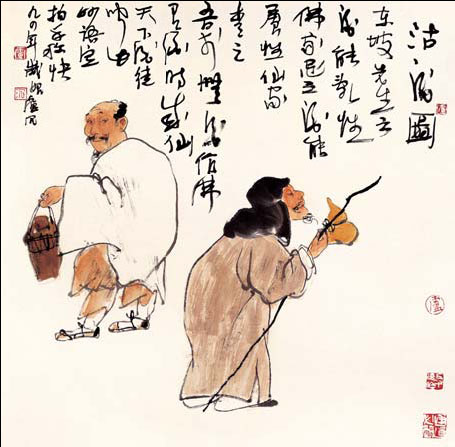
Lu Chen and Zhou Sicong continue to inspire generations of artists with their innovative approach to ink art, long after their death. Zhu Linyong reports
While some deceased artists live on through their masterpieces, some living artists may actually be dead in terms of artistic creation. There are few, however, who remain role models long after their death.
"Lu Chen (1935-2004) and his wife Zhou Sicong (1939-1996), both of whom were my teachers, belong to this category," says Feng Yuan, a well-known figure painter and secretary-general of the All China Federation of the Cultural and Literary Circles.
He made the remark at the opening of a commemorative show of the works of the artist-couple, that will run until June 3 at the National Art Museum of China.
The exhibition is the culmination of three years of preparations by researchers and curators from six art institutions in Beijing and the Mountain Art & Culture Education Foundation from Taiwan.
It has more than 230 works on display, along with numerous sketches, documents and photographs. "We hope it will give visitors a condensed history of the couple's lifelong pursuit of artistic perfection," says Wang Mingming, dean of Beijing Fine Art Academy and vice-chairman of the Chinese Artists Association, who studied ink painting under the couple for decades.
In their true-to-life ink portraits of common workers, peasants, soldiers and children created in the 1960s and the 1970s, the artists stressed the physical characteristics and feelings of their subjects, emphasizing the tiniest of details.
However, their later works evolved roughly from realism, to expressionism, and then lyricism, as some critics describe it.
Arguably the most influential in late 20th century Chinese art, Lu and Zhou "exerted a far-reaching influence on Chinese art history and art education", says Shao Dazhen, a veteran art historian.
The couple are not only remembered for their innovative creations but also for their efforts to integrate traditional and Western techniques into the Chinese art education system, Shao says.
Lu is widely recognized as a pioneer of experimental ink art, who pushed the boundaries of Chinese painting in the 1950s and again in mid-1980s, based on his study of modern Western art.
He established the first experimental studio for Chinese ink art, advocated cross-disciplinary training for art majors, and introduced the latest Western art concepts and techniques in 1987. Schooled in the strict Soviet tradition, Lu established himself as a figure painter of the socialist realism style as early as the 1960s.
In the early 1980s, new art concepts flooded into China, and exhibitions of Western masters, such as Pablo Picasso, Robert Rauschenberg, and Joan Miro, became common.
The social and cultural changes that swept China in the early 1980s made a strong impact in Chinese art circles. It posed a particular challenge to Lu, whose artistic style was rooted in realism. "In my first encounter with Western art, I exclaimed: 'How can life be interpreted in such a strange way?," Lu once said.
However, he made the switch to a more expressive style of free-hand figure painting that drew praise from critics and collectors in China and abroad.
But even as his brushwork became more casual, he continued to use calligraphy-style strokes and lines in his experimental ink works.
All the strokes and lines have individual aesthetic value and are "written" rather than painted, he once explained. "Chinese calligraphic art accounts for the ink blots, strokes, lines and dots that shape the composition."
In terms of subject matter, Lu was opposed to the idea of Chinese paintings depicting only traditional costumes and settings. Many of his works feature people in daily life, giving his ink portrayals an earthy feel.
Like Lu, Zhou Sicong constantly sought new styles and techniques to express her inner feelings.
Born in 1939 in Hebei province, Zhou graduated in 1963 from Central Academy of Fine Arts, with strict training in traditional Chinese painting under such masters as Li Keran, Jiang Zhaohe, Ye Qianyu, and Li Kuchan.
Her signature works include Premier Zhou Enlai and the People, which won the gold at the 1979 National Art Exhibition, Hatred of Coal Miners series which denounced the crimes committed by the invading Japanese army in northeast China during World War II, Ethnic Yi Women depicting people in Sichuan's remote, mountainous areas, and the poetically enchanting Ink Lotus series, Zhou's swan song.
Through the use of forceful lines, misty dots, and well-textured ink patches, Zhou's works show village women collecting firewood, picking wild fruits, looking after babies, and indulging in clandestine love trysts.
Most of the figures are shown bearing heavy burdens, against a backdrop of vast, barren lands, and gray skylines, marking a departure from the peaceful pastoral scenes that dominated the works of her contemporaries.
Her style was evolving again when rheumatoid arthritis struck in 1987, confining her to the home for five years. Even so, Zhou longed to be close to nature. Despite her numbed fingers and painful knees, she painted scenes of clouds, wind, rain, streams, and cottages in her tiny albums. Her favorite subject was the lotus, which she gave a misty, dreamy look.
Her works are a peculiar mixture of depression and vitality, sorrow and merriment, loneliness and enthusiasm.

Many of today's mainstream Chinese ink painters have either been students of Zhou and Lu or been influenced by their style in one way or another.
"Lu and Zhou played a key role in modernizing Chinese ink art. They remain an inspiration to this day," says Tian Liming, a renowned figure painter with the National Research Institute of Chinese Arts.
"Their selfless guidance will always be cherished."


Copyright 1995 - . All rights reserved. The content (including but not limited to text, photo, multimedia information, etc) published in this site belongs to China Daily Information Co (CDIC). Without written authorization from CDIC, such content shall not be republished or used in any form. Note: Browsers with 1024*768 or higher resolution are suggested for this site.
License for publishing multimedia online 0108263 Registration Number: 20100000002731