Beautiful traditional Hanfu clothes
When talking about traditional Chinese clothing, one might immediately think of qipao, or cheongsam. Some people even call it “the China Dress.” However, the history of this dress is only a few hundred years old compared to China’s thousands of years of civilization. In a strict sense, this dress is not native to most Chinese.
Traditionally, Chinese people trace the clothing system back to the Huang Di or the Yellow Emperor. It is said in a book written three thousand years ago that “The Yellow Emperor lowers his draped arms and the world was well ruled.” Obviously to ancient Chinese, garments are not only something to cover the body with, but also the embodiment of civilization. Clothing has evolved to be an essential part of the etiquette system. It is even used as a synonym of Chinese culture in some context. For instance, thousands of years ago when parts of China were invaded every now and again, a man would be moved to tears if he saw Chinese costumes in occupied areas. He would cry out: “Our culture is still there!”
 |
As Chinese people become more self-conscious over the recent years, they started taking an interest in traditional dresses again. They are keen to renew the traditional costume, known as “Hanfu”, which has been around three thousand years ago, as opposed to qipao, which has only been around for three hundred years.
The “Hanfu” gets its name from the Chinese people, who are known as the Han race, as opposed to other minor ethnic groups such as the Man people, and “fu” means clothing.
Hanfu has a number of distinct characteristics. One of them is the style on its front. The picture below is depicts a typical woman’s dress. There are two parts overlapping on the front. This is called “Jiao Ling” (Crossing Collar), which is a main feature of nearly all Asian costumes (influenced by China). The order of the two parts is quite important. From the wearer’s point of view, the crossing is always on his/her right side, which is called “You Ren” (Right Front). Some ethnic groups in Asia have costumes almost identical to Hanfu, but they prefer to put the crossing on the left side. Therefore, the front style is an important symbol of group differentiation and culture identity. An easy way to recognize Hanfu is that its collar forms a “y” shape if you look at the dress from the front.
 |
Another major characteristic of Hanfu is that it usually does not have buttons. The famous “China Knot Buttons” seen on Qipao appeared very late in Chinese history. Hanfu is usually fastened by ribbons, only occasionally decorated by a few buttons. On the contrary, Qipao is especially fond of buttons. They tend to overuse buttons so much that they are sometimes called “centipede costumes.”
Hanfu usually has a waistband, on which various little decorations are hung, including Yu (jade) and Chinese knots. These hung decorations, together with the long ribbons and relatively wide sleeves, can sway as one walks. Its idea is to to cover up any imperfections and to accentuate the bodily beauty of an East Asian woman.
Men’s Hanfu is basically the same as the womens’, only more conservative in color and fewer patterns to choose from.
Hanfu’s beauty makes it perfect for performances. For example, in the Beijing 2008 Olympics, most performers were dressed in Hanfu.
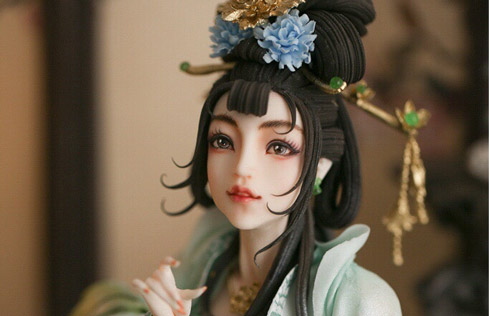
People dressed in Hanfu make good subjects for painting, sculpture and other forms of art. Here are just some of its masterpieces.
 |
This silk painting was found in a tomb which dates back to more than 2000 years ago. One of the earliest silk painting, it depicts a slim woman in a long dress with a Chinese dragon and a phoenix flying over her head.
 |
This is a relic carving on brick found in a tomb dating back to the 5th to 6th century AD. It depicts an elegant lady with a high hairstyle.