Just aching to write
By Yang Guang (China Daily)
Updated: 2010-03-19 09:34
 |
Large Medium Small |
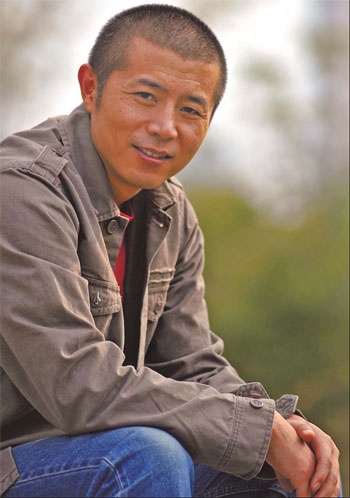
Literary star Bi Feiyu says all the stories that he has penned are essentially one - the story of pain. Yang Guang reports
Often described as the country's best male writer on the female psyche, Bi Feiyu, 46, does not see himself worthy of the accolade.
"I wouldn't say I've been writing about women. Rather, I've been writing about humans," he told a roomful of enthusiasts at the Bookworm International Literary Festival on Monday.
But the description is not without reason. Almost all his best-known works feature distinctive female characters, including The Moon Opera (Qing Yi), long in the running for the 2008 Independent Foreign Fiction Prize, and Three Sisters (Yumi), winner of the Lu Xun Literary Award in 2004. The English versions of both books, by Howard Goldblatt, a leading translator of Chinese literature, are now available. They are published by Houghton Mifflin Harcourt in the United States.
Bi explains that he may have unconsciously chosen female characters because women, being sensitive, are best able to convey his overarching motif - pain.
"I've written essentially just one story - under different names - the story of pain."
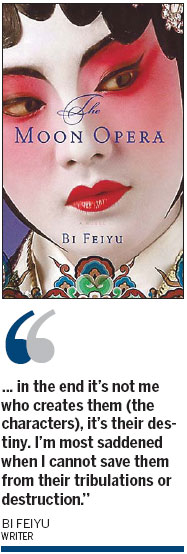
It is, indeed, true. The main characters' desperate struggles to change their destinies and bitter disillusion in Three Sisters could be seen as the pain of, and after, the "cultural revolution" (1966-76), while Peking Opera actress Xiao Yanqiu's obsessive commitment to her role in The Moon Opera explores the searing pain of her internal struggles.
Bi's preoccupation with pain might appear gratuitous, considering he has not suffered much hardship to get where he is today. But, as he says, the feeling of pain could be purely metaphysical.
Bi had to move often with his family, before he entered college, when his father was branded a "rightist".
He began to write in 1987, while teaching at a school in Nanjing, Jiangsu province. He recalls how he wrote into the wee hours, simply to let off steam. "I was like a car filled with petrol, rambling as the key turned, even if there was no steering wheel, no brake, no destination, and worst of all, no road," he says.
In those early years he penned a number of short stories in the then popular avant-garde style, characterized by narrative innovation, imagination and Westernized language.
Between 1992 and 1998, he worked as a reporter with Nanjing Daily. Ironically, he was sacked and reinstated at least four times, because of his tendency to lace his reporting with fiction.
This triggered a shift in his writing style. He began to look more sharply at the social reality and focus more on characterization.
"For me, creating characters is about getting along with people. For instance in Three Sisters, I constantly hand wrestle with Yumi, who is very strong inside," he says.
"But in the end it's not me who creates them (the characters), it's their destiny. I'm most saddened when I cannot save them from their tribulations or destruction."
While not a fatalist, Bi does believe in destiny. Despite being faced with a number of options for a career, it was as if he was guided by destiny to pick writing. Similarly, he says, the stories are always there but connect to a writer by pure chance.
So it was with Three Sisters. After finishing The Moon Opera he tried, in vain, for 13 months to come up with the next story.
One day he overheard a song on TV. The word "corn" in the lyrics immediately struck a chord, bringing back childhood memories of roasting corn cobs by the fire, and sowed the seeds for the character Yumi, literally corn, the main character of Three Sisters.
Bi's strongly cinematic text also explains why his works are sought after by film directors. Zhang Yimou adapted What Happened in Shanghai (Shanghai Wangshi) into the award-winning film Shanghai Triad, while director Kang Honglei has made The Moon Opera into a namesake popular TV series.
More than 20 years of writing has taught Bi the wisdom to write what he is capable of, instead of what he desires. "But I still feel the pain of wanting desperately to write what I desire," says the editor of the Nanjing-based literary magazine, Yu Hua.