我們都聽說過一些“返祖現象”,比如某個嬰兒身上的毛發特別多,或是長了尾巴;還有本來沒有腳的動物比如鯨魚,卻多出了兩只像腳一樣的東西。那么,”返祖“究竟是怎么回事呢?有人認為這是基因的問題。
 |
|
Photo by China Photos/Getty Images
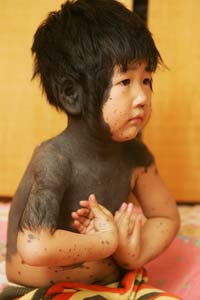
Four-year-old Jiaxue, of China, was born with hairy black moles covering parts of her back, chest, neck and face. The media reported her condition as an atavism.
|
Perhaps you've heard of the world's hairiest man. The media loves to show his picture. Newspapers call conditions like this and others atavisms(返祖現象). Is the world's hairiest man really a throwback to our simian(猿) ancestors? Not quite. Ape faces are clear of hair, as Michael Le Page notes in his New Scientist article on atavisms. So hypertrichosis(多毛癥), a condition in which excessive amounts of hair cover the body, isn't an atavism -- unless our ancestors were werewolves(狼人). If it is an avatism, it's not from the animals we point to when we talk about evolution, like chimps.
What's the difference between atavisms and vestigial(發育不全的,退化器官的) structures? They're actually pretty close. Vestigial structures are body parts that survive as degenerate, imperfect versions of what they should be. Think of the ostrich: It has wings, but it can't fly. Ostriches use their wings for other purposes, like balance, but their wings can't function as wings. Their wings are vestigial -- they're used for a purpose, but not the purpose for which they were designed.
Atavisms are traits of distant ancestors that reappear in the modern day. In order for the trait to be an atavism, an organism's parents can't have the trait, and neither can recent ancestors. The atavism you've probably heard of most often? The human tail. It's not just a gag to pull in a Farrelly brothers movie -- it really happens. There are two kinds of human tails, however: the pseudo-tail and the much rarer, true human tail. The pseudo-tail doesn't have any bones or cartilage(軟骨) -- it's skin and fat. But the true human tail has nerves and muscles and sometimes even cartilage or vertebrae(椎骨), although there seems to be some scientific debate about this last point. All vertebrates have the ability to make a tail, and guess what? Humans are vertebrates. Way back when, maybe we all had tails, and they provided some important function for us, perhaps to help us balance.
So how do these traits crop up? One idea is that instead of genes being lost during evolution, they're merely silent - they're still there, they're just not doing anything. But maybe these genes can be turned back on. Studies have shown species that lose and regain wings millions of years afterward. Are these species just evolving once again? Or did a silent gene labeled "grow wings" suddenly switch back on?
Scientists aren't sure how atavisms work -- not yet. They point to embryos to help decipher the answer. Embryos develop characteristics in the womb that later disappear. Whale embryos do grow buds where their legs would be, but they lose them as they develop. When you were a fetus, you had a little bud where a tail would be, but it disappeared before you were born. But on rare occasions, they don't disappear, and a baby whale is born with leg-like appendages or a human baby is born with a tail, which is usually amputated.
So why do atavisms happen? What place do they have in evolution? We don't know the answer. Often when people think of genetic information, they think about cloning, designer children and other controversial topics. But as scientists delve more deeply into our genetic information, this could be one of the most exciting areas of research -- finally figuring out where we came from and how we got to where we are.
(來源:howstuffworks.com 英語點津 Annabel 編輯)
我要了解更多趣味百科知識


