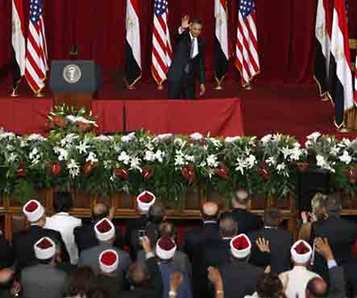
Good afternoon. I am honored to be in the timeless city of Cairo, and to be hosted by two remarkable institutions. For over a thousand years, Al—Azhar has stood as a beacon of Islamic learning; and for over a century, Cairo University has been a source of Egypt's advancement. And together, you represent the harmony between tradition and progress. I'm grateful for your hospitality, and the hospitality of the people of Egypt. And I'm also proud to carry with me the goodwill of the American people, and a greeting of peace from Muslim communities in my country: Assalaamu alaykum.
We meet at a time of great tension between the United States and Muslims around the world — tension rooted in historical forces that go beyond any current policy debate. The relationship between Islam and the West includes centuries of coexistence and cooperation, but also conflict and religious wars. More recently, tension has been fed by colonialism that denied rights and opportunities to many Muslims, and a Cold War in which Muslim—majority countries were too often treated as proxies without regard to their own aspirations. Moreover, the sweeping change brought by modernity and globalization led many Muslims to view the West as hostile to the traditions of Islam.
Violent extremists have exploited these tensions in a small but potent minority of Muslims. The attacks of September 11, 2001 and the continued efforts of these extremists to engage in violence against civilians has led some in my country to view Islam as inevitably hostile not only to America and Western countries, but also to human rights. All this has bred more fear and more mistrust.
So long as our relationship is defined by our differences, we will empower those who sow hatred rather than peace, those who promote conflict rather than the cooperation that can help all of our people achieve justice and prosperity. And this cycle of suspicion and discord must end.
I've come here to Cairo to seek a new beginning between the United States and Muslims around the world, one based on mutual interest and mutual respect, and one based upon the truth that America and Islam are not exclusive and need not be in competition. Instead, they overlap, and share common principles — principles of justice and progress; tolerance and the dignity of all human beings.
I do so recognizing that change cannot happen overnight. I know there's been a lot of publicity about this speech, but no single speech can eradicate years of mistrust, nor can I answer in the time that I have this afternoon all the complex questions that brought us to this point. But I am convinced that in order to move forward, we must say openly to each other the things we hold in our hearts and that too often are said only behind closed doors. There must be a sustained effort to listen to each other; to learn from each other; to respect one another; and to seek common ground. As the Holy Koran tells us, "Be conscious of God and speak always the truth." That is what I will try to do today — to speak the truth as best I can, humbled by the task before us, and firm in my belief that the interests we share as human beings are far more powerful than the forces that drive us apart.
Now part of this conviction is rooted in my own experience. I'm a Christian, but my father came from a Kenyan family that includes generations of Muslims. As a boy, I spent several years in Indonesia and heard the call of the azaan at the break of dawn and at the fall of dusk. As a young man, I worked in Chicago communities where many found dignity and peace in their Muslim faith.
As a student of history, I also know civilization's debt to Islam. It was Islam — at places like Al-Azhar — that carried the light of learning through so many centuries, paving the way for Europe's Renaissance and Enlightenment. It was innovation in Muslim communities — it was innovation in Muslim communities that developed the order of algebra; our magnetic compass and tools of navigation; our mastery of pens and printing; our understanding of how disease spreads and how it can be healed. Islamic culture has given us majestic arches and soaring spires; timeless poetry and cherished music; elegant calligraphy and places of peaceful contemplation. And throughout history, Islam has demonstrated through words and deeds the possibilities of religious tolerance and racial equality.
I also know that Islam has always been a part of America's story. The first nation to recognize my country was Morocco. In signing the Treaty of Tripoli in 1796, our second President, John Adams, wrote, "The United States has in itself no character of enmity against the laws, religion or tranquility of Muslims." And since our founding, American Muslims have enriched the United States. They have fought in our wars, they have served in our government, they have stood for civil rights, they have started businesses, they have taught at our universities, they've excelled in our sports arenas, they've won Nobel Prizes, built our tallest building, and lit the Olympic Torch. And when the first Muslim American was recently elected to Congress, he took the oath to defend our Constitution using the same Holy Koran that one of our Founding Fathers — Thomas Jefferson — kept in his personal library.
So I have known Islam on three continents before coming to the region where it was first revealed. That experience guides my conviction that partnership between America and Islam must be based on what Islam is, not what it isn't. And I consider it part of my responsibility as President of the United States to fight against negative stereotypes of Islam wherever they appear.
But that same principle must apply to Muslim perceptions of America. Just as Muslims do not fit a crude stereotype, America is not the crude stereotype of a self-interested empire. The United States has been one of the greatest sources of progress that the world has ever known. We were born out of revolution against an empire. We were founded upon the ideal that all are created equal, and we have shed blood and struggled for centuries to give meaning to those words — within our borders, and around the world. We are shaped by every culture, drawn from every end of the Earth, and dedicated to a simple concept: E pluribus unum — "Out of many, one."
Now, much has been made of the fact that an African American with the name Barack Hussein Obama could be elected President. But my personal story is not so unique. The dream of opportunity for all people has not come true for everyone in America, but its promise exists for all who come to our shores — and that includes nearly 7 million American Muslims in our country today who, by the way, enjoy incomes and educational levels that are higher than the American average.
Moreover, freedom in America is indivisible from the freedom to practice one's religion. That is why there is a mosque in every state in our union, and over 1,200 mosques within our borders. That's why the United States government has gone to court to protect the right of women and girls to wear the hijab and to punish those who would deny it.
So let there be no doubt: Islam is a part of America. And I believe that America holds within her the truth that regardless of race, religion, or station in life, all of us share common aspirations — to live in peace and security; to get an education and to work with dignity; to love our families, our communities, and our God. These things we share. This is the hope of all humanity.
Of course, recognizing our common humanity is only the beginning of our task. Words alone cannot meet the needs of our people. These needs will be met only if we act boldly in the years ahead; and if we understand that the challenges we face are shared, and our failure to meet them will hurt us all.
For we have learned from recent experience that when a financial system weakens in one country, prosperity is hurt everywhere. When a new flu infects one human being, all are at risk. When one nation pursues a nuclear weapon, the risk of nuclear attack rises for all nations. When violent extremists operate in one stretch of mountains, people are endangered across an ocean. When innocents in Bosnia and Darfur are slaughtered, that is a stain on our collective conscience. That is what it means to share this world in the 21st century. That is the responsibility we have to one another as human beings.
And this is a difficult responsibility to embrace. For human history has often been a record of nations and tribes — and, yes, religions — subjugating one another in pursuit of their own interests. Yet in this new age, such attitudes are self-defeating. Given our interdependence, any world order that elevates one nation or group of people over another will inevitably fail. So whatever we think of the past, we must not be prisoners to it. Our problems must be dealt with through partnership; our progress must be shared.
Now, that does not mean we should ignore sources of tension. Indeed, it suggests the opposite: We must face these tensions squarely. And so in that spirit, let me speak as clearly and as plainly as I can about some specific issues that I believe we must finally confront together.