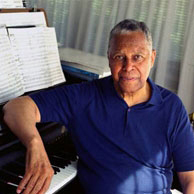
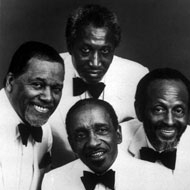
Lewis combined classical music with traditional jazz to create songs for himself and the 3 other members of his quartet.
VOICE ONE:
I'm Steve Ember.
VOICE TWO:
And I'm Shirley Griffith with the VOA Special English program PEOPLE IN AMERICA. Today, we tell about pianist John Lewis. He created one of one of the most famous jazz groups in America, the Modern Jazz Quartet.
(MUSIC)
VOICE ONE:
John Lewis was known for his creativity. He was a skilled piano player and musical director of the Modern Jazz Quartet for almost 50 years. He wrote and arranged all the music for the small group. Mister Lewis was responsible for the group's sound and its identity.
John Lewis was interested in jazz, blues, and bebob, a music with a great deal of energy. Yet he was also greatly influenced by his training in European classical music. Classical music is expressive and intense, but is also structured. He thought jazz should be presented the same way.
John Lewis combined classical music with traditional jazz to create songs for himself and the three other members of his quartet. He believed music should be simple and clear, yet played in a meaningful way. Here is one of the Modern Jazz Quartet's big hits, "Django."
(MUSIC)
VOICE TWO:
John Lewis was greatly influenced by the piano style of the famous jazz bandleader, Count Basie. Like Basie, Lewis believed in making every note of music count. He depended as much on silence as he did on notes to get his message across.
John Lewis often used a form of music called fugue. Fugue is a series of opposing melodies used to create a complex effect. Mister Lewis also combined written music with music that the group invented as it went along.
This new kind of jazz attracted both lovers of jazz and classical music. It also appealed to people who did not necessarily like jazz. Here is an example of fugue in the song "Alexander's Fugue."
(MUSIC)
VOICE ONE:
The Modern Jazz Quartet included John Lewis, Milt Jackson, Percy Heath and Connie Kay. The group made its first recording in 1952. And they continued to play together, with a seven year break, until 1999.
John Lewis was as concerned about appearances as he was about the music. The musicians had to dress well for every performance. They played mostly in concert halls instead of small dance clubs. Lewis believed jazz should receive the same respect as classical music.
VOICE TWO:
John Lewis was born in La Grange, Illinois, in 1920. He grew up in Albuquerque, New Mexico. He started playing the piano when he was seven. As a teenager, he played professionally in churches around Albuquerque. He soon was playing in local dance halls.
Lewis studied anthropology and music at the University of New Mexico. In 1942, he joined the Army and served in Europe during World War Two.
After the war, Lewis moved to New York City and played in Dizzy Gillespie's big band. He also studied for his master's degree at the Manhattan School of Music.
VOICE ONE:
John Lewis played in the rhythm section of Gillespie's band. Other members were drummer Kenny Clarke, bass player Ray Brown and vibraphone player Milt Jackson. The 4 often performed together while the horn players in the band rested.
The 4 band members continued to work together after leaving Dizzy's group in the late 1940s. At that time, they were criticized for not playing "true jazz." But they continued anyway. Ray Brown and Kenny Clarke soon left the group. Bass player Percy Heath and drummer Connie Kay replaced them. In 1952, the group became the Modern Jazz Quartet and established its own identity.
VOICE TWO:
In 1956, the Modern Jazz Quartet played a series of concerts in Europe. The group helped make jazz popular with many music listeners in Europe. The members of the quartet had become major stars by the time they returned to the United States.
The Modern Jazz Quartet continued to perform all over the world for sold-out crowds until the late nineteen seventies. People loved the group's teamwork and their amazing sound. Listen as we play "Vendome", another big hit.
(MUSIC)
VOICE ONE:
Critics say John Lewis's "less is more" piano style and Milt Jackson's energy on the vibraphone were the secret to the group's long-lasting success.
Yet over the years, Mister Jackson expressed dissatisfaction with limits that were put on his talents. The group separated in 1974. However, the members of the quartet reunited after 7 years. They played together until Milt Jackson's death in 1999.
In addition to his work with the Modern Jazz Quartet, John Lewis worked for many years as musical director of the Monterey Jazz Festival in California. He wrote the music for several Hollywood films. He taught at Harvard University and the City College of New York. And he helped establish a jazz school in Massachusetts.
VOICE TWO:
Through the years, John Lewis worked with some of the biggest names in jazz, including trumpet player Miles Davis. Yet for all the praise Lewis received, he was known for putting the interests of the group over the individual.
John Lewis lived a quiet life with his wife, Mirjana, in New York City. In March, 2001, he died of cancer. He was eighty years old. His death officially marked the end of a historic period in modern jazz.
(MUSIC)
VOICE ONE:
This Special English program was written and produced by Cynthia Kirk. Our audio engineer was Roy Benson. I'm Steve Ember.
VOICE TWO:
And I'm Shirley Griffith. Listen again next week for another PEOPLE IN AMERICA program on the Voice of America.
long-lasting: enduring or existing for a long period of time(持久的,長久的)