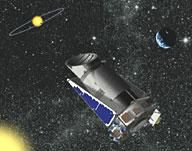
On Thursday, the U.S. space agency NASA is set to launch its newest space telescope. The Kepler mission has one goal - to find Earth-like planets elsewhere in our galaxy.
Kepler's telescope will stay pointed at an area of the sky with a concentration of some 100,000 stars that are considered likely candidates to have planets like Earth.
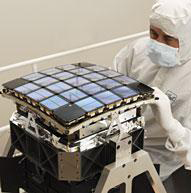
At Kepler's heart is an array of 42 CCD sensors, like you might have in your digital camera, only bigger and better. Your camera might have 10 megapixels; Kepler has 95 in a sensor covering about 700 square centimeters.
Scientists won't be able to see any planets directly. Instead, says Kepler Project Manager Jim Fanson, they look for a slight dimming of stars as planets pass in front of them.
"We have to be able to measure the brightness change of stars down at the 20 part per million level. It's akin to measuring...We have to be able to measure the brightness change of stars down at the 20 part per million level. It's akin to measuring a flea as it creeps across the headlight of an automobile at night. That's the level of precision that we have to achieve."
If a star dims once, then dims again 10 months later, the fluctuation might be caused by a planet circling that star every 10 months. Or it might be something else, so the Kepler science team will wait another 10 months to see if the star dims again. They also look for confirmation from ground-based telescopes.
Astronomers have found more than 300 planets outside our solar system - exoplanets, they're called. Most are giants more like Jupiter than Earth. And lead scientist William Borucki says it's impossible to know what Kepler will find.
"Kepler's designed to find hundreds of Earth-size planets, if such planets are common around stars. And if we find that many, it certainly will mean that life may well be common throughout our galaxy. If, on the other hand, we don't find any, it will mean that Earths must be very rare; we may be the only extant life in our universe."
Astronomers should be able to use the data from Kepler to determine the size, mass, and some other characteristics of these newly discovered exoplanets. But even though the telescope is designed to find "earth-like" planets, it won't detect whether there is life on any planets it finds, and astronomer Debra Fischer of San Francisco State University says they actually may not be very much like Earth.
"I think that the science fiction writers are going to be challenged to imagine the diversity that we could expect to find even in these types of planets. They may not be rocky worlds. They may be water worlds. These could be worlds that in fact have life like our oceans but are perhaps not sending radio signals to us."
Fischer and lead scientist William Borucki agree that Kepler is just one step in learning about the worlds that orbit distant stars.
"Kepler, by virtue of the statistics that it finds, is going to tell us how frequent the occurrence of Earth-sized, Earth-massed planets are. And then that's going to tell us what the next step should be,"
"We're taking steps. The first step is what Debra talked about. Step after that, find out what's in their atmospheres. Step after that might be that our children or grandchildren send an automated probe to those stars and look for themselves."
Kepler is due to launch aboard an unmanned rocket from Cape Canaveral, Florida.
Earth-like planet:類地行星
akin: having a similar quality or character; analogous(類似的)