當(dāng)你使用便利的取火工具--火柴和打火機(jī)時(shí),有沒(méi)有想過(guò)這些東西是怎么發(fā)面的嗎?下面這篇文章將為您講述一下火柴的歷史。
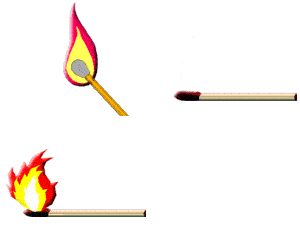 The quest for ways to ignite a fire began about 1.5
million years ago, when the caveman discovered that he could start a fire by
rubbing two sticks together, and ended with the successful invention of the
non-toxic matches we use today.
The quest for ways to ignite a fire began about 1.5
million years ago, when the caveman discovered that he could start a fire by
rubbing two sticks together, and ended with the successful invention of the
non-toxic matches we use today.
Today, approximately 500 billion matches are used each year and about 200
billion of these come from matchbooks.
In 1669, an alchemist, one who
mistakenly believes that he can change base metals into gold, mixed up a batch
of something which was, surprisingly, not gold, but a substance he named
phosphorous. Since his recipe did
not produce the gold he desired, he tossed it onto the heap of history.
Next was Robert Boyle, an English physicist, after whom Boyle's Law was
named. He cleverly coated a piece of paper with phosphorous and, armed with a
splinter of sulfur-coated wood, bravely bulled the wood through the paper, which
burst into flames.
Much later, in 1826, John Walker stumbled upon a chemical concoction that
produced fire. After stirring together a mixture of chemicals, which did not
contain phosphorous, John removed the stick he used, only to find a dried lump
at its end. When he scraped the stick against the floor to rid it of the lump,
the stick ignited. His mixture of antimony sulfide, potassium chlorate, gum, and
starch could produce fire. In his rush to demonstrate his discovery to others,
John bypassed the patent office.
In no time, a person at one of John's demonstrations, Samuel Jones, spotted
an overlooked, golden opportunity, and patented the invention under his name.
Mr. Jones produced matches he named Lucifers, which produced phenomenal sales.
The widespread availability of the matches actually led to a significant
increase in smoking.
The dark side to Lucifers was their ungodly odor, and the fireworks display
they gave when ignited. In fact, Lucifers carried a warning label stating that
they, not the cigarettes they lit, were dangerous to one's health!
In the 1830s, Charles Sauria, a French chemist, decided to improve upon the
existing formula by adding white phosphorous to do away with the stench of the
matches. What Mr. Sauria did not know, was that white phosphorous was lethal to
those who came into contact with it.
Unknowingly, he created a deadly monster by adding the white phosphorous. The
phosphorous was responsible for a nearly epidemic disease known as "phossy jaw,"
match factory workers developed poisoned bones, and children who sucked on the
matches developed infant skeletal deformities. Even the amount of white
phosphorous contained in one pack of matches could kill a person, and actually
did, through numerous suicides and murders.
Finally, by 1910, the general public's awareness of the dangers of the white
phosphorous in these matches led to a worldwide campaign to ban them.
Thankfully, Diamond Match Company obtained an U.S. patent for the first
nonpoisonous match, which used the harmless chemical sesquisulfide of
phosphorous in place of the deadly white phosphorous.
So critical was Diamond Match Company's discovery to public health, that U.S.
President Taft made a public plea to the Company voluntarily to surrender their
patent rights to the invention. Despite the enormous moneymaking potential of
the patent, Diamond Match Company granted President Taft's request on January
28, 1911. Congress followed suit by passing a law that raised the tax on white
phosphorous matches to a level so high that their production soon ceased.
Discussion of the match would be incomplete without mention of the matchbook.
John Pusey, in 1892, invented something he named the matchbook. He had the right
idea, but had it backwards, as he placed the striking surface for the match on
the inside of the book of 50 matches, so when one match was struck, the
remaining 49 also ignited!
Once again, Diamond Match Company intervened and saved the day, by purchasing
the patent to the matchbook, by moving the striking surface to the outside of
the cover where it belonged, and by marketing the revamped match as the "safety
match."
alchemist: 煉金術(shù)士
phosphorous: 磷
(來(lái)源:coolquiz.com 英語(yǔ)點(diǎn)津 Annabel 編輯)


