Delivery apps gobbling up food biz
Rapidly growing segment feeds off high technology, big investors and busy consumers
This winter, amid freezing temperatures, China's food delivery market will turn red hot.
It will pull out all the stops and open up a whole new bag of marketing tricks to serve millions of convenience-craving, cold-averse, indoor-loving consumers such as Xiong Ling, 34, who runs her own healthcare business from her home in the Wangjing area of northeast Beijing.
These days, nothing pleases Xiong as much as the ring of her doorbell. It rings three times a day. As if by magic, every time she answers the bell, a fresh, hot and tasty meal materializes in a bag hung on her apartment's front door.
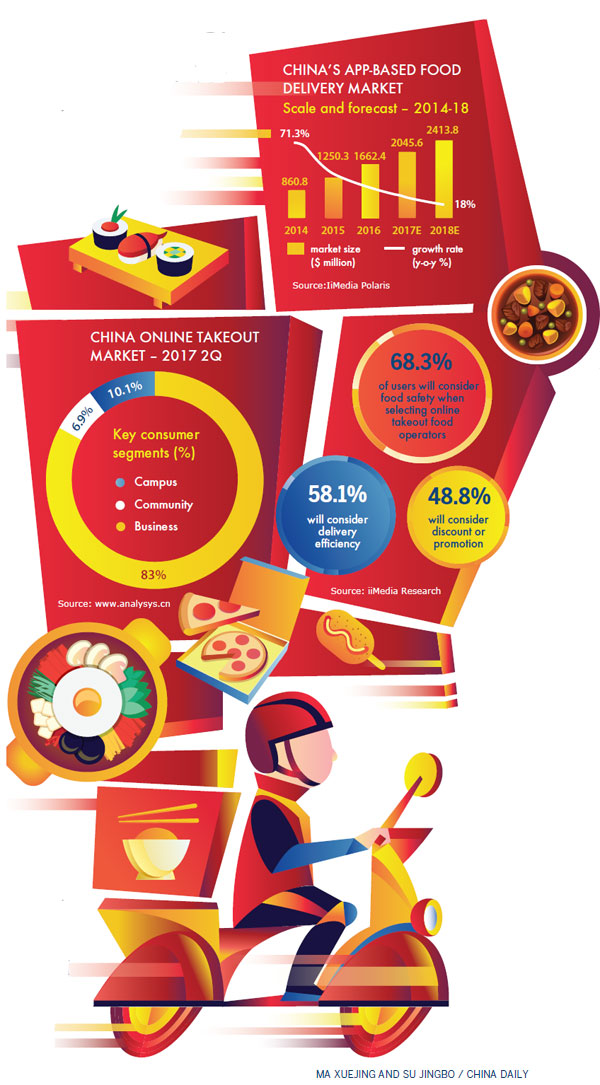
Consumers such as Xiong are dependent on app-based food delivery companies that now account for 10 percent of the catering industry's annual sales, up from 7.4 percent last year.
By the end of June, Ele.me, the market leader, had 34.02 million active users, followed by Meituan.com (29.89 million) and Baidu Waimai (17.48 million).
Food delivery companies' rapid growth can be discerned from the latest data as well as estimates.
According to the China Internet Network Information Center's China Internet Development Report, 295 million people used online food delivery services in the first half of this year.
By the time 2018 rings in, around 350 million consumers will likely have used such services, spending more than 200 billion yuan ($30 billion; 26 billion euros; £23 billion), higher than the 160 billion yuan spent last year, which itself was up by 33 percent from the 2015 level.
In absolute numbers, food and beverages will have been delivered more than 350 million times this year, up from 256 million times last year, according to the China Cuisine Association.
Jiang Junxian, director of the CCA, attributed the rapid growth of the food delivery market to the advent of technology: reliable telecommunications infrastructure, nifty smartphones, imaginative apps, mobile payment tools and enhanced logistics capacity of delivery companies.
Chinese consumers' growing impatience with time-consuming restaurant visits, and their reluctance to cook at home due to work pressures, are also key factors.
For instance, Xiong's saviors are "riders", or deliverymen, the backbone of food delivery services. "Takeout food services have set me free from housework, which means I can focus on work," she says. "You can even have a cup of coffee and ice cream delivered by the riders to your home."
A deliveryman for Dada-JD Daojia, a food delivery unit of online marketplace JD.com, says the business is all about speed. "You've got to make sure the food is warm (or does not melt) when it reaches the customer."
He receives 5 yuan per delivery in addition to a basic monthly salary. He races against time on his electric two-wheeler through the day, more so during the peak hours around midday.
The Dada app enables him to compete with his peers for orders. He works from 7 am to 9 pm and delivers meals, snacks or beverages 40 to 50 times in between.
An organized rider can take home 10,000 yuan a month, while the average is about 6,000 yuan, he says.
He also says the food delivery segment's two giants, Ele.com and Meituan.com, are hiring heavily this winter. Consumers are reluctant to step out to dine at restaurants or shop for groceries to cook at home.
As demand for food delivery services soars, riders receive winter incentives from their employers.
According to market information company Analysys' China Internet Catering Market Report 2017, the April-June quarter has seen the food delivery segment notch up sales of almost 46 billion yuan, up by 28 percent from the previous quarter and up by 82 percent year-on-year.
The July-September quarter, for which data is yet to be announced, is also considered part of the peak period for takeouts. This summer, growth has been the highest in three quarters on the back of a spurt in night orders.
The frenetic growth of the food delivery sector has not been without incidents and concerns.
For instance, a Meitian-Dianping deliveryman in Qingyuan, Guangdong province, was said to have not only tampered with a customer's food parcel on Oct 21 but made it disgusting and unacceptable, prompting the company to tender an unreserved apology.
It said it would follow it up with additional measures like introducing sealed food parcels in at least 30 cities by the end of the year.
In addition, the segment has come under fire from green organizations for excessive use of synthetic packaging materials, posing an environmental threat.
Speeding riders who pose problems to pedestrians and motorists alike are also a cause for concern.
The industry's leading lights are said to be brainstorming to come up with an apt response to each of these challenges.
Amid all of this, several interesting insights have been plucked from market data.
In the April-June quarter alone, white-collar workers and professionals spent 38 billion yuan on delivered food, or about 83 percent of delivery companies' sales (down from 84 percent in the first quarter).
In contrast, university students accounted for 10.1 percent of sales, while residents of housing estates contributed almost 7 percent.
Deliveries of afternoon snacks and dinners have seen strong growth, suggesting personalized services will likely find favor soon as the market matures, necessitating diverse foods.
According to iiMedia Research, some food delivery platforms are raising the fee they collect from restaurants for inclusion on their apps. High fees could push restaurants and caterers to either look for cheaper delivery alternatives or exit the takeout channel altogether, says iiMedia.
All these developments, it appears, have fascinated investors to no end. Sensing big business opportunities, corporations are vying for a slice of the food delivery pie.
Ele.me, which is backed by Alibaba Group Holding, acquired Baidu Waimai, the food delivery unit of internet search company Baidu Inc, for 4.2 billion yuan in August.
Meanwhile, Meituan-Dianping, China's leading group-buying and dining information platform, said on Oct 19 that it has raised $4 billion in its latest financing round, which valued it at $30 billion.
The round was led by Tencent Holdings and includes a new investor, the Priceline Group, and other big investors such as Sequoia Capital, the China-UAE investment Cooperation Fund and GIC of Singapore.
The fund infusion will allow Meituan-Dianping to increase investment in artificial intelligence and unmanned delivery, to promote its transformation into a modern services player.
Food delivery services are expected to compete for quality next, using technology in a way that addresses consumer needs and strengthens links with other businesses, says Chen Liteng, an analyst with the China E-commerce Research Center.
Things are already evolving in that direction. Some food delivery service operators have extended their takeout categories by linking with traditional retailers such as supermarkets, fresh food retailers and pharmacies.
wangzhuoqiong@chinadaily.com.cn