


Talent hunters give the best a fresh start
New first-tier cities present a world of opportunity as the battle for expertise intensifies
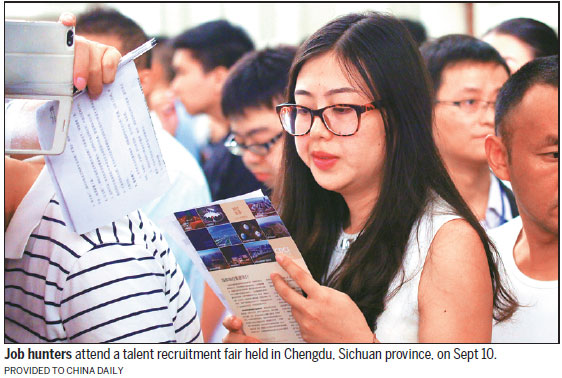
The search for talent and expertise is not unusual but its frequency seems to have accelerated this year, and a competition has begun.
In February, the Hubei provincial capital Wuhan announced a plan to attract 1 million university graduates in the next five years. The news seems have triggered a domino effect.
The Shaanxi provincial capital Xi'an and Hunan provincial capital Changsha drafted similar five-year plans in May and June. While Xi'an plans to invest 3.8 billion yuan ($578 million) to attract 1 million candidates with suitable expertise, Changsha will invest 10 billion yuan to do the same. At least another eight provincial capitals have so far announced preferential policies to attract talent and expertise. Smaller cities are doing the same.
Experts said an unprecedented battle for talent has started in the country and will continue to become fiercer as innovation and technology-driven industrial upgrading continues across the country.
Statistics have shown a trend of talent flowing to other cities from crowded and resource-strained first-tier cities of Beijing, Shanghai, Guangzhou and Shenzhen.
Experts believe competition for talent will speed up the flow and that first-tier cities will face the task of introducing additional talent with international perspectives as the country goes ahead with economic globalization.
Many cities have lowered or even lifted the threshold for talent with bachelor or higher degrees to get hukou, or household registration. Many also offer cheap apartments, subsidies for buying homes, or even cash rewards.
Currently in China, without hukou, people may be excluded from the benefits of social welfare locals enjoy. In some cities, for example, children without hukou are restricted from schools.
The Wuhan government is building apartments especially to accommodate 200,000 people with expertise introduced to the city over the following five years. Those graduates who have left college in the last three years can apply for the apartments if they don't own a home in the city.
Li Xing, 27, who graduated from Hubei University in 2015 with a bachelor's degree in Chinese, got one of the first 3,605 apartments in Wuhan in July. The primary school Chinese teacher said she only pays 1,400 yuan a month for her apartment, but the market rent is at least 2,700 yuan. And she also enjoys free tap water and electricity.
Changsha will give subsidies of 15,000 yuan and 10,000 yuan to those with doctorates and bachelor degrees respectively and 6,000 yuan for a master's degree for the first two years after they settle down and work in the city.
The fierce competition for talent is taking place against the backdrop of a changing economic structure.
The country is upgrading its economy to make it more knowledge-based and technology-driven. This has brought major cities huge opportunities, said Guo Sheng, chief executive officer of Zhaopin.com, a leading recruitment website in the country.
Ni Pengfei, director of City and Competitiveness Research Center at the Chinese Academy of Social Sciences, agrees. "Generally speaking, GDP growth in many cities has been more and more innovation-driven rather than capital-driven," he said. "The new development mode is highly related to talent and technology. This is why there has been such fierce competition for talent."
According to a "comprehensive business index" formulated by CBN Weekly, 15 cities are recognized as "new first-tier cities", including the Zhejiang provincial capital, Hangzhou, Jiangsu provincial capital, Nanjing, Sichuan provincial capital, Chengdu, and Qingdao in Shandong province, as well as Wuhan, Tianjin, Xi'an and Chongqing.
The competition for talent is just the primary stage of a broader industrial competition among major cities. These cities are now accumulating reserves for further industrial competition, which will be fiercer and fiercer, Ni told Oriental Outlook magazine.
Cities like Wuhan deserve applause for the preferential policies they introduced, but there will be far more intense competition for talent in the country, said Xie Shouguang, director of the Social Sciences Academic Press, who specializes in sociological surveys.
"It has been almost 40 years after reform and opening-up was introduced in China. In the past 40 years, 'investment promotion' was one of the most important slogans for the country. Now the slogan needs to be changed to 'talent introduction'," he said.
Graduates have expressed a strong desire to work in new first-tier cities.
A 2016 report by Zhaopin, which is based on interviews with 89,000 fresh graduates, has found 38.3 percent of interviewees hoping to work in new first-tier cities, almost 10 percent higher than those who would like to work in first-tier cities.
The company's 2017 report, which interviewed 93,000 graduates, found 37.5 percent of graduates were willing to work in new first-tier cities, while that for first-tier cities stood at about 30 percent.
Guo said, however, these major cities may fail to attract many of the talents they need if they only provide preferential policies for property and subsidies.
"High-end talent actually cares more about the general environment. While conditions for scientific research matters, the social environment, including educational opportunities for children, is also important," he said, adding the major attraction for middle-end talent is good enterprises with excellent entrepreneurs.
The most efficient measure for these major cities is to attract those who left for further education back to their home cities, he added.
He said, however, it's wise for graduates to choose to work in these major cities at this time.
Many of the major cities are accumulating the conditions for a sharp rise in new talent. It may be too late if people choose to work in these cities several years later when living costs, including property prices, have gone up, he said, citing Shenzhen as an example.
"Jobseekers will never regret their decision to work in new first-tier cities. Time will prove them wise after three or five years though many currently fail to see the emerging trends of these cities," he said.
As domestic talents flow to these major cities, the first-tier cities face a different task of attracting talent with an international perspective as China carries out the Belt and Road Initiative and moves ahead in economic globalization, said Wang Huiyao, president of the Center for China and Globalization, one of China's leading independent think tanks.
"Instead of choosing talent from the more than 1.3 billion population in China, the first-tier cities should broaden their perspectives and attract talent from the 7 billion global population," he said.
Jiang Chenglong contributed to this story.
Contact the writers at houliqiang@chinadaily.com.cn















