


Chinese mobile phones: It's their time
New manufacturers have open-minded young leaders who have developed products with high performance and reasonable prices
European consumers should be well aware by now of the rise of Chinese brands across many industry sectors. But they're almost certainly not familiar with the forthcoming wave of functionally advanced and professionally branded Chinese mobile phones.
Few product areas generate as much attention as mobile phones, but until recently this was one of the few areas where brand China had failed to penetrate.
Chinese technology brands, such as Huawei, ZTE and Lenovo, are now well known internationally, with an enviable reputation for both quality and service. But lesser-known brands such as the Chinese mobile phone Xiaomi - often referred to as China's Apple - are now expanding internationally, too.
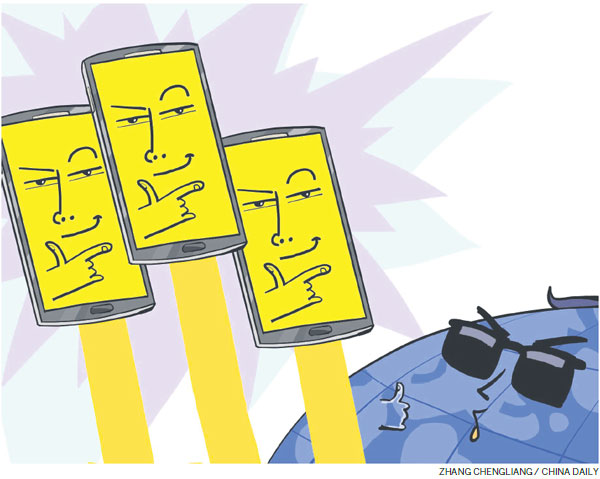
Huawei's range of mobile phone offerings continues to grow, as does its market share. Last year it became the world'd third-largest smartphone producer, behind Apple and Samsung. In so doing, Huawei has stifled iPhone's momentum in China and has also identified wealthy consumers, particularly in Europe, as key to its continued global expansion.
For a long time, the high-end mobile phone market has been dominated by Apple and Samsung, but Huawei is certainly leading a Chinese charge. The Shenzhen-based company is not just matching Samsung and Apple in the technology department but is also continuing with ambitious brand building, with huge sums invested in promotional campaigns and sponsorship deals.
Huawei's leading role has probably incentivized many of the smaller Chinese mobile phone brands that are now pursuing a similar global brand-building strategy.
Xiaomi is definitely following in Huawei's footsteps with significant strategic intent. But few European mobile phone users will have even heard of the following increasingly competitive Chinese mobile phone brands: Vernee, Oppo, Meizu, Letv, UMI, Leagoo, Doogee, Oukitel, Bluboo and Mazze.
All combine very competitive specifications with excellent value for the money.
But even more impressive is the Chinese phone brand OnePlus 5, produced by the Shenzhen-based company OnePlus. Retailing at only £449($609; 509 euros), this mobile phone combines excellent software with a solid design. Competing with the Galaxy S8 and LG G6, the phone matches its better known rivals in functionality and provides superb value for money too. It is regarded widely as incredibly fast and has vastly improved cameras. But at a retail price of only £391.91 the Xiaomi Mi6 may be an even better deal. Famed for being fast and easy to use, the Mi6 should be very high up on any European consumer's value for money list.
And if the Mi6 offer was not enough, the Honor 9, a flagship brand that is part of Huawei's brand portfolio, retails at even less (£380). Despite lacking a few flashy features such as waterproofing, the Honor 9 runs fast, and its overall performance matches the very best mobile phones currently on the market.
Equally impressive, but even less well known, the Meizu Pro 6 Plus phone offers brilliant value with very competitive specifications and performance. The Meizu Pro 6 Plus is on the market for £399 with a slightly higher price in part justified by a high-resolution screen and a more than decent camera.
But even less known is Shenzhen-based Umidigi, which produces the UMIDIGI Z Pro. This mobile phone provides powerful performance with a large battery and a decent screen and retails, unbelievably, at shade over £200.
Finally, Xiaomi's budget Redmi Note 4X phone comes in at a little over £150 but also offers very competitive specifications, speed and reliability.
So, an abundance of young, innovative Chinese mobile phone brands should be taken into serious consideration by European users. But it is important for European consumers not to associate these very competitive prices with low quality and poor reliability. This is now very much not the case.
The technology and overall quality levels found with these new Chinese mobile phone producers rival the most established brands in this dynamic, fast-moving industry. Samsung and Apple have enjoyed an almost unrivaled dominance for a long time, but this is now under serious threat.
What the nascent mobile phone brand producers are lacking is the skills, knowledge and experience needed in all aspects of brand building and management. And this is where European business partners could form effective alliances and provide much-needed support.
While Huawei has been very successful with a portfolio of internationally competitive mobile phone brands, the majority of the younger Chinese mobile phone producers remain reliant on competitively priced models only.
It is also the case that the majority of these producers make use of the corporate name prominently in their brand naming. More advanced, professional brand building almost always requires a move toward individual product branding, such as Samsung's Galaxy, or two-tier branding, such as Apple iPhone.
A quantum leap has taken place inside many Chinese companies in recent years, with the use of the latest technology implemented effectively to raise quality levels substantially, but a leap of similar proportions is now needed in brand management.
For example, emotionally associative names could be considered as alternatives to the more technically descriptive names currently in use. Apple's very strong and emotional brand image is underpinned by its very name and the direct association it provides. Galaxy is also a clear attempt at creating an emotional association that has nothing to do with any reference to functionality or technological advance. Chinese producers should follow suit.
But what might surprise Chinese companies, and not just those belonging to the mobile phone industry, is the opportunity for creative, emotional image building via association with Chinese history and elements of traditional Chinese culture. European consumers now trust Chinese companies on quality, obviating any need therefore to somehow hide behind a Western sounding name and Western brand appearance. In addition, European consumers value Chinese culture and history highly and would consider such associations appealing, since an emotional experience is now the focus of brand building in mobile phones and many other sectors.
Chinese corporate names should still feature heavily in any brand-building strategy, but a second, sub-brand name could refer directly to some element or elements of traditional Chinese culture.
European companies could play a major part in this much-needed influx of professional brand management. For example, co-branding partnerships could be established where the European partner provides market access and knowledge across Europe and over the long term gains an invaluable understanding of the Chinese business environment.
Encouragingly, the majority of the young, entrepreneurial Chinese mobile phone brand manufacturers have at their helm equally young, open-minded leaders. Effective tie-ups with suitable European partners is something with which these capable leaders are comfortable.
European consumers need to take these producers very seriously. And the European mobile phone industry should also take seriously the exciting prospect of effective, long-term business connections.
The author is a visiting professor at the University of International Business and Economics in Beijing and a senior lecturer at Southampton University. The views do not necessarily reflect those of China Daily.















