


Inside the tomb of the emperor
Sixty-one years have passed, but Sun Xianbao well remembers exactly what he saw after squeezing himself through the narrow opening between two giant stone panels that formed the gate to the burial chamber of Emperor Wanli (1563-1620).
"On the ground were rotted wooden boards and some whitish circles," the 80-year-old says.
"The circles, it turned out, were paper coins meant for the deceased. Time had turned the paper into grainy dust."
Once inside the tomb in 1957, Sun removed a rectangular stone slab that had leaned against the panels and had served as a lock for 337 years.
|
Clockwise from top left: Archaeologists recording what they saw inside the Dingling Mausoleum's underground tomb in 1957; archaeologists clearing the coffins at Dingling Mausoleum; inside Emperor Wanli's underground tomb. Photos Provided to China Daily |
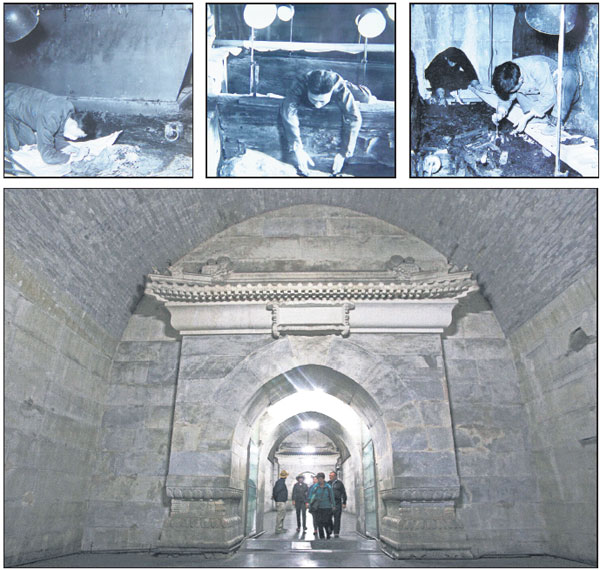
Now the gate leading to the final resting place of the longest-reigning emperor of China's Ming Dynasty (1368-1644) had finally been opened.
"The excavation of the Dingling Mausoleum came about by pure chance," says Yang Shi, wife of Zhao Qichang, a key member of the excavation team who died in 2010. Emperor Wanli had the mausoleum built for himself between 1584 and 1590. The Chinese character for ding in the name means to anchor - a fitting metaphor for the emperor - and ling simply means tomb.
In the late 1980s Yang, together with Yue Nan, a historian, wrote the book Wind and Snow at Dingling (Feng Xue Ding Ling), a vivid account of the excavation process.
In the 1950s, when leading historians and archaeologists decided to excavate an imperial tomb from the Ming Dynasty for research, Dingling was not even near the top of the list, Yang says.
"They initially focused on other tombs, either belonging to historically more important Ming emperors or promising to yield crucial information - imperial tomes, for example."
They did not lack choice. Of all the 16 emperors of the Ming Dynasty, 13 were buried in the region. The immense burial ground, with meandering mountains as a backdrop, is known today as the Ming Mausoleums.
Hardly had the excavation team got down to work than they realized they faced a giant conundrum, the answer to which the designers and builders of the mausoleums had tried very hard to hide. With no clues visible of the tombs they were aiming for, frustrated archaeologists eventually decided to focus on any mausoleum that might yield clues. That was when someone noticed a caved-in section of wall surrounding the circular area that constitutes the second half of the mausoleum's design.
The layout of the mausoleum is split in two - a rectangular part at the front and a circular part at the back, separated by a stone tower known as Ming Lou, or the Worldly Tower. The different shapes were meant to represent Earth and Heaven, believed by ancient Chinese to be square and circular, respectively.
The circular part, known as Bao Cheng, or the Treasure City, has at its heart an earth mound that rises more than 10 meters above the ground. Since the burial chamber was most likely to be deep in the ground and directly under the peak of this symbolic burial mound, the question had always been: How to approach it?
The broken wall might be the place to start. This was in May 1956.
"The bricks had gone and there was a big hole about half a meter in diameter," Yang says. "Since it was three meters above the ground, the team members set up a human ladder to reach the hole and take a peek inside. It was a peek that would change the contemporary history of the Dingling Mausoleum."
The rim of the hole appeared like the upper edge of an arched gate. Peeking inside, the man at the top of the human ladder also glimpsed brick marks - marks left on earth indicating the previous existence of bricks. What, according to some villagers, had been a hiding place for local bandits suggested to the archaeologists the entrance to a secret tunnel.
So they began digging. Two hours later, a stone stele was unearthed bearing the characters sui dao men, or tunnel gate. Ten days later, 4.2 meters underground, the team discovered brick walls on both sides of an 8-meter-wide path that ran along the circular wall of the Treasure City. In retrospect, we now know that the path, called "the brick tunnel", was the route the colossal coffins of the emperor and his two empresses traveled after their arrival at the mausoleum.
However, a promising beginning did not lead to a quick ending. After digging for months and finding nothing, the team pressed ahead and dug more along that same route, but still found nothing.
"It seemed that they had assiduously followed this clue that rolled out before them like thread from a skein, only to arrive at the end and find nothing but the end of the thread," says Yang. "It was in July and August, with rainwater constantly filling the trench. Yet just when most people were about to give up, the emperor, if you like, sent another beckoning."
The team unearthed a second stele. Inscribed on it was a line of words that translates as: "From here to the wall, the horizontal distance is 53.28 meters and the vertical distance is 11.66 meters."
Today the stele, lying in a glass cabinet in one of the two exhibition halls of the mausoleum, is presented by tour guides to visitors as "the key of Dingling". And the wall mentioned is the one that separates the burial chamber of the emperor and the tunnel that leads to it.
"Elated by the new find, the team started digging its third and last tunnel from where the second stele was found, at the back of the Worldly Towers. Not long into digging, they discovered another tunnel - not a brick one but a much sturdier stone one that ran toward the center of the burial mound.
"It's clear now that the stone tunnel constitutes the last section of the journey taken by Emperor Wanli and his empresses en route to their final resting place," Yang says. "The team could not find the stone tunnel initially because there is a turn between the brick tunnel and this stone one."
At the end of this 40-meter-long tunnel lies "the wall", called Jin Gang Qiang, or "The Impregnable Wall". Made of big stone blocks, the wall indeed seemed impregnable until the archaeologists realized that the central part of it could be easily dismantled by pulling out blocks one by one, like pulling drawers from a chest.
Sun remembers vividly when the first stone block was pulled out.
"There was a clear puff, accompanied by a plume of dark smoke. The air, trapped inside for more than three centuries and thick with the smell of mold, charged out.
Wearing a face mask and with a rope tied to his waist, Zhao, fresh from the Archaeology Department of Peking University, was the first to get in.
"His sleeves and both legs of his trousers were sealed tightly so no noxious air could enter," Sun says.
When Zhao arrived at the stone gate standing right behind the wall, it was closed. Under the light of an electric torch, he discerned a narrow opening between the two stone panels. Pressing himself against that opening, he could see a huge rectangular stone slab leaning against the panels from inside the chamber. It was a lock, a firm one - anyone who wished to enter the forbidden area needed to find a way to remove the stone - from the outside.
Zhao's answer to the challenge was some thick iron wire.
"He fashioned the wire into a half circle with a long handle and then gradually put that circle through the opening, noosed the stone slab on the top and pushed," says Yang, who has lived in a retirement home in suburban Beijing since her husband died at the age of 84 in 2010.
"The upper edge of the stone slab, the part that was in contact with the gate, was slightly lifted backward, so the gate could be pushed open just a little bit," she says.
A little bit indeed, but big enough for Sun - back then a skinny 18-year-old - to squeeze through.
That was in May 1957. A year had passed since the team members had dug out their first shovelful of dirt.
Three months after that, the archaeologists opened the wooden coffins of the emperor and his two empresses, coffins that had lain in the innermost room of this five-room burial chamber. Some parts of the coffins had rotted away, or even collapsed. And the corpses had long been reduced to bones. But the items found inside the coffins, including brocaded fabrics and accessories made of silver, gold and jade, stunned the archaeological world in China and beyond.
However, due to inadequate conservation techniques, many precious objects, fabrics in particular, were exposed to the air and suffered irreversible damage.
"The luster retained for centuries, thanks to the lack of oxygen inside the tomb, was lost forever," says Yang, who married Zhao in the winter of 1957, a few months after the excavation was completed.
"The loss was genuinely mourned by everyone who had taken part in the excavation."
In fact, in 1956, before digging started, opinion had been divided on whether it should go ahead. Those who opposed it warned of the significance of the task and the gravity of the matter if anything went wrong.
But eventually, Zhou Enlai, the Chinese premier, gave the nod. After the warning had turned, at least partly, into reality, Zhou, petitioned by a group of saddened archaeologists, ruled that there would be no further excavations of imperial tombs, either in his lifetime or until the Chinese archaeological world had become fully prepared. That decree still holds today.
Zhao, who later became renowned as a historian and archaeologist, an expert on the history of Beijing, died in the winter of 2010.
"He suffered respiratory problems for nearly three decades before death," Yang says.
"I always felt that the disease had something to do with his time spent in the burial chamber. At the time, senior members of the team often reminded him to put on a face mask, but many times he would overlook the precaution. He was so young and everything was so exciting."
Sun, who spent most of his time with the team carrying either a kerosene light or an electric generator, says the most memorable moment was when he entered the tomb, through the opening between two stone slabs.
"I was so scared. It was still and chilly, but eventually everyone let out that thrilled cry."















