


Xiongan calls for brand new approach
European and other Western companies must recruit locally and modify their investment strategy to succeed in long term
It has been just a matter of days since China's central government announced to the world that it will establish the Xiongan New Area about 100 km southwest of Beijing.
Now, there is nothing surprising in the announcement of another free trade zone. In fact, seven new FTZs were announced last year.
But one need look no further than the size and scope, not to mention the new area's geographical proximity to the capital, to appreciate the new area's significance.
The Xiongan New Area will initially cover approximately a mere 100 sq km, but this will double midway through the phased development and will rise further to a staggering 2,000 sq km in the long term, according to the official circular.
To put this into perspective, Xiongyan New Area will reach a size that is almost three times that of New York City.
European business had no doubt been expecting a multiplying of FTZs across many geographically diverse and relatively underdeveloped parts of the Chinese mainland. And any expectations about economic development in and around the Beijing area were almost certainly dominated by attention to Tongzhou district on the eastern side of Beijing.
European business should now be aware of the Chinese phrase sheng dong ji xi (making a feint to the East and attacking the West), in order to appreciate fully the extent to which even the Chinese public was caught by surprise with the Xiongan New Area announcement.
European businesses across the entire industry spectrum have long benefited bountifully from China's two current major special economic zones or new economic areas: the Shenzhen Special Economic Zone, established in the early 1980s soon after the start of the opening-up policy, and the Shanghai Pudong New Area, created in the 1990s.
But the same significance should be attached to the Xiongan New Area. In fact, this new economic area may soon eclipse both Shenzhen and Shanghai, and only those international businesses that invest early and capitalize on some sort of first mover advantage will reap full rewards.

Xiongan New Area will aim to address many of the challenges facing China and the Chinese economy. Reducing pressure on first-tier cities, and Beijing in particular, is high among the objectives of this exciting new initiative. But this also represents a significant investment in an environmentally friendly future for the Chinese economy, with protection of ecology at its heart. Bridging the gap between urban and rural China is also an important aim of the new area.
European industry, therefore, must pay very close attention to this very recent announcement and incorporate investment and expansion considerations here into their short- and long-term business planning process.
But why this particular location? It would appear that the site has been chosen very carefully and for many good economic and social reasons. Tianjin, the Chinese mainland's major port in the north and northeast region, is situated sufficiently close by to attract trade and investment and allow international businesses to build regional and even national distribution centers in Xiongan.
In fact, the recent announcement of the new area highlighted the centrality of the location and the attractiveness for international business as a central transportation and storage center. The announcement also stressed the significance of opening up the domestic economy further via this new development.
Innovation and new growth industries should also play a leading role in the industrial development of Xiongan, according to the circular.
European industry should interpret this very positively as a further, unequivocal signal that modernization is the driving force behind government economic policy and Xiongan should contribute significantly, long into the future.
Xiongan's emergence will also lead to a domino development effect that could spread across a far larger area of the Chinese mainland's relatively underdeveloped regions and cities.
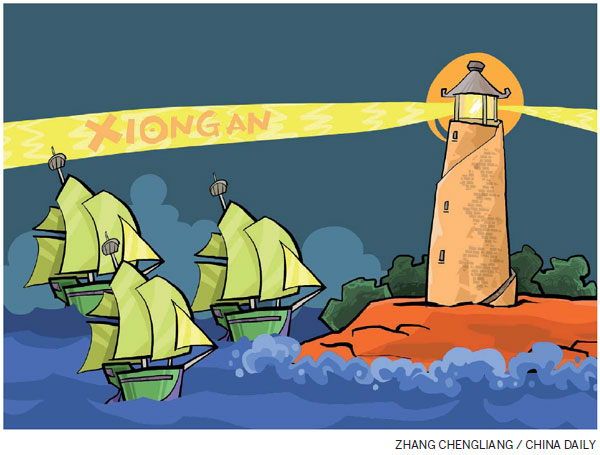
European and Western brands that rely almost extensively on China's first-tier cities and coastal cities - and most of them still do - should see Xiongan as the gateway to the vast Chinese mainland market and a bridge to expansion westward.
Xiongan's excellent ecological environment, home to Baiyangdian, one of the largest freshwater wetlands in North China, should set in place very high anti-pollution standards and serve to attract clean energy and other related growth industries of the future.
Clearly, China's economy is on a firm modernization and innovation path, and hitherto untrammeled territories could very soon open up to European and other Western companies. But should such businesses also adapt and modify their approach to investment and expansion across China? Absolutely.
First-tier cities, especially Beijing and Shanghai, have become very international, and European and other Western brands operate in much the same way as they do across most major Western cities. But any rapid economic development that Xiongan brings may not lead to a consumer culture similar to that which now exists in first-tier cities in China.
European and other Western brands, in order to succeed long term, may have to study local culture and customs in the Xiongan area and beyond very closely and adapt their brand positioning accordingly. Simply transplanting their first-tier business model and brand strategy to Xiongan and its surrounding regions and cities, where a very different market may be found, might result in rejection.
Xiongan should be seen as a potentially very different segment of the larger mainland market, and European and other Western brands have to respect and adapt or pay a heavy price.
Blindly rushing into this exciting new development should be avoided, and a very localized approach should be taken instead.
Such an approach necessitates the inclusion of local business partners and also the recruitment of local staff.
Western companies traditionally retain a centralized control structure across their organizations, in which the power remains very much at a Western headquarters situated far from the Chinese mainland market. It is also the case that Westerners often remain in key, strategic decision-making positions and local Chinese recruits are not provided with similar promotional opportunities.
But Xiongan will attract the best, brightest and freshest young Chinese talent that China increasingly has to offer, and it is only this pool of talent that will provide the necessary understanding of this very different consumer culture that lies in wait for almost certainly unsuspecting European and other Western businesses.
Paradoxically, therefore, while Xiongan signals exciting expansion opportunities across China, at the same time it behoves businesses, European and other Western ones in particular, to review all aspects of their business model and adapt to a very different business and consumer environment.
Xiongan New Area, projected to eventually reach three times the size of New York City and offering a strategic, central location, provides enormous opportunities for European and other Western businesses, but only those that really study the local culture and environment and, crucially, allow local Chinese people to lead them in the long term will succeed.
The author is a visiting professor at the University of International Business and Economics in Beijing and a senior lecturer at Southampton University. The views do not necessarily reflect those of China Daily.















