BeiDou turns eye toward Belt, Road
Chinese location technology seeks to hit big time with economic initiative
Arecurring theme in the annual Government Work Report, the latest edition of which Premier Li Keqiang presented to the National People's Congress on March 5, has been the promotion of high-end manufacturing and the Belt and Road Initiative, as well as helping Chinese companies to globalize their equipment and technologies. The BeiDou Navigation Satellite System is one example of that spirit.
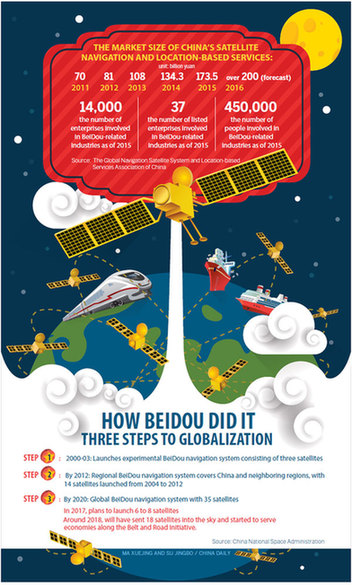
The GPS-like navigation system, a product of the Chinese National Space Administration, and managed by the China Satellite Navigation Office, is accelerating its expansion into economies along the Belt and Road Initiative. China plans to launch six to eight BeiDou satellites this year and the system has made significant progress in terms of accuracy.
The strategy is part of China's broad plan to build a BeiDou navigation system with a constellation of 35 satellites by 2020. By comparison, GPS has 24 satellites.
"The globalization era for BeiDou is coming," says Miao Qianjun, secretary-general of the Global Navigation Satellite System and Location-based Services Association of China. The GLAC was founded in 1995 to promote the commercial application of BeiDou technologies.
"China is supporting BeiDou's exports in roughly the same way it supports exports of high-speed railway products and technologies. BeiDou will become another high-tech name card for China," Miao says.
In February, the GLAC invited its enterprise members involved in BeiDou-related industries for discussions. With help from the National Development and Reform Commission, China's top economic planner, it set up an alliance for enterprises seeking to take BeiDou products and solutions to markets along the Belt and Road Initiative.
"We received affirmative responses from 27 enterprises within a week. They are all eager to be part of our efforts," Miao says, adding that alliance members will receive financial support from the government.
Policy support for navigation technologies was first articulated in guidance released by the NDRC in November 2016. It called for more help for enterprises to enable them to apply BeiDou technologies in Thailand, Laos, Indonesia and other countries in Southeast Asia.
"The close economic ties between China and ASEAN will pave the way for BeiDou's entry. More important, in Southeast Asian countries located in low latitudes, BeiDou is more accurate than GPS," says Ming Dexiang, director of the Beidou Open Laboratory, an agency that promotes commercial applications of BeiDou.
Steady improvements have helped improve the accuracy of its navigation and location-detection systems. China announced earlier this year that BeiDou's satellites can locate ground-based users to an accuracy level of 1 or 2 meters with the help of a new chip. Before this, BeiDou's accuracy was a radius of 10 meters from the actual spot.
Li Xueli, an engineer working with BeiDou, says: "For users, there are two big improvements. One is the time the system takes to process your journey. This is down from 30 seconds to just three seconds. The second improvement is position accuracy. The system can now tell if the car is on the main road or a side road."
With precision of 1 or 2 meters, BeiDou is just behind the European Union's Galileo Satellite System, which gives consumers an accuracy level of just 1 meter. GPS accuracy is 5 meters, while Russia's GLONASS satellite delivers accuracy of 4.5 meters to 7.4 meters.
Given the potential for taking the lead globally, China is accelerating steps like launching new navigation satellites to expand the coverage area of BeiDou.
Yang Yuanxi, an academician at the Chinese Academy of Sciences and a member of the CPPCC National Committee, which advises legislators, says: "China will launch six to eight satellites this year. After constructing a network of 18 satellites by around 2018, we will serve economies along the Belt and Road Initiative."
The project has come a long way since the first BeiDou satellite launch 16 years ago. At that time, it was designed to serve the military. It was not available for commercial applications until 2012.
But within just four years of development, the commercial model has been widely applied in smartphones and automobiles in China to help consumers navigate busy traffic.
As of August 2016, about 759 smartphone models supported BeiDou's navigation services, accounting for 21 percent of all phones and reflecting the enormous potential of the market.
In 2015, BeiDou was used to track vehicles in Singapore. GLAC's Miao was instrumental in clinching this deal for BeiDou. A joint venture was set up to run the project. Singapore's Economic Development Board, a government agency for planning and executing strategies, poured 50 million yuan ($7.23 million; 6.76 million euros; 5.9 million) into it.
Sun Jiadong, an academician at the Chinese Academy of Sciences and former chief designer of the BeiDou system, says: "Domestic trials are checking for possible applications in foreign countries. The globalization boom for BeiDou will come around 2021, but we need to start as soon as possible."
masi@chinadaily.com.cn