


Endangered species make up new focus
Former paraglider stays connected to natural world through wildlife photography
Gu Ying was once a paraglider, winning gold medals in national competitions. But now she is a wildlife photographer, taking photos of endangered species.
In the past three years, Gu has trekked to the Earth's "three poles" - the North Pole, South Pole and the Qinghai-Tibetan Plateau - to catch a glimpse of wildlife living in the most extreme environments of the planet.
Her shots of polar bears, emperor penguins and Tibetan antelopes, and her efforts to promote public awareness of endangered animals, won her the title of 2016 Chinese Culture Person of the Year, awarded on Jan 11 by the Chinese Culture Promotion Society.
|
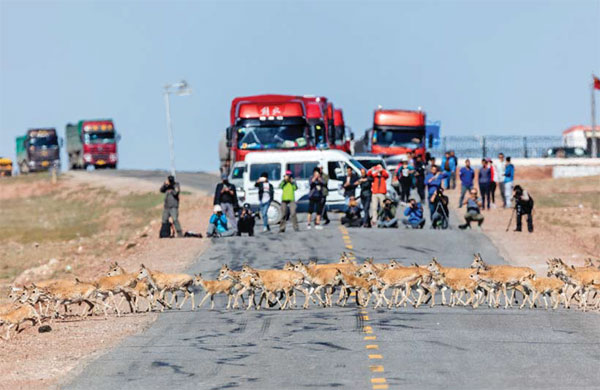
Tibetan antelopes cross the Qinghai-Tibet Highway in a picture Gu Ying took in 2016 in Qinghai's Hol Xil. Provided to China Daily |
Gu was born into a military family in Beijing. Her parents worked in the air force and, when she was still a little girl her family was relocated to a radar base in the mountains near Xuzhou, Jiangsu province.
"Sometimes I missed the school bus and had to walk alone on the mountainous paths between home and school," recalls Gu. "I got my guts and love for nature during that period of time."
After graduating from university, Gu worked in Shenzhen, Guangdong province, and started a successful business in the late 1990s, but she never forgot about the mountains and went outdoors whenever she could.
Once, when Gu was hiking on a mountain, a paraglider flew by and waved at her.
"I was thrilled because I once wanted to be a fighter pilot," says Gu. "The paraglider evoked my childhood dream."
Gu then registered for a paragliding course and, after three weeks' training, made her first flight.
"It felt like I was a bird and belonged to the sky."
Since then, Gu has taken many classes and later became a paragliding athlete. She won gold medals four times in national competitions and set a national women's record for 100-kilometer paragliding.
In 2009, Gu fell from the sky in an accident and broke her back. Luckily, her spine was not irreparably injured. After three months in bed, Gu was able to stand up again, but she had to say goodbye to her paragliding career.
"We paragliders call ourselves birdmen," says Gu. "When I couldn't fly like a bird, I found another hobby - taking photographs of birds."
Since 2011, Gu has taken photos of around 1,000 species of birds in dozens of countries. Some of her photos of rare birds have been included in The Handbook of the Birds of the World.
Starting with bird photography, Gu gradually became a wildlife photographer.
In 2014, she embarked on a journey to capture the moment polar bears bring their newborn cubs out of their caves after hibernation. It took her more than 10 days at a base within the Arctic Circle in Canada to get a good shot.
The next year, Gu flew to inland Antarctica to take shots of the emperor penguin. This time, she was stuck in a camp near the habitat of the penguins for 18 days because of strong storms caused by the El Nino effect.
"Everyone was frustrated, but I was very happy because I could spend more time taking photos of emperor penguins," says Gu. "And only in storms could one capture their real living environment."
"Every day, I spent more than 10 hours out there photographing the penguins," adds Gu.
Last year, she went to Hoh Xil in Qinghai province three times. She wanted to photograph Tibetan antelopes in the least populated area of China, 5,000 meters above sea level.
In order to capture the Tibetan antelope's breeding process, Gu remained hidden from 5am to 9pm every day.
"I could not go outside, nor eat any food that had a smell. It was really tough, but I think it was worth it," says Gu, whose photos have been used by the Hoh Xil local government in applying for UNESCO's World Heritage List.
"After all these years photographing wildlife, recording their lives has begun to feel like a responsibility for me," says Gu.
"But I don't want my photos to be the last 'living monuments' of those species that can be seen only in a frame."
xingyi@chinadaily.com.cn















