Yuan in demand
European financial centers seek renminbi business, as Chinese currency gains momentum
With the Brexit vote in Britain raising uncertainties about London's leadership in Chinese currency trading, other European financial centers are trying to get a piece of the action.
Already the world's third-largest trade finance currency after the US dollar and Euro, the yuan's reserve currency status was boosted by its inclusion in the International Monetary Fund's basket of special drawing rights currencies in October.
The inclusion allows the yuan to sit alongside the dollar, euro, pound and yen in a basket that asset managers globally follow for asset allocation. The yuan makes up 10.9 percent of the basket.
To facilitate Western investors' increasing yuan asset allocation, the Chinese government also significantly opened up its domestic bond market to foreign access this year and encouraged the issuance of offshore bonds denominated in yuan, also known as dim sum bonds.
The Chinese Ministry of Finance issued its first sovereign offshore bond in yuan in London in May, in an effort to boost market confidence by providing liquid and safe bonds against which all other offshore yuan assets can be priced.
Miranda Carr, senior analyst at Haitong Securities in London, says the sovereign bond and subsequent offshore renminbi bonds made it easier for international investors to access investment opportunities in Chinese currency.
"Due to the growing prominence of the renminbi globally and its inclusion into the SDR, investors globally are trying to increase their portfolios' weight of renminbi assets," Carr says.
Jan Dehn, head of research at London-based Ashmore Investment Management, says the increasing issuance of offshore bonds reflects China's decision to open its capital account.
"This decision has enormous significance," Dehn says. "Clearly, an open capital account exposes the country to more foreign exchange volatility, so it is highly advantageous that the renminbi becomes a global reserve currency, since global reserve currencies tend to be more stable than other currencies."
Dehn added that the issuance of dim sum bonds reflects market demand for yuan, particularly for hedging purposes by corporations.
"Most issuers of overseas RMB tend to be highly solvent institutions that could easily finance in their own currencies or the established global reserve currencies. Hence, they tend to issue in order to meet a specific demand," Dehn says.
More issuance of RMB bonds abroad also helps to "populate the offshore renminbi yield curve", meaning future issuers can more easily find the prices of RMB bonds, Dehn says.
In yet another milestone, in April the government of Hungary became the first Eastern European sovereign to issue a dim sum bond. In the first seven months of 2016, 68.3 billion yuan ($9.9 billion; 9.3 billion euros; 7.85 billion) of dim sum bonds were issued.
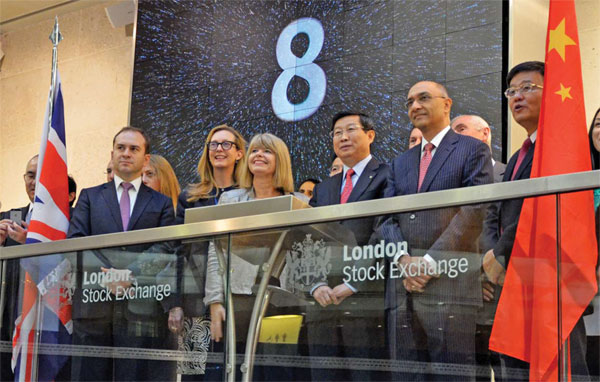
Meanwhile the London Stock Exchange is on track to produce a feasibility study on a link between London and Shanghai stock markets, which over the long term could help Western investors buy A-shares listed in China.
Brexit uncertainties
Currently, London is the dominant European center for offshore RMB activity. The city overtook Singapore to become the largest yuan clearing center outside China in April, and London's yuan activity has continued to grow despite Brexit uncertainties.
The People's Bank of China shows London's yuan-denominated business transactions in August were 60 percent above those in July. Between June 2014, when an official RMB clearing bank was designated, and August 2016, a landmark 10 billion yuan were cleared in London transactions.
Brexit - the June referendum in which British citizens voted to leave the European Union - has injected an element of uncertainty. Even so, European financial centers outside of London are competing for RMB activity. Germany's Deutsche Borse made an announcement in October in London that it would establish a D-share market in the second quarter of next year for Chinese companies to raise euro-denominated funds for local acquisitions.
Meanwhile Luxembourg Stock Exchange's CEO Robert Scharfe visited China in October to strengthen collaboration with Chinese financial institutions, including Bank of Communications and China Merchants Bank. The Luxembourg exchange currently has the largest listing of offshore RMB bonds in Europe.
"We have witnessed increasing efforts from other European centers to attract offshore renminbi business," says Andrew Carmichael, a partner at the law firm Linklaters.
He says each European center has its respective strengths. For example, Luxembourg has strength in funds, and Frankfurt is backed by the largest European economy and enjoys proximity to the European Central Bank, Carmichael says.
Currency convergence
China's journey to internationalize the RMB started after the 2008 financial crisis, when significant quantitative easing by the US government caused China's US dollar-denominated foreign reserves to lose value.
Traditionally, because the Chinese government encouraged export-led economic growth, it fixed the renminbi to the US dollar for its exchange rate, which resulted in the accumulation of a large quantity of US dollar foreign reserves.
After setting its RMB internationalization agenda, China allowed the renminbi's exchange rate to gradually move toward a managed float coherent with the market equilibrium exchange rate, and encouraged the renminbi's increasing use internationally for trade and investment financing.
According to November figures from the Society for Worldwide Interbank Financial Telecommunication, the RMB is the third-most-active currency in trade finance, after the US dollar and euro, with a share of 4.61 percent.
SWIFT data also show that 57 countries now use the yuan for more than 10 percent of direct payments to China.
Offshore yuan use grew significantly in recent years, but one key development for 2016 is an offshore-onshore convergence facilitated by a growing number of onshore RMB bonds issued.
Known as panda bonds, these onshore bonds in China are increasingly sought by global investors as China's domestic bond market liberalizes. Convergence between the onshore and offshore markets is significant in helping the renminbi to move more swiftly across borders, and facilitate liquidity growth in its international use.
Sales of panda bonds in the first seven months this year totaled 55.6 billion yuan.
Significantly, Poland became the first European country to issue government debt in China's bond market in August. In September, the World Bank issued the first renminbi-settled special drawing rights bonds in China.
Panda bonds like the Polish sovereign bond and the World Bank bond will be traded in China's $7 trillion interbank bond market.
Despite being the world's third-largest bond market, the foreign investor share there is only 2 percent so far. One key reason is the previous lack of access, but in recent months a significant opening-up has been achieved, and the creation of more international products in this market, like the World Bank bonds, is expected to increase foreign investors' interest.
Ivan Chung, associate managing director at Moody's, says the simplification in the panda bond issuance procedures is a big driver for more panda bonds and onshore-offshore renminbi market convergence.
"The onshore market has undergone considerable reforms in the area of market liberalization over the past 18 months, integrating it more with international investors and issuers. We are seeing considerable progress in onshore and offshore market convergence this year," Chung says.
Carr says more international organizations will be issuing and buying RMB denominated bonds in the future, encouraged by the World Bank initiative.
But she also warned that in the shorter term there are still challenges for foreign investment in China's bond market, especially unfamiliarity with this new asset class that has only recently opened to international investors.
Aside from high-profile financial reforms and RMB financing deals, Chinese shoppers' increasing spending in Europe is becoming a significant driver of RMB internationalization, thanks to payment systems like UnionPay and Alipay, which allow Chinese tourists to pay for goods and services in yuan.
In 2015, Chinese outbound tourists spent $229 billion overseas, according to research firm GfK.
UnionPay already has a network involving 2 million retailers across 39 countries in Europe, where Chinese shoppers can use their Chinese bankcards to pay for shopping, and the card service is rapidly expanding its network.
Cui Zhijian, an associate professor of operations management at IE Business School in Spain, says the initiative will facilitate the internationalization of the yuan and will enhance the position of the Chinese financial industry in the world market.
Contact the writer at cecily.liu@mail.chinadailyuk.com
|
Representatives at a ceremony when 1 billion offshore bonds denominated in yuan, or dim sum bonds, issued by the China Construction Bank, were listed on London Stock Exchange's markets in October 2015. Zhou Zhaojun / China News Service |