


Anhui cuisine: Pungent fish and furry bean curd
Editor's note: To understand China, sit down to eat. Food is the indestructible bond that holds the whole social fabric together and it is also one of the last strong visages of community and culture.
Sour, sweet, bitter, salty and spicy are the five main flavors that Chinese chefs play around with to create a spectrum of regional cuisines that would take several lifetimes to sample thoroughly.
Sometimes, chefs go to exceptional lengths to be different, and sometimes the best dishes are accidents of serendipity.
|
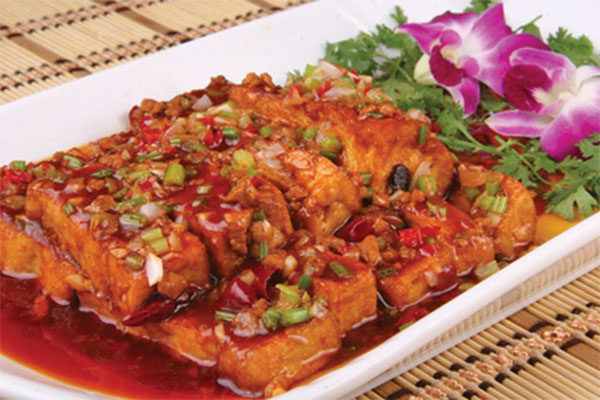
Furry tofu is made of fresh tofu that has been left to grow a pelt of white mold before being deep-fried to a crisp golden brown. Chai Shijue / For China Daily |
This is especially true of the food of Anhui province, an ancient region that began to prosper during the Tang (618-907) and Song (960-1279) dynasties.
It is a beautiful region of panoramic peaks and picturesque rivers. The Xin'anjiang River, with its age-old stone dam irrigation system, and the Yangtze River both flow through it. Anhui's most famous mountain is Huangshan, now a UNESCO World Heritage site.
The historic village of Hongcun is another World Heritage site and showcases Anhui's classical black-and -white architectural style with its distinctive scholars' studies.
Anhui's third World Heritage site is the part of the Grand Canal that flows through the province. In the times when the Grand Canal directly connected Beijing in the north and Hangzhou to the south, Anhui traders fanned out across China.
These merchants are historically respected for their astute abilities. They established bases far from home and their business acumen was, and still is, widely acknowledged.
Anhui businessmen played a pivotal role in broadcasting their home cuisine. Whenever they entertained their clients, their first preference was always to serve the best dishes from home. That's one of the reasons Anhui food is now among China's eight great cuisines
So what did they eat?
They liked soft-shelled turtles braised with Chinese ham, red-cooked civet cat, steamed pungent mandarin fish, braised Huangshan pigeon, steamed mountain stone frog, and a furry-white fermented bean curd.
On a visit to Hongcun many years ago, I wandered down cobbled alleys to the village pond and saw an old woman selling a basin full of baby turtles.
"Pets?" I asked our guide. He grinned and said: "Lunch." This was the famous horseshoe turtle, a little creature they steamed in soup.
Fortunately, for those who aren't natives, Anhui cuisine offers plenty of other options. Many dishes have interesting flavor profiles and even more interesting stories.
There is chouguiyu, or pungent mandarin fish, a dish that has become a signature of Anhui cuisine. It also has a touching tale of filial piety, considered a prime Chinese virtue.
Apparently, a certain merchant had made his fortune in Hangzhou, where he had first tasted a fish that was sweet, fresh and had very few tiny bones. He immediately thought of his elderly parents.
He bought a few fish to bring to them. However, the long journey took its toll on the fish and when he finally reached home, they were all smelling somewhat off.
His mother, naturally frugal and appreciative of her son's filial gesture, decided to cook the fish nevertheless. To everyone's surprise, the fish smelled bad but tasted very good.
These days, Anhui chefs deliberately allow the fish to develop a certain ripeness before cooking it.
Another famous Anhui specialty is maodoufu, or furry tofu. It is fresh tofu that has been left to grow a pelt of white mold before being deep-fried to a crisp golden-brown.
According to culinary legend, there was a famous tofu maker in Anhui. He had fallen ill and couldn't go to market to sell his bean curd. When he eventually got out of bed, he found to his horror that all his tofu was covered with white mold.
He couldn't possibly sell it, but he couldn't bear to waste it, either.
He decided to deep-fry it because high heat would kill the mold. The result was so delicious that all his customers started clamoring for more.
Anhui cuisine is characterized by its heavy use of oil, deeply flavored sauces, and superior soups and stock. The main cooking style is to braise or roast, with an expert manipulation of heat and fire.
Its chefs specialize in ingredients available locally, so from its mountains come wild game such as civet cats, stone frogs, pigeons and birds. Young bamboo shoots, regularly harvested, also are a major ingredient in Anhui cuisine.
Turtles, eels, fish, snails and whelks all come from its rivers and streams.
Anhui folk also like to salt their own meats like ham and pork, which go into the pot with chickens and ducks to produce very deeply flavored soups. A popular dish is salted meat on a bed of bamboo shoots steamed on a wooden cutting board, or daobanxiang.
Unlike some other regional cuisines, this is one cooking style that is very heavy on animal protein and relatively light on the greens.
Although its representative dishes seem somewhat exotic, they only tell half the story.
paulined@chinadaily.com.cn
Cooking at home
Stinky fish and moldy bean curd may be favorites with the older gourmets, but younger Anhui folks seem to prefer lighter fare.
That many of them have left to work in cities such as Beijing and Shanghai also contributes to changing tastes, but most still remember the flavors of home.
"My dad still likes the pungent mandarin fish, but I find it a little hard to stomach," says Li Xinzhu, 33, a full-time mother in Shanghai who used to work as a food writer.
She says home-cooked food for them is more poultry than game, and cited clay pot chicken, pressed duck and braised fish, as well as deep-fried tofu.
"Our home in Anhui was nearer Nanjing, so the dishes we made were lighter. My favorite is a steamed, glutinous-rice-coated meatball."
Wang Kaihao, 28, a journalist in Beijing, is an Anhui lad whose home is in Wuhu, a city in southeastern Anhui right by the Yangtze River.
"We didn't eat mandarin fish, but we had delicious knife fish, which was seasonal and plentiful in spring. My father would buy it fresh from fishermen after his morning walk. Sometimes it only took an hour from their boat to our dinner table.
"Sadly, knife fish is now rare and very expensive." Then he showed us a photo of an Anhui home-cooked dish he had just made: pig trotters braised with whole soybeans.
Pei Pei, 32, is a young working mother in Beijing who comes from Bengbu in Anhui.
"Our hometown cooking values all-natural ingredients. We prefer fish caught in the river over farmed fish. Our braised wild yellow eel is delicious and very good for you."
Hu Yongqi, 29, travels widely for work but agrees that fresh Anhui produce is what he likes best.
"You have to come taste the cooking of my hometown in Anhui's Anqing city. We make the simplest food delicious - like stir-fried snake beans with pork." Hu, too, cooks for himself whenever he wants a taste of home.
So while Anhui cuisine may sound exotic, it is down-home practicality that still prevails in many of its home kitchens.















