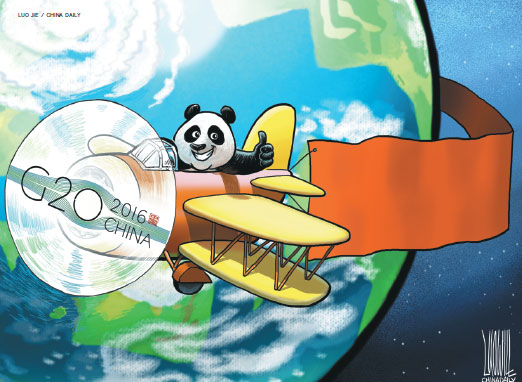
G20 chair and globalization's future
China's role in the G20 has greatly evolved since the global financial crisis broke out in 2008. After watching other economies take the G20 chair for five years, China made its bid in 2014 and was chosen to host the G20 Leaders Summit in 2016. But has the G20 chair come to China too late for the globalization agenda?
Back in autumn 2008, when the global financial system was in freefall, China stepped in to play an important role, together, with the other leading economies at the then new G20 Leaders Summit in Washington in November 2008, and at the next summit in London in April 2009. But despite China's efforts to stabilize the world economy, the traditional powers did not offer to share the global responsibilities with it.
China coordinated with other leading economies to send the right signals to the global financial markets. But as soon as a sense of order was restored in 2009, the world's leading powers reverted to their previous positions.
The G7 countries attempted to restore their global influence at the apex of the global system, although China abjured from taking the G20 leadership at that time.
Instead China directed its diplomacy to creating a new grouping, BRIC (Brazil, Russia, Indian and China) which became BRICS when South Africa joined it in 2011.
China also turned its diplomatic attention to shoring up some regional cooperation mechanisms within Asia, as part of the ASEAN+3 (China, Japan and the Republic of Korea) grouping. It was not until the G20 Summit in Seoul in November 2010 that the dominant pattern of G7/8 nations hosting the G20 process was put on hold.
Throughout this period, China watched as other countries rushed to host the G20 Summit. Until recently, Chinese officials saw the G20 as little more than an ad hoc, informal, though useful, platform for global economic crisis management. The G20, in the meantime, struggled to show its added-value after the initial summits.
China as the G20 Summit host this year seeks to create new sources of growth for the global economy, ward off growing protectionism in key economies, and upgrade the G20 itself as a platform for global governance.
We hope the G20 Summit in Hangzhou, East China's Zhejiang province, is a success, but if the main aspiration of the summit is to save globalization, it may be too late.
The rise of populism and protectionism in the advanced economies, and the broad upsurge of inward-looking, socio-economic anger that fed the Brexit vote are the latest signs that there is no longer broad public support for the previous globalization agenda, especially if it also entails financial volatility and instability.
So where does this leave China as the G20 chair and the host of this year's summit? To whom can China turn to as it tries to ward off protectionism with, let alone promote, the global economic openness and integration agenda?
Except for India, China's BRICS partners are in the recovery or re-stabilization mode. Growth in Asia remains steady, but the Asian members of the G20 alone are not enough to form a coalition, especially because Japan remains opposed to China-led efforts and has serious doubts about the G20.
China's growth has slowed, though it remains steady. Where is there appetite for pushing for global openness and integration other than at the Organisation for Economic Co-operation and Development?
The challenge for China is that it has assumed the G20 chair at a time when the previous globalization agenda has run its course. On a global scale, the perception and reality for many are that the upside benefits no longer exceed the downside.
A new global economic agenda is needed. So China would do well if it speaks to and supports new global aspirations and different models of growth.
Gregory Chin is an associate professor of Political Economy at York University, Canada, and Hugo Dobson is a professor of Japan's International Relations at the University of Sheffield, UK.