


Brexit may boost RMB internationalization
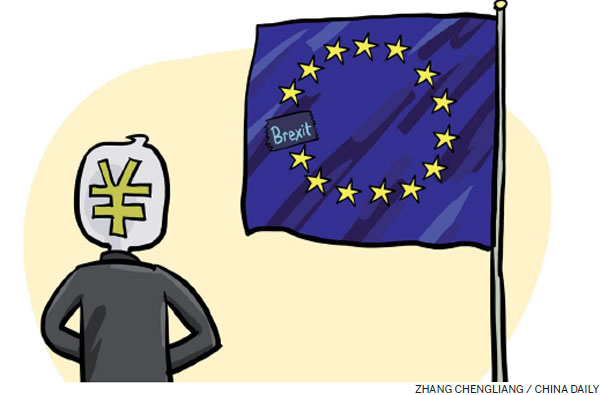
Vote to leave will allow Britain more flexibility to cooperate with China on the economy and help offset any disadvantages
Individuals, advocacy groups and political parties have pursued Britain's exit from the European Union as a political goal since the country joined the precursor of the bloc in 1973. In the June 23 referendum, 51.9 percent of votes were in support of Brexit.
Leaving the EU will have a great political and economic impact on Britain, the EU and the rest of the world, and could possibly affect the ongoing internationalization of the renminbi, China's currency.
After the referendum, the pound fell about 10 percent against the US dollar, and the yen saw a sharp appreciation against the pound.
The renminbi was adjusted accordingly. It fell about 0.56 percent against dollar on June 23, but the exchange rate relative to a basket of currencies remained stable, with the China Foreign Exchanges Trading System's RMB index falling only 0.1 percent.
From a financial perspective, although Brexit will have an effect in the short and long terms, the vote to leave could be seen as a wise decision for Britain.
The campaigns leading up to the referendum highlighted many conflicts in Britain: elite versus the general public; old versus young; urban versus rural; locals versus immigrants; politics versus economy; and sense versus sensibility.
Many analysts say leaving the EU could harm the British economy, yet the victory for Leave is a backlash against the bloc entering an era of negative interest rates.
Continental Europe is a manufacturing and agriculture-led economy, while Britain's is led by the services sector, the biggest part of which is the finance industry.
Remaining in the EU, Britain can hardly keep a positive financial rate. If London's rate became negative, then the financial center's interest rate curve would be restructured, which could do massive harm to the industry. At a time when the United States Federal Reserve is raising interest rates to transfer to a "normal rate" pattern, Britain's status as a global financial center could be jeopardized both from outside and inside.
Now, the world's economies are divided into two groups according to their interest rate polices: the negative interest rate group of Japan and the EU, and the positive group of China and the US. The pound's nominal interest rate is around 0.50 percent, so Britain has to make a decision. Its exit from the EU could be regarded as a decisive choice once and for all - leaving the negative interest rate group and joining the positive interest rate group.
As the finance sector provides Britain's core competitiveness, it is wise to leave the EU to ensure that it will not be trapped in a negative interest rate. Otherwise, London, as an international financial center, could be marginalized, like Japan in the 1980s, when Tokyo, as an Asia-Pacific financial center, carried out a policy of negative interest rates and caused yen transactions to be replaced by the dollar and other currencies.
So what impact will Brexit have on the RMB in the short and long run then?
In the short run, it will not have a large effect. First, Britain does not belong to the eurozone, and the jurisprudence is different, too, which will lessen the impact.
Second, cooperation between the EU and UK economies will go on under the current framework, with negotiations on a new institutional framework likely to last up to 10 years.
Third, the possible impact of Brexit on financial markets has partly been hedged. Banks have drawn up contingency plans. After Brexit, the central banks of China and Japan have both said they have fully communicated with related parties and are well prepared for the possible consequences.
Finally, Brexit has reduced the possibility of the US Fed raising interest rates, which will help improve global financial liquidity and lessen the impact of Brexit.
In the long run, Brexit will be helpful for the internationalization of the RMB.
First, Britain will have more ability and freedom to cooperate with China on the economy and RMB internationalization. London is already an offshore RMB center. After Brexit, the British capital will get rid of the pessimistic prospect of being dragged by the EU into a negative interest rate situation and can have more freedom to decide its economic policy.
Brexit could harm the traditional relationship between Britain and the US. We can reasonably predict the US will directly cooperate with France and Germany, with Paris and Frankfurt becoming more important, and London becoming less important. With the reduction of financial business from the EU, London will wish to embrace the rise of the RMB to reduce uncertainty and increase revenue.
Second, Brexit has impaired both Britain and the EU, which in return will benefit China. Both will try to lessen the blow by enhancing relations with China by lowering investment thresholds. With the weakness of the euro and the pound, more central banks will increase the percentage RMB in their portfolios.
Actually, Brexit may be a landmark event that shows the fall of Europe, including the UK. Since Britain is important to a united Europe, if the country and the EU cannot act as a collective power, their currencies will also be weakened, as we know that the internationalization of a currency is essentially a reflection of economic strength.
In today's international finance sector, competition has shifted from commodities to capital. Brexit will bring great uncertainty to Britain and the EU. Many investors will feel reluctant to invest before the uncertainty has been eliminated. But the uncertainty could last for many years. When Britain exits the EU, it will have to renegotiate the institutional framework, which could last years, too.
Finally, for the EU, there are many uncertainties, also. Although European integration has been carried out over many years, the rise of nationalism could become a new trend in Europe, especially after the UK leaves. If France and Germany can hold together, the new EU will be stabilized in the short time. But as democratic countries, their future could largely depend on the voters' judgment and mood, which are difficult to predict.
History has repeatedly proved that British people are resourceful, and an integrated Europe will be a win-win situation. Brexit does not mean the reversal of the European economic integration process. It is a landmark of the decline of the status of Europe, but the decline is slow, and Europe will still have an important role in the international world.
For the RMB, the external environment becomes favorable with the decline of Europe, but the final decisive factors are from the Chinese economy. The decline of the status of Britain and Europe increases the need for other global currencies, such as the yen and the dollar, and so the RMB can benefit.
China's huge economy will help with RMB internationalization, but the economy development's quality is not high, while the economy also faces major risks. If China can solve its own problems, RMB internationalization will be a natural process.
The author is a lecturer at Shanghai University's Management School and a research fellow at the China Europe International Business School's Lujiazui International Finance Research Center. The views do not necessarily reflect those of China Daily.















