


Firing up an ancient art
Japanese craftsman recreates a rare style of Song Dynasty porcelain that has been long lost in China
In 2007, Japanese ceramic artist Kyosuke Hayashi brought his reproduction of rare chinaware to Beijing for an exhibition. His Chinese counterparts greatly admired the replicas, but were also a little embarrassed as no one in the country could recreate it.
The rare piece Hayashi reproduced is jianzhan, which literally means tea bowls fired in kilns. The craft originated in the southern province of Fujian during the Song Dynasty (960-1279).
|
Japanese artist Kyosuke Hayashi's passion for jianzhan pottery has set him on a journey of exploration to create a new type of chinaware. His creations are now in the collections of the Palace Museum in Beijing and the British Museum in London. Photos by Cai Hong / China Daily |
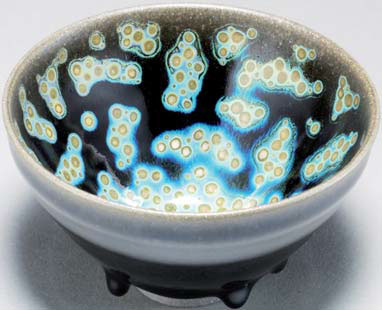
China's ceramic experts commended Hayashi's reproduction for achieving a similar scale of beauty to the Song masters.
"It's amazing that the potters 800 years ago had a very good command of the technique," says Hayashi, adding that ceramic making reached a peak in the Song.
His creations, referred to as yohen tenmoku in Japanese (literally: changed by fire), are now in the collections of the Palace Museum in Beijing and the British Museum in London.
Hayashi, who was born in 1962 in Toki, central Japan's Gifu prefecture, one of Japan's major ceramic producers, has won many awards for his pottery and ceramic works in his homeland.
The jianzhan have starburst patterns embedded in a black glaze. In each star is the navy blue of glistening mother-of-pearl, a shiny substance that forms the inside of certain mollusk shells. When observers gaze long enough at the surface, it appears to resemble an expanse of stars drifting across the heavens on a summer's night.
People in the Song Dynasty had a reason for tea bowls of this type. They would grind compressed tea into a fine powder with a stone mill, and then whisk it into froth. The best teas were judged by the purity and whiteness of their froth.
Jianzhan tea bowls were ideal for appreciating the light frothy foam. The bowls had deep blacks and reds with flecks of gold, the perfect contrast to the white and green of the tea, making the tea seem even more pure.
Another method used was oil-spot glazing, one of the most difficult glazing techniques. It required precision in the application, the firing conditions and the cooling process. Oil spots occur when there is an excess of iron oxide, which is allowed to cool slowly and form radiant spots on the surface.
In the 13th century, Buddhist monks introduced jianzhan ware to Japan after returning from their studies in China.
Japan's Ashikaga shoguns (1336-1573), warriors and avid tea practitioners, promoted the use of the Chinese-made tea bowls in chado, the Japanese tea ceremony. Since then, yohen tenmoku tea bowls have held a revered position in the history and development of chado.
The Song Dynasty came to an abrupt end in the wake of the Mongol nomads, and with it powdered tea gave way to tea leaves. The secrets of jianzhan glazing and firing techniques were lost.
However, Japanese artists continued the Song tradition. With their source of yohen tenmoku bowls cut off, they began creating replicas.
China has excavated many fragments of jianzhan ware but not a single complete piece. The only four complete examples of the chinaware fired in the Song exist in Japan.
Three of them are designated as national treasures of Japan and are kept in Seikado Bunko Art Museum in Tokyo, Fujita Art Museum in Osaka and a temple in Kyoto. The fourth is in Miho Museum outside Kyoto, and the piece's existence was not widely known until fairly recently.
Up to the 1990s, it was widely believed the techniques and quality of the Song could not be replicated. To learn more about the tradition and techniques, Hayashi traveled to Fujian to look for relics of yohen tenmoku before their glaze was changed by kiln firing. He was lucky to find one that was exactly what he wanted.
"It was helpful in my study on replicating yohen tenmoku ceramics," he says.
Scientists have discovered that items of jianzhan or yohen tenmoku contain a unique and incredibly difficult to produce crystalline formation known as epsilon-phase iron oxide. Coincidentally, the jianzhan pieces with the highest count of this formation are also some of the most coveted for their beautiful silvery appearance.
It is believed there was no way to control the finished product in the massive wood-burning kilns in the Song Dynasty. Because the adjustment of the fire in the kilns was left to chance when the bowls were made, their final appearance was impossible to predict.
Thanks to modern technology, things are easier now. Hayashi works with modern techniques to recreate yohen tenmoku ware. He uses an electric kiln to get better control of firing and more consistent results.
Now, his biggest challenge is the weather, as different conditions can influence the flow of smoke coming out of the kiln and, as a result, the bowls.
Jianzhan or yohen tenmoku bowls are still considered among the most perfectly realized objects devoted to the beauty and culture of tea. "It would be no exaggeration to say that yohen tenmoku ware are the epitome of ceramic style," Hayashi says.
His passion for the pottery set him on a journey of exploration that continues to this day. His long-term goal is to create a new type of yohen tenmoku. "When I look at the replicas coming from my kiln, I always think that better ones are on the way tomorrow," he says. "I enjoy the firing process more than the wares."
caihong@chinadaily.com.cn















