


Chinese eyeing private equity firms' portfolios
Investors are bidding for PE companies' assets, but many are wary of paying too high a price
Chinese insurer Anbang's bid to buy Strategic Hotels & Resorts for $6.5 billion in March attracted widespread attention, but arguably more striking is the fact it came just months after private equity firm Blackstone Group had acquired the hotel chain for $6 billion.
The return sought by Blackstone in such a short turnaround time is significant, and also highlights a trend of Chinese investors buying overseas assets from private equity companies.
|
China's biggest overseas acquisition from a pe firm - China National Chemical Corp's purchase of German industrial machinery maker KraussMaffei Group for $1 billion in January - was made from Canadian PE company Onex Corp. Zha Chunming / Xinhua |
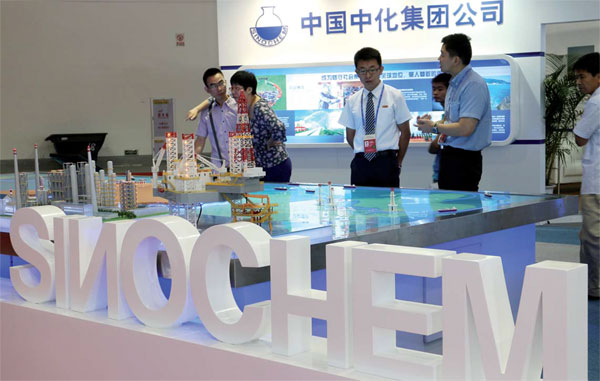
China's biggest overseas acquisition - China National Chemical Corp's purchase of German industrial machinery maker KraussMaffei Group for about $1 billion in January - was made from Canadian PE company Onex Corp. Kohlberg Kravis Roberts, a private equity firm in the United States, also recently sold a majority stake in French luxury brand SMCP to Shandong Ruyi Group in a deal worth 1.3 billion euros ($1.48 billion).
Analysts say a key factor behind the trend is the increasing willingness among PE firms to sell their portfolio companies through trade sales as an exit route due to current favorable merger and acquisitionsconditions. This makes it vital that Chinese firms employ the most professional advisers on outbound deals, to ensure fair terms.
"You're negotiating deals with PE firms that are more sophisticated and experienced sellers than the management team of target companies, so it pays for a Chinese firm to hire an experienced team," says Zhang Yi, a Hong Kong-based partner at law firm King & Wood Mallesons.
He says despite the apparent high profit margins involved when PE firms sell to Chinese companies, it is not possible to assess whether they have overpaid.
"One justification for the profit margin is that PE companies were able to buy these assets themselves. All assets are unique, and PE firms had to work hard to grab good-quality assets, so often strategic buyers need to pay more for assets in their portfolios," Zhang says, adding that PE firms' large network of contacts gives them more opportunities to access the best assets.
However, Chinese companies are not prepared to pay high amounts for targets when they feel prices are not justified. For example, a consortium led by Anbang abandoned a bid to buy Starwood Hotels & Resorts Worldwide in March after offering $14 billion.
The consortium, which also included private equity firms JC Flowers & Co and Primavera Capital Group, dropped out because the deal became too expensive, says Fred Hu, chairman of Primavera. "There wasn't any issue with funding," he adds.
Andre Loesekrug-Pietri, founder and managing partner of ACapital, a PE firm in Brussels, says one way for Chinese enterprises to lower the risk of overpaying for an outbound deal is to co-invest with a foreign company that understands China and has "expertise in managing a company in the US or in Europe".
"This is the best guarantee for Chinese investors - and their regulator if it is state-owned - that there is a local player taking a similar risk to them, with a strong alignment of interests," he says.
Despite the best attempts by Chinese companies, paying a premium to private equity firms may be unavoidable and, in some case, justified.
James Hsu, a partner at law firm Squire Patton Boggs in the US, says PE firms' portfolio companies are attractive to Chinese firms because they have standardized and professionally audited financial statements, which makes due diligence and value recognition much easier for Chinese buyers.
Small businesses, often startups or family-owned companies, are one type of asset PE firms like to acquire then use their expertise to standardize accounting and auditing standards, build a stronger professional management team and sell at a premium.
For such firms, the process of doing due diligence would be more complex and lengthy if Chinese firms try to acquire them directly, Hsu says.
PE firms also like to buy publicly traded companies, to take them private and then sell at a premium. Blackstone's sale of Strategic to Anbang is one such example.
"Blackstone was able to sell at a premium because it took Strategic private, meaning Anbang would need to negotiate with only one shareholder - Blackstone", Loesekrug-Pietri explains.
"Had Anbang attempted to buy Strategic when it was a listed company, it would have had to hold complex discussions with many investors and stakeholders, as well as stock market regulators."
Gong Jie, a partner at PE firm Pantheon in London, adds that Chinese purchases from Western PE firms are likely to occur in situations where purchases are made to acquire Western design, technology and brands to upgrade the buyers' domestic offerings.
In those cases, she says, the acquisition targets often are in earlier stages of growth, meaning PE firms can use their local knowledge and deal-making skills in working with Chinese companies.
Those deals contrast with Chinese acquisitions that focus on diversifying the buyer's assets and geographical locations, often targeting stable, mature businesses with strong professional management. Gong says those acquisitions leave less room for participation by PE firms.
Some assets bought from Western PE firms by Chinese companies a few years ago have already proven successful after post-merger integration. Management at those companies often feel the Chinese buyers' perspective has given them more room for growth than the short-term focus of private equity firms.
One such case is Chongqing Machinery & Electric Co's purchase of British toolmaker Precision Technologies Group in 2010 for 20 million pounds ($28 million; 25 million euros). The company invested extensively to help Precision conduct research and development into cutting-edge machine tools.
Knowledge-sharing between the parent and subsidiary also allowed Chongqing Machinery to upgrade its technology.
"We have a very good relationship with our Chinese parent company built on mutual respect and appreciation for advanced technology," says Neil Jones, group business development director for Precision.
"Our Chinese parent's long-term perspective allows us to invest more than 10 percent of annual revenue in R&D, which is not always a possibility when a company is under PE ownership, because often PE owners are more focused on short to medium-term returns."
cecily.liu@mail@chinadailyuk.com















