


Germany key to Chinese investment
Nation's 'hidden champions' make its smaller companies highly attractive acquisition targets
Germany's ranks of small and medium-sized enterprises, especially so-called hidden champions, have been key to drawing more Chinese investment, and the trend shows no signs of abating, according to Hermann Simon, one of the country's most influential business thinkers.
Hidden champions are often market leaders, either worldwide or within the continent they are based in, with revenues below 5 billion euros ($5.55 billion).
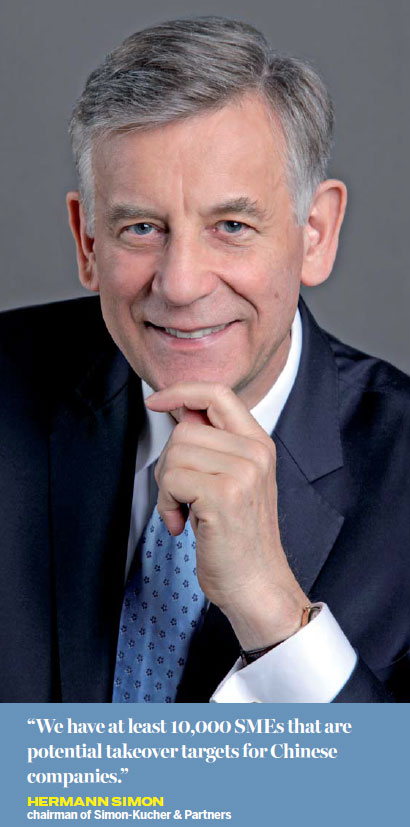
Simon, chairman of Simon-Kucher & Partners, a global consultancy firm founded in Bonn, says Chinese investors, unlike some US firms, see acquisitions in Germany as long-term strategic investments. He says most German businesses are happy with Chinese buyers.
An Ernst & Young report in February shows Germany was the most attractive destination in Europe for Chinese investment last year, with 36 acquisitions. The United Kingdom came second with 34 and France third with 20.
Simon, 69, believes this trend will continue thanks to Germany's many hidden champions, a term he coined to describe relatively unknown SMEs that are the backbone of a nation's economy and have for many years sustained Germany's leading position in exports.
"We have at least 10,000 SMEs that are potential takeover targets for Chinese companies," he says, adding that of the 3,000 or so hidden champions worldwide today, "about 1,300 are from Germany".
Many German SMEs are leading niche markets globally and are valued below several billion euros, he says, which makes them natural targets as the majority of Chinese acquisitions in Europe are limited in size, and Chinese industrial companies have a strong sense of affinity or preference for German SMEs.
China is one of few nations with so many entrepreneurs that understand the concept of hidden champions, Simon says.
One prominent example he cites is a Chinese chemical products owner whom he met during a recent visit to Shandong province. To focus on his core business, the Chinese entrepreneur gave up a couple of businesses and as a result is now the world leader in three chemical compounds.
On another occasion, when Simon was giving a presentation in Shanghai, he noticed the hidden champions concept was met with great interest. "The ones that pursue this successfully will be role models for the next generation," he says.
There is a largely positive attitude in German business circles toward Chinese investors, according to Simon, who says that, unlike some US companies that acquired European enterprises and focused on maximizing short-term gains before looking to offload them again, Chinese buyers tend to see such purchases as strategic investments.
"Having gained a foothold in Germany and in international markets, they tend to focus on longer-term prospects and on creating a group of Chinese and German companies that are successful in global markets in the long term," he says.
The Chinese investment in Germany is less aggressive compared with the Americans, he says, adding that Chinese buyers in Germany behave in a moderate and reasonable way. This means an SME is more likely to retain its identity after a takeover, he adds.
Simon acknowledges there is concern in Germany about more Chinese investment pouring into the country, but says: "When General Motors took over Opel in 1929, or Ford built a huge automobile plant in Cologne in 1930, people said we would be dominated and conquered by the Americans, and that we would be a colony of the US. But it turned out to be nonsense. The same is now true for Chinese acquisitions."
He believes Chinese investment can bring advantages for both sides and refutes the notion that Chinese companies are simply trying to extract know-how from Germany to transfer to China.
"To a large degree, that's impossible because a very large part of the knowledge resides in the employees. I meet German companies all the time and they tell me their know-how is not in the patterns, not in the written or digital documentation, but it is in the skills of their employees, not only the engineers and scientists, but also the workers."
In addition, he says, Chinese investment means German SMEs can gain a "stronger capital base" and access to the Chinese market.
Simon, who in an online poll by Frankfurter Allgemeine Zeitung newspaper was named the second-most influential management thinker in German-speaking countries, says German SMEs are in general becoming more open due to internationalization.
"They're increasingly taking on foreign managers, non-Germans and nonfamily members, and the positive experiences foster an attitude of openness."
Although he believes Germany's hidden champions can be excellent role models for Chinese companies, Simon says most would still prefer to avoid a takeover if possible.
"There is a sufficiently high number that need capital or have succession problems, or are under increasing pressure from overseas companies - in China, for instance. It's not solely voluntarily that they are saying 'We are open now'. Often they need to take on external investors."
wangmingjie@mail.chinadailyuk.com
What makes a company a hidden champion
They go for growth and are driven by market leadership.
They focus on narrow markets and are deep rather than broad. They tend to do things themselves and refrain from outsourcing core competencies.
They combine specialties in products and know-how with global sales and marketing, and serve the target markets through subsidies.
They are massive innovators, and the effectiveness of their R&D beats that of large companies by a factor of five.
Their innovation processes are fundamentally driven by the market and technology.
Their greatest strength is their closeness to customers, while their strategies are value oriented, not price oriented.















