


Chinese protecting Kenya's wild side
More volunteer to lend a hand as celebrities help raise awareness of endangered species
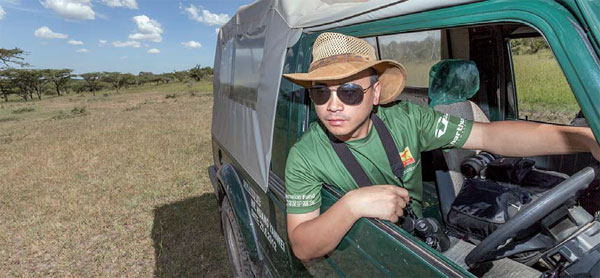
Zhuo Qiang has been involved in wildlife conservation in Kenya for five years, but he says he still gets odd looks from locals and tourists when they see him reinforcing bomas, which are predator-proof cowsheds used in the Maasai Mara's Ol Kinyei Conservancy.
"People rarely believe that Chinese are working to conserve African wildlife, or that we're doing a good job at it," says the founder of the Mara Conservation Fund, a nonprofit based in Nairobi.
|
Zhuo Qiang inspects Ol Kinyei conservancy in Maasai Mara in Kenya. He is the first Chinese national to found a wildlife conservation not-for-profit organization in Kenya. Photos by Xie Songxin / China Daily |
Zhuo, who started the fund in 2011 using his savings and donations from friends, says that view has remained largely unchanged despite the visible contributions in recent years by Chinese to conservation across the continent.
In China, celebrities have gone a long way to raising awareness about wildlife protection in Africa.
Yao Ming, the retired basketball star, visited Kenya in 2013 and appeared in the documentary, End of the Wild, which captured the threat posed by poachers to elephant populations.
The former NBA All-Star is expected to return to the country for a star-studded summit to promote the issue in Nairobi on April 29, joining Hollywood stars Leonardo DiCaprio and Nicole Kidman, musician Elton John, US business leaders George Soros and Howard Buffett, and several heads of governments in Africa.
Chinese actress Li Bingbing has also been involved in efforts to protect African wildlife.
Celebrities help to increase the visibility of a campaign, says Edwin Wanyonyi, chief strategist at Kenya Wildlife Services. "It means the information (about conservation) reaches a larger number of people and is more likely to resonate with them."
This certainly appears to have been the case in China: When the Zimbabwean government announced in September that poachers had killed 85 elephants in a wildlife sanctuary by putting cyanide in their watering holes, many Chinese took to the Internet to condemn the act and call for tough penalties for the perpetrators.
According to WildAid, a US-based NGO, poaching has fallen by 80 percent in recent years thanks to the work of governments and wildlife groups. The government of Kenya confirms that just 57 elephants and 5 rhinos were killed in Kenya in 2015.
Wanyonyi says China has made significant contributions to elephant conservation in the country.
During a three-day visit to Nairobi in 2014, Premier Li Keqiang pledged $10 million to support African wildlife protection. And shortly after President Xi Jinping's visit to Zimbabwe in December last year, China donated vehicles and equipment to anti-poaching forces there, too.
"This is all in addition to capacity building and technical assistance, and we've seen more than 20 of our experts get scholarships to Chinese universities in one year," Wanyonyi says.
China and Kenya have also made significant progress in tightening surveillance of entry points for illegal ivory, he says. "Being bundled together in a group of eight by CITES (the Convention on International Trade of Endangered Species) was both a negative and positive for us. It pushed us to rein in the tide as we were considered the source, transit and destination countries. The joint efforts of security teams in both countries, together with the Interpol, have been positive."
Moreover, the Chinese government's ban on the import of illegal ivory has been a major step. "The agreement between Kenya's Environment Ministry and its Chinese counterpart has created a broad network of partnerships," he says.
Mara Conservation Fund founder Zhou, who is known locally as "Simba", has commended his country's government for participating in Kenya's conservation efforts. "It's been rare and unprecedented. The international community should recognize this, as China can become a leader in global wildlife conservation," he says.
However, he adds, "For wildlife conservation to be successful more Chinese NGOs need to be established to champion the cause. I've been advocating for the establishment of a China-Africa wildlife conservation fund to support exchanges and win-win cooperation."
Huang Hongxiang agrees. He is CEO of China House, an organization in Nairobi that helps Chinese companies with social projects in Kenya, including wildlife conservation. Since 2014, the group has hosted hundreds of Chinese volunteers keen to lend a hand.
"Chinese citizens want to be part of the campaign, but they lack platforms. This is what we do in line with our mission to integrate the Chinese into Africa," he says. "In national parks, we encounter skeptics who question our agenda, but I'd say that the Chinese are really interested in this endeavor."
He says more investigations are needed globally to understand and effectively curb the illegal trade of ivory and rhino horn, and admits he has reservations about the forthcoming CITES meeting in South Africa that will discuss proposals to legalize the trade.
Mexican economist Alejandro Nadal has expressed similar concerns. During a recent presentation in Nairobi, he said: "There's just no tangible data that can be used to support this idea. This would definitely reverse the positive efforts so far made in the global campaign.
"We don't know the size of the illegal market, nor what is fueling demand and supply structures," he added. "We need better research and good economic analysis to understand how the market works."
Zhuo says a strong international mechanism independent from political divisions, along with a clear consensus on law and enforcement, would boost efforts to halt the trade. This, he believes, will require key contributions from the United Nations Environment Program, the United States, China and the European Union.
"Wildlife protection is essential to global ecology," he adds. "Many places in Africa are the last habitats for many large wild animals, so it's the obligation of every global citizen to protect the ecological environment and wildlife habitats to save endangered species."
lucymorangi@chinadaily.com.cn















