


What makes the middle class tick
Song Xuejun gets his kicks out of clicks, the sound made by any of his two dozen or so wristwatches as he winds them. It is not just the sound that thrills him during his regular ritual. Just looking at the watches' elegant inner workings and moving gears puts him in a happy frame of mind.
"People tend to be hooked on their mobiles," says Song, 48, a company executive in Beijing. "But I like to communicate with watches; they're like friends. I don't buy them to show off; I buy them because I love them."
Song regularly gets together with other watch aficionados and, with his wife's backing, puts money aside to buy his watches. He can afford this luxury because he belongs to an economic group that is perhaps the most talked about in China. Every habit of their lives seems to have been weighed, dissected and analyzed by researchers far and wide, and talk of their prospects preoccupies the global media.
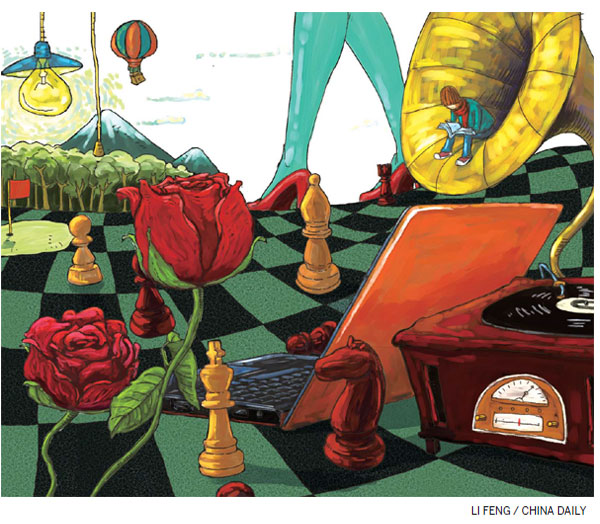
This is the country's relatively new and burgeoning middle class, and sometimes it seems that on these people the future not only of China but the world economy hangs.
Unlike in many Western countries, the middle class in China is expanding, reflecting the way the country's economy and society are evolving. But who exactly are these people, and what does the way their lives are unfolding hold for the future, especially given the myriad changes that will inevitably follow?
In October, the Global Wealth Report by the Credit Suisse Research Institute in Switzerland said China had the largest middle class, 109 million people, compared with the United States' 92 million. (As a proportion of the population, the middle class of the US, accounting for about 30 percent, is of course far greater than that of China, at about 8 percent.)
The report defines middle-class people as those with assets of between $50,000 and $500,000, which puts Song squarely in this group, even if he is reluctant to be categorized that way.
That unwillingness to be put into a box may be understandable, particularly given that economists and other experts cannot even agree among themselves on what exactly the term "middle class" means.
A survey in the 2016 edition of The Blue Book of China's Society, a series of reports edited by sociologists with the Chinese Academy of Sciences, draws on three indicators: the occupations of a person and his or her spouse; total family income; and how much money they spend in a year.
The collective purchasing power of the middle class gives a strong fillip to consumption and the economy in general, the study says. That in turn helps prevent society becoming polarized, it says, adding that the social attitudes and values of the middle class play a mostly positive role, and can act as a model for others.
Of the roughly 3,000 people surveyed in Beijing, Shanghai and Guangzhou, just under half were middle class with an average age of 40. The survey put the average annual family income of the middle class in 2013 at about 197,900 yuan ($30,465; 27,390 euros) and their expenses at 113,740 yuan.
They spent most on food and beverages, housing, apparel and accessories, entertainment and daily expenses. Also, they spent a sizable chunk of their income, an average of 10,000 yuan, on educating themselves and their child or children.
They spent a total of an hour a day getting to and from work, which is not that long, perhaps partly because 43.6 percent of them owned cars. About 61 percent owned their home; 30 percent worked in private companies, 22 percent worked in state-owned enterprises, 15 percent in public institutions and 8.6 percent were traders.
"Private companies would be appealing for these people because in many cases salaries are based on performance," says Zhang Haidong, a researcher who worked on the survey, and who is a professor in the School of Sociology and Political Science at Shanghai University.
Despite the incentives in the commercial world, working for state-owned enterprises remains a popular choice because of the security, decent salaries and high social status, he says.
But none of this should be taken to mean that the middle class thinks and acts as a homogenous group. Indeed, the income range is broad, and a lot of what's written about their consumption of luxuries and enthusiasm for extravagant trips refers to what in the West would be called the upper middle class.
Researchers note that Beijing's middle class lead lives that are faster paced and full of pressure than their counterparts in Guangzhou, who lead relatively leisurely lives and have more time to take care of their families.
The lifestyle ascribed to the middle class in Guangzhou seems counterintuitive, given the highly commercial and competitive nature of the city, reflected in the fact that on average its middle-class respondents in the survey said they had income of 39,900 yuan a year related to activities outside employment.
The middle class survey subjects also seem to attach great importance to health and nutrition, with 65 percent saying they often eat environmentally friendly food.
The researchers also asked respondents about social justice, trust in society and their satisfaction with life. On these issues, the replies of the middle-class respondents were more positive than others, the researchers say, and more of those in the middle class than not said they took part in public service activities and social events, and discussed political issues.
The middle-class respondents were more involved with charity than the non-middle class ones, their activities including making monetary or other donations.
"The middle class are well-educated, with great vision and rational thinking," says Zhu Di, an associate professor at the Institute of Sociology, Chinese Academy of Social Sciences. "As the backbone of society, they play an important role in the formation of core values."
Though the middle class in cities tend to pamper themselves by using expensive products and to take part in cultural and leisure activities, they do this to be happy rather than to show off, she says.
Comparing leisure activities of the middle class and those of lower economic status, she says the former are more likely to play computer games, surf the Internet, travel and go to the cinema or a concert, while the latter tend to take part in more traditional activities like playing mahjong or cards or visiting someone for a chat.
"Mass consumption, to which the middle class is the main contributor, is a driving force to expand domestic demand and transform the economic development mode. They are more willing to buy high-quality and creative products, but some of this consumption demand is shifting (and being felt) abroad."
xulin@chinadaily.com.cn















