Dairy farmers in New Zealand hit by China's slowing economy
When China's economy was growing in double digits, dairy farmers more than 9,600 kilometers away in New Zealand felt like they had won the lottery.
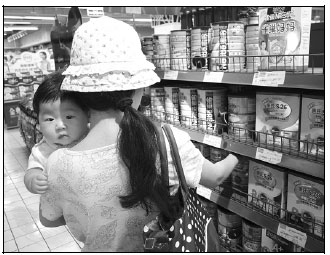
They were getting record prices for their milk and it seemed there was no slaking China's thirst for premium New Zealand infant formula, especially after a tainted milk powder scandal made Chinese shoppers wary of domestic brands.
Now, it's as if farmers have discovered the lottery ticket was not valid. A world milk glut and a decline in Chinese demand for imported dairy products have sent prices down by 50 percent. Many farmers are borrowing to stay afloat and rural suicides have increased.
Dairy exports in the year that ended June totaled NZ$12 billion ($7.6 billion), down from nearly NZ$16 billion a year earlier. Dairy trade to China has proved particularly volatile, rising from NZ$2.8 billion in 2013 to NZ$6 billion last year, then plunging to NZ$2.3 billion this year.
"We saw it happening on the cash-flows way back in April-May, and could see well ahead that there was going to be just massive deficits," Chris Engel, a farmer with 400 cows in Wairarapa, a region of quaint towns, rolling green pastures and a striking backdrop of snow-peaked mountains, said.
Engel, who has been farming with his wife Jude for more than three decades, said there have been droughts and other challenges in the past, but never such bleak pay days. "We just had to be in constant contact with the bank, updating them regularly, to get their support to pay the bills."
The financial dilemma for New Zealand's dairy farmers, and the economy they help power, underscores that China's quarter century of supercharged growth has given it enough global weight to create not only winners, but losers too.
China's growth last year of 7.4 percent was its slowest in more than two decades, sending ripples around the world. The forecast is for 7 percent or less this year.
Australia, which boomed for a decade on Chinese demand for its vast reserves of iron ore and coal, is grappling with a painful transition after those sources of growth shriveled.
Last month, Tony Abbott was toppled as Australia's prime minister by a challenger from his ruling Liberal Party, in part reflecting dissatisfaction with waning economic growth.
Abbott's inability to successfully articulate a new strategy for the $1.5 trillion economy just increased his problems.
But the challenge from China is not only its slowing economy.
In some industries, its domestic companies are becoming more effective competitors to foreign exporters who had visions of unlimited growth in the market of 1.4 billion people.
The government is encouraging many Chinese dairy producers to combine into financially stronger entities. Domestic dairies struggled to recapture market share after the 2008 scandal over tainted milk and prompted many shoppers to switch to expensive imported products.
But they have recently been successful in launching new brands, including yogurt products by Mengniu and Yili, two leading dairies, according to Euromonitor food analyst Lianne van den Bos.
China's Agriculture Ministry figures showed a recovery in milk production last year from 2013 and a substantial drop in total dairy imports in the first half of 2015.
In August, South Korea reported its biggest monthly drop in exports for six years that was both a sign of weak global demand and a shift in the type of goods China needs to import.
Chinese leaders are trying to give consumer spending a bigger role in the economy, weaning it from overreliance on trade and investment in real estate and heavy industry.
"South Korea exports are mostly intermediate goods to China (such as computer chips and auto components)," Jung Kyu-chul, a fellow at Korea Development Institute, said. "If China reduces investment and boosts consumption, that's not good for us."
Experts also believe Chinese companies are gaining competitiveness against South Korean exporters partly because of strong support from the government.
"Televisions, communications devices and components are the areas of strength for South Korea but China is likely to catch up," Jung said.
In New Zealand, the country's central bank is trying to prevent a farming-led recession. It has cut benchmark interest rates three times this year, as it seeks to give farmers and other exporters a boost by lowering the value of the country's currency.
Reserve Bank Governor Graeme Wheeler said last month that if drought conditions develop this summer, as some forecasts predict, it could prompt further rate cuts.
Statistics released last month show 27 New Zealand farmers and farm workers committed suicide during the past year, the most in five years. The rate of suicide tends to be higher in rural areas than in cities, even during prosperous times. The isolation of farm life may be one factor.
Theo Spierings, the chief executive of New Zealand's Fonterra, which collects and sells most of the country's milk, said China is very serious about developing its own supply.
But Spierings does not believe China will be able to produce enough on its own to meet the rising demand, and there will still be a place for foreign suppliers.
Chinese dairy consumption per person nearly tripled from 7 kilograms in 2004 to 19 kilograms last year, according to Euromonitor International, a research firm based in the United Kingdom. Sales should rise by at least 10 percent a year in the long term, Euromonitor predicted.
To help keep farmers solvent, Fonterra has offered hundreds of millions of dollars in interest-free loans, repayable only when the price of milk rises.
Engel, the Wairarapa farmer who is also local chairman for advocacy group Federated Farmers, is among many who are operating at a financial loss this year. "Do you buy food for that cow? Or, you have to fix the tractor. Do you just not fix it?" said Engel.
|
A woman with a baby selects imported infant formula in a Beijing supermarket. Provided To China Daily |