


Genomics firm maps route into Europe
Chinese company working in specialized area uses acquired technology to make inroads into continent
Chinese genomics specialist BGI is making significant inroads into European markets, championing its strong research and development ethos and its ambition to achieve breakthroughs in analyzing the genomes of organisms, particularly humans.
It is an important specialty: The genome is the entire DNA content that is present within one cell of an organism. Experts in genomics strive to determine complete DNA sequences and perform genetic mapping to help understand disease, according to life sciences website news-medical.net.
|
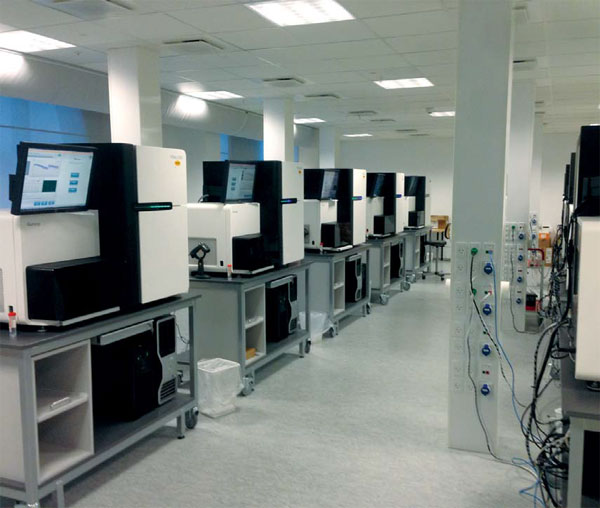
Chinese genomics company BGI's laboratory in Denmark. Provided to China Daily |
Globally, the company is one of the three biggest genomics institutes, alongside Sanger in Britain and Broad in the United States. BGI, known until 2008 as Beijing Genomics Institute, is based in Shenzhen. It has grown rapidly in recent years, especially after buying the California-based Complete Genomics Inc for $117 million (104 million euros) in 2013. BGI has projects across Asia, the US, Europe, the Middle East and South America.
"We have two key long-term dreams to be achieved through research. One is to find ways to reduce the incidence of human suffering and illness from birth defects, and the second is to find ways to discover and treat tumors at earlier stages of a patient's illness," Li Ning, CEO of BGI Europe SA, says.
To achieve these goals, BGI is working in different international markets and in the process, taking the knowledge accumulated from each market back to China, to create synergy with China's large market and tap the large amount of available investment capital, Li says.
BGI was founded in 1999 in Beijing as an independent, nongovernmental research institute to participate in the Human Genome Project as China's representative.
BGI has grown significantly, and in 2010, BGI Europe was founded in Denmark. In 2011, BGI Europe set up a research laboratory in Copenhagen with the goal of working with European researchers in the fields of biological research, molecular breeding, healthcare and related fields vital for genetic analysis. Molecular breeding involves the application of molecular biology tools.
The Copenhagen laboratory covers 1,200 square meters and has been equipped with advanced research tools developed by BGI in China. In the laboratory, much of the research by BGI is carried out for its clients in Europe, such as in Denmark, Sweden, the United Kingdom, France, Norway, Finland, Germany, Spain, Turkey, Slovenia, Italy, the Netherlands and Russia.
Li says international expansion is not new for BGI. Rather, it is a part of the company's culture since it was founded, as several of the major initial projects the company participated in were all global in nature. One example is the Human Genome Project, started in 1990 and completed in 2003, which determined the sequence of chemical base pairs that make up human DNA. It was the world's largest collaborative biological project, involving a joint effort from research centers in the US, the UK, Japan, France, Germany and China.
Li says at the time the Human Genome Project did not necessarily require Chinese input, but the vision of BGI's founders including Wang Jian and Yang Huanming made clear the importance for China of participating in this project. They persuaded the leaders of the Human Genome Project to let them handle 1 percent of the work, making China the only developing nation to play a major role.
"We realized from an early stage that international cooperation is key for genomics research, so we started the organization with an international perspective," Li says.
When BGI was founded, its founders foresaw the biotechnology industry as having an important future, because the slowing of China's rapid industrial development and information technology boom could be foreseen and, globally, the growth of biotechnology was taking off.
"Because of our founders' correct vision, we managed to join the genomics research industry at around the same time as other companies globally, so we started with a level playing field," Li says.
After participating in the Human Genome Project, BGI then joined the International HapMap Project, which aimed to determine common patterns of human genetic variation. HapMap is used to find genetic variants affecting health, disease and responses to drugs and environmental factors.
BGI completed about one-sixth of the work of the project. Other research centers involved in the project are in Canada, China, Japan, Nigeria, the UK and US. The project started in 2002 and its data was published in 2009.
Li says it is projects like the Human Genome Project and the International HapMap Project that gave BGI a solid foundation in its early years, allowing the company to learn best international research practices and exchange knowledge with researchers all over the world.
Building on this knowledge, BGI then got involved in many more commercial research collaboration projects, with hospitals, universities and individual companies in the pharmaceutical, healthcare and food sectors. It has about 1,200 collaboration projects running worldwide.
Li says one key advantage BGI has is its hardware, which consists of high-technology systems used in the genetic testing and clinical trials, and which helps its partners do better research and development and implement the results in clinical trials.
These advanced tools are developed through the expertise of BGI's strong R&D team, as BGI's growth coincided with a large increase of highly skilled scientists in China, he says.
Another milestone of BGI's growth was in 2010, when it bought 128 of Illumina's state-of-the-art DNA sequencing machines, each costing $500,000, according to the MIT Technology Review. It now owns more than 240 sequencers from several manufacturers, which enables BGI to sequence 30,000 human genomes a year.
BGI has achieved a number of significant technology milestones. In 2003, it decoded the SARS virus genome and created a kit for detecting the virus, and in 2011 BGI did the genome sequencing for the deadly E. coli outbreak in Germany in three days under an open license, meaning the results of the research are freely available.
In 2013, Li says, BGI's acquisition of Complete Genomics allowed BGI to gain access to the technology that collects data on DNA, an area traditionally dominated by US companies.
"It would be less efficient for us to develop this technology ourselves, because China's technology is not yet advanced enough to achieve such technology, but through the acquisition we are now armed with genome sequencing technology and our service will become more integrated and cost effective for our clients," Li says.
BGI has about 4,000 employees globally. BGI Europe has about 20 employees based in Denmark who travel across Europe to work with its partners.
BGI has participated in major government-backed projects both domestically and internationally. It has played a key role in building the Shenzhen-based China National Genebank, which holds data on genomics that are made available for medical institutions and research organizations.
In this project, BGI worked with four Chinese government departments - the National Development and Reform Commission, the Ministry of Finance, the Ministry of Science and Technology, and the Ministry of Health.
It participates in Genome Denmark, a research project that aims to map the genome of the Danish population. Li says because the technology provided by BGI to projects such as China National Genebank and Genome Denmark are of a uniform standard, data users should find it very easy to compare data across the different projects.
cecily.liu@chinadaily.com.cn















