


Policy measures to yield results in H2, says NBS official
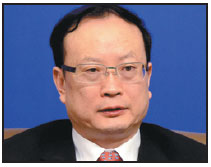
Economic indictors have gradually picked up and there are more signs the economy has started to stabilize, Wang Baoan, director of the National Bureau of Statistics, told People's Daily in an interview.
The NBS announced major economic data on Wednesday and said the economy has slowly stabilized. Do you think the economy performed well in the first half?
With a series of policies and measures promoting steady growth, structural adjustment and preventing risk firmly in place, major economic indicators have clearly picked up.
China's GDP grew by 7 percent year-on-year in the second quarter, the same as the previous quarter. The country created 7.18 million new urban jobs in the first half, more than 70 percent of the full-year target. The consumer price index rose 1.3 percent, the same as the first quarter. Summer grain output saw a 3.3 percent annual growth. The national per capita disposable income grew 7.6 percent. Real estate sales saw a recovery. Sales of commercial housing grew 10 percent, compared with a fall of 9.3 percent in the first.
The economy is managing to shift from being industry-dominated to service-led. The government's efforts at promoting innovation and entrepreneurship effectively stimulated this strong economic vitality, with newly registered companies increasing more than 19 percent in number in the first six months.
GDP growth declined by 0.4 percentage points over the same period last year, but that's in line with the "new normal" of the Chinese economy - meaning slower but more sustainable growth.
What are the major reasons for these positive changes?
The most important is the State Council continued to strengthen and optimize its macroeconomic policies.
Steady growth creates a favorable macroeconomic environment for structural adjustment, but in the short term, too fast a transition between the old and new drivers also means greater downward pressure.
Development of the real economy needs financial support and a reasonable level of liquidity, but in the context of the slowdown, excessive monetary easing may lead society to take on higher financial risks, given the accumulated debt risks of the real estate sector, overcapacity and local government debt.
Faced with the dilemma, the State Council has done a good job in combining the "invisible hand" of the market and the "visible hand" of government.
It cut a lot of red tape and relaxed market entry for many sectors. The timely reduction in the reserve requirement ratio and the issuance of new bonds and displacement of local bonds, also had a significant effect.
What factors will contribute to maintaining this steady momentum into the second half?
We are confident full-year economic and social development targets will be reached and the economy will continue to stabilize.
China has yet to complete its urbanization and industrialization so there is still great potential in industrial and technological updating.
According to our estimates, over the past decade, one percentage point of increase of urbanization led to 3.7-percentage points of growth in investment and 1.8-percentage point growth in consumption.
The effects of the State Council's series of policies and measures will be more apparent in the second half. From a financial policy perspective, the government issued a series of fiscal policy measures including allowing local governments to issue new bonds and swap local debt for new official municipal and provincial bonds to initiate major infrastructure project packages, involving railway, urban rail transit, airport and other large-scale projects.
In the second half, such investment growth is expected to rise as debt financing functions of local governments are restored. From a monetary policy perspective, the central bank cut RRR, lowered benchmark interest rates and relaxed various purchasing policies and as a result we expect real estate development and investment to rebound in the second half.
What major difficulties and problems face the economy?
The global economic recovery remains slow, trade protectionism is rising and international trade growth has been sluggish for three years. China's exports grew less than 1 percent in the first three months, so meeting its full-year target will be hard.
There are also a number of outstanding internal problems. Businesses are facing overcapacity difficulties. Profits dropped in the first half due to falling commodity prices, rising costs and slowing sales.
And some resources-exhausted cities and old industrial bases are seeing shrinking local fiscal revenue and are under pressure to create more jobs.
How can the existing difficulties be overcome and the economy stabilized?
In the short term, we need to let investment play a role in driving the economy. In the medium to long term, economic restructuring will rely on innovation, but most importantly, we need reform to unleash vitality and allow the market to really play a decisive role in the allocation of resources.
Deepening reform at this stage should be focused on four aspects: Liberalization of price controls, lowering entry thresholds of industries, further relaxing in technology management and accelerating State-owned enterprise reforms.















