


Smartphone makers must up the ante
Chinese companies make inroads overseas, but brand building is a serious challenge
Four years ago China overtook the United States as the world's No 1 smartphone market. Now the Chinese market is reaching saturation point, with about nine out of 10 mobile phones sold in 2014 being a smartphone.
As the market grew rapidly, it drew smartphone makers from near and far to grab a piece of the action. Chinese smartphone makers that have been particularly successful in this are Xiaomi and Huawei, which are ranked in the top three in sales after Apple in China as of the first quarter this year.
|
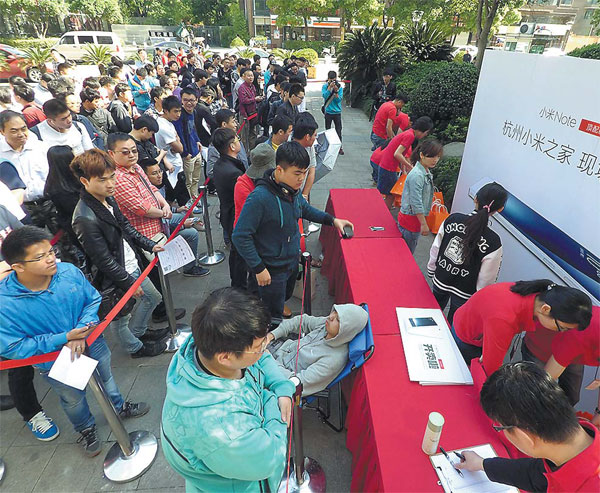
People queue to buy Mi Note smarphones in Hangzhou in May. Provided to China Daily |
Chinese smartphone makers have some advantages over their foreign rivals. For one thing, they seem to be more flexible with their pricing and the way they market the products.
In the heat of the fierce price war, Chinese brands have become very good at keeping their costs down and have developed efficient and complete industrial chains. Both of these elements have given them a strong competitive edge that helps them as they expand overseas, which is the next necessary step for these companies.
The fast development of the "Internet of Things" has also been important in helping Chinese smartphone makers expand. This concept means that everyday devices are equipped with sensors and connectivity to work together, as Digitaltrends.com notes.
Smartphones are important to this concept because phones are becoming personal hubs touching many parts of our lives. With the growth of Internet-enabled products, smartphones can control intelligent home appliances and consumer devices.
Because China has a strong foundation in the Internet of Things, its smartphone producers, if they act wisely, stand to go into the next phase of competition well ahead of their rivals, especially in the domestic market. In pitting themselves against international rivals, Chinese companies obviously have to go global, and this, of course, applies to smartphone makers. Though they have made undoubted strides in recent years, they still need to do a lot more to gain global recognition.
Generally, emerging markets, where the demand for affordable smartphones is still high, offer the greatest growth opportunities for Chinese smartphone makers.
In fact, the demand from such markets makes it likely that within three to five years, one or two Chinese brands may overtake Apple in sales. However, Apple is likely to stay ahead of the pack in China in terms of profit, given that it serves the highly lucrative high-end market.
In developed markets such as the United States, Apple continues to dominate, and it is hard for its Chinese rivals to increase their market share. Building brand recognition in such markets is also particularly difficulty given the solid base of loyalty that the likes of Apple and Samsung enjoy.
In the short term, the biggest challenge is one of revenue, and in the long term, it is one of branding.
At the moment the brand recognition that Chinese smartphones enjoy tends to be highly limited geographically. For example, Lenovo and Xiaomi are well known in China but are only now beginning to become known in emerging markets. Huawei, a name well known to Chinese, has a minuscule share of the smartphone market in the US.
Of course, every Chinese smartphone maker has its own particular strategy for tackling the overseas market. Some, such as Huawei, TCL and ZTE, have good relationships with big telecommunications companies and can tap into these channels to increase their sales.
The likes of Xiaomi and Lenovo are adept at e-commerce and can draw on this in expanding overseas.
However, there is one thing that all of these companies, no matter which market they are in, need to do to ensure their continued success. Even as they increase their sales, they will also need to raise their prices, because sales figures that keep on rising are almost meaningless if the revenue they bring in barely covers costs.
The author is a principal analyst at research firm Gartner Inc in Taiwan.















