Old fisherman recalls heroic act
Seven decades after the end of WWII, historians shine a light on Chinese valor during a tragedy at sea, Joseph Catanzaro, Zhou Wa and Liu Xiaoli report.
Shen A'gui stared vacantly at the ceiling above his bed, hands fluttering weakly like broken birds on the bunched-up blankets. They are the hands of a fisherman, every scar and callus a footnote for a life spent hauling oars and nets in the stony seas off China's southeastern coast. They are the hands of a man who saved lives when the world was gripped by war and so many others were taking them.
Standing at the bedside, his friend Xu Guoquan, 67, shook his head. "He's 92 years old, and he's sick with a fever," he said. "He hasn't spoken in two weeks."
The fisherman is the only surviving Chinese participant of a daring rescue in 1942 that saw hundreds of British servicemen saved from almost certain death. "I don't know if he remembers," his friend said.
Suddenly, a paper-thin voice emanated from Shen's sickbed. "I was scared," the elderly man whispered. "I was only 19. The Japanese were shooting. Hou'Ao beach ... that is where we rescued the foreigners."
Shen's voice and memory returned. He has not forgotten the day when the war came to his home on the Dongji Islands and a humble group of Chinese fishermen became heroes.
This year, as the world commemorates the 70th anniversary of the end of World War II, China is preparing to mark the conclusion of the War of Resistance against Japanese Aggression (1937-45), a bloody chapter in the global conflict. Western and Chinese historians have only recently begun to shine a light on how China's fight against the Japanese army played a crucial role in the greater Allied victory.
Rana Mitter, director of the University of Oxford's China Centre and author of China's War with Japan 1937-45: The Struggle for Survival, is among those working to broaden the historical narrative.
Forgotten ally
During the Cold War, the Western nations and China forgot the significance of their wartime alliance against Japan, according to Mitter. "Various things China did changed the path of the war," he said. "Most noticeably the decision ... to continue resistance after (Japan invaded China in) 1937, when they could well have surrendered. Over the course of the war, at their height, (China) was holding down 500,000 Japanese on the Chinese mainland."
Those Japanese troops, tied down fighting Chinese soldiers, could not be deployed in Southeast Asia and the Pacific theater, a handicap that may well have changed the outcome of key battles, according to Mitter. China's resistance also prevented Japan from pushing into new fronts that could have had a significant impact on the war in Europe.
A Japanese incursion into British India would have threatened a source of manpower and resources vital to the fight against Nazi Germany. A push into Russia, an ally that proved crucial in Adolf Hitler's eventual defeat, would also have seen the already beleaguered Red Army fighting on two fronts.
Mitter said Japan planned to conquer China in three months. Almost five years after the initial invasion, when Pearl Harbor was bombed, Japan was still "stuck in the Chinese quagmire".
But China paid a heavy price for its refusal to surrender. By the time the guns finally fell silent in 1945, an estimated 15 million Chinese soldiers and civilians had been killed. To put that in context, the fighting in China is estimated to have accounted for 90 percent of all casualties in the Pacific theater. "These were major contributions that don't tend to be remembered very much in the West," Mitter said.
Conversely, China was only able to stay in the fight because of the supplies and support it received from Western allies, in particular Britain and the United States, which were also engaging Japanese troops elsewhere who could have been thrown against China.
"Without the Chinese contribution, it's much harder to see an Allied victory in Asia during the war," he said. "But without the British and Americans, it's also much harder to see a Chinese victory."
Even less well known are the tales of camaraderie between locals and foreigners in China during the war. In the northeastern city of Shenyang, Chinese people endured alongside captured British, US and Australian troops in the concentration camps, often smuggling in what little food they had to the emaciated foreigners. In Guizhou province, in China's southwest, foreign doctors working for the Red Cross helped save the lives of many thousands of Chinese soldiers and civilians. In western, central and southern provinces, British and Australian commandos trained and fought alongside Chinese guerrilla forces. And in other locations, locals such as Shen staged daring rescues to save foreign prisoners of war.
"This is really a story about both sides helping each other, and I hope that's the view that becomes more lodged in the historical consciousness," Mitter said.
They may be the forgotten allies on the forgotten front, but seven decades on, there are those in China who still remember.
Ocean rescue
On the docks of Qingbang Island, one of four wave-battered rocks that make up the Dongji Islands chain, Liang Yijuan, 86, walked slowly among the fishmongers and women mending nets.
When Liang was 13, he stood on the same spot and scanned the horizon for any sign of his parents. They had been among 198 locals who had hurriedly cast off in 46 sampans early in the day, called out to sea by a noise like thunder and a rising column of smoke.
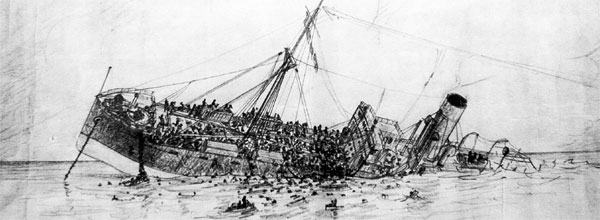
It was Oct 1, 1942, and the Japanese transport ship Lisbon Maru had just been torpedoed by a US Navy submarine about three nautical miles from Qingbang.
Unknown to the sailors aboard the USS Grouper, in addition to carrying 700 Japanese troops, below decks the holds of the Lisbon Maru were crammed with nearly 2,000 British servicemen taken prisoner after the fall of Hong Kong. As the ship sank, a high-ranking Japanese officer (not the captain) gave the order to secure the hatches and leave the captives to their fate.
The POWs who managed to break out were met with deadly machine gun fire.
Shen and Liang's parents were part of the Chinese fishing fleet that arrived at the scene. Despite being fired upon, the fishermen decided to risk all to save the foreigners. Eventually, nearly 400 British soldiers were rescued.
Tony Banham, author of The Sinking of the Lisbon Maru: Britain's Forgotten Wartime Tragedy, said the British death toll would have been much higher if the Chinese fishermen had not intervened.
"In many cases, the fishermen pulled the British from the water right under the noses of the Japanese. They could have been shot. Some survivors believe the Japanese only joined in the rescue efforts because they saw what the Chinese had done and realized that some of the prisoners would now survive (to tell the tale)."
Liang said he remembered the moment his parent's fishing boat arrived at the docks carrying a cargo of emaciated British soldiers. "It was a bit strange," he said. "I had never seen a foreigner before."
Each fishing family took a few of the POWs into their homes, fed them, and in some cases clothed them. When three of the British soldiers indicated they wanted to hide, it was Liang who helped them, taking them into the jungle to a cave that had once been used as a shelter for children during pirate raids.
"I used to play in that cave, and I suggested we hide the soldiers there," he said. It was lucky he did, because the next day the Japanese returned in force. "I wasn't afraid," he added, although he later realized he should have been.
Doctor Karl James, a senior historian at the Australian War Memorial in Canberra, Australia, said China remains the "unappreciated fourth ally" of World War II, and much of its contribution has been overlooked, a fate shared by Allied forces deployed on the Chinese front.
Roughly 27,000 US troops made up the bulk of Allied forces in China in 1944 and 1945. "There was camaraderie, but I wouldn't want to say it's an uncomplicated story of everyone simply mucking in together," Mitter said. "There are tensions as well during that time."
But on the island of Qingbang in 1942, Liang said the solidarity ran both ways. Knowing that to do anything else would risk the lives of the fishermen and their families, all but the three British POWs that Liang had hidden surrendered to the Japanese army.
"The Japanese came many times looking for the (three hidden) soldiers," Liang recalled. "They captured some villagers and pointed guns at their heads and asked where the UK soldiers were hiding. No one told them anything."
An enduring relationship
Guerrilla fighting groups eventually smuggled the three remaining POWs across China to British forces operating in the west, and they were repatriated to Britain.
On Miaozi, the largest of the Dongji Islands, Liang's daughter, Liang Yindi, 48, is one of several locals who take care of a small museum dedicated to the sinking of the Lisbon Maru. Visitors are few and far between, but she said, "It's important for people to remember there is a link between the people here and Britain, for people to know that 70 years ago there were Chinese fishermen who were brave and warm-hearted."
Ten years ago, the island received a small group of elderly British veterans who had survived the tragedy. Liang is unsure, but he thinks one of the men was among the three he helped to save. "We hugged and we cried," he said. "I had never forgotten them."
Banham said he only knows of one British veteran from the sinking who is still alive. Similarly, Shen is believed to be the last of the rescuers.
Lying in his sickbed, Shen said he never expected or wanted accolades for doing the right thing. He also met with one of the returning veterans in 2005. The embrace they shared was reward enough.
"It is better to save one life than to build a temple to the gods," he said.
Contact the writers through josephcatanzaro@chinadaily.com.cn
|
An illustration shows the sinking of the Japanese troopship Lisbon Maru, which was carrying British POWs when it was torpedoed by a US Navy submarine in 1942. Many of the POWs were rescued by Chinese fishermen. Photos Provided to China Daily |