


Lisbon on a plate
|
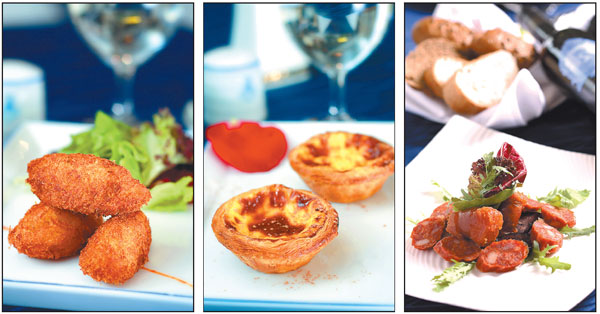
From left to right: Salted codfish, egg tarts and Portuguese sausages are among the signature treats of Portugal. Photos Provided To China Daily |
Portuguese food is less-known across China than other European fare, but a transplanted chef is eager to change that in Beijing. Liu Zhihua tucks in for a tasting.
When Portuguese chef Paulo Quaresma came to the Chinese capital nearly five years ago, one of his first customers was rather disappointed. The Chinese guest ordered Portuguese chicken and was bewildered by what Quaresma served, insisting the dish was not what he expected.
Traditional Portuguese chicken, the chef says, is a whole chicken marinated and barbecued with white wine, olive oil, lemon and spices like chilies, bay leaves and garlic. What the customer expected, Quaresma founded out later, was flavors such as coconut, curry and other ingredients from Southeast Asia that Portuguese people do not use - perhaps because many Chinese people get their impression of Portuguese food from Macao, which was a Portuguese colony until it was returned to China in 1999.
Like many European chefs who come to Beijing, Quaresma faces the challenge of expectations - some customers seeking the absolute original cuisine, others looking for adaptations to Chinese tastes. But unlike many Italian, French and Spanish chefs, Quaresma has the chance to give customers something unexpected: He's the only Portuguese chef working in a Portuguese restaurant in Beijing, he says.
The small Portuguese community in the capital has fewer than 100 people, and there are few authentic Portugal restaurants on the Chinese mainland, which accounts for why few Chinese people have tasted authentic Portuguese food, he says.
"I was surprised at first, but not now," says Quaresma, executive chef at Camoes Portuguese Restaurant in the Legendale Hotel. He says he has never regretted the decision to leave his home country.
When Chinese people eat Portuguese cuisine while they travel to Macao or abroad, in most cases the food has been altered to appeal to locals, he says.
"I don't want to change to appeal to people's wrong ideas of Portuguese specialties," he adds. "I cook the way Portuguese mothers do and I want to tell people what real Portuguese cuisine tastes like."
China, he says, has also given him a lot back.
"I have a good job and live a happy life here," the 40-year-old says, recalling that he was going through sadness and the chaos of a divorce when he got the job offer. Now he has settled down in Beijing with his Chinese wife and a 2-year-old son.
Quaresma started his cooking career in 1995, after graduating from a famous culinary school in Portugal. But while his resume became studded with experience at famous restaurant chains and top hotels, his personal life was in crisis. When his marriage ended, he had an urge to work abroad and gain overseas experience to make a fresh start.
He says he has always liked Chinese food and culture, and so his first two months were like living in a dream. He made his home in a hutong compound and enjoyed exploring the city and places nearby.
He soon discovered that the Chinese food he knew outside China was totally different from its origin - just like what happens with food from his own country.
Dining experience
Camoes restaurant is named after one of the country's greatest poets in history, with decoration and furnishings that showcase European elegance and luxury. His kitchen is stocked with ingredients imported from Portugal.
I visited the restaurant with a colleague, and all dishes we had were impressive. My favorite was salted codfish with salad.
Dried and salted codfish has been a traditional ingredient in the seafaring country's cuisine for hundreds of years. Sailors long ago learned to preserve fish by drying them after salting, the chef says.
He poaches and shreds the codfish first, then shapes the flesh into oval meatballs with parsley, garlic, mashed potatoes and other ingredients, before frying them. The tasty meatballs were golden and crispy on the outside, and white with dots of green spots inside.
I also liked the dish "small ham" very much, which was served simply with olive oil and breadsticks. The ham slices were razor-thin, just 1 millimeter, and were simultaneously soft and chewy.
Other hams often have a strong smoky flavor, but I didn't sense any smokiness until I was about to put the ham into my mouth.
According to Quaresma, the ham is made from free-range, organic pigs, which eat only acorns and flowers to give the pork a special flavor. The pork is salted to reduce water, and then air-dried for at least 14 months, often absorbing the scent of soft smoke. The longer the ham is dried, the drier and chewier it will be. Smoke from different types of firewood also gives the ham different flavors.
Portuguese egg tarts, a staple of Macao, are very popular with Chinese, and in the restaurant I had the most delicious egg tarts I've ever tasted.
The golden and brown surface was very crisp, but the inside was warm and sweet, and literally melted in my mouth with a pleasant aroma. The secret lies in the high cooking temperature, Quaresma says. With high heat, the egg tart cooks fast, reducing the chance for the moist filling to soak into the pastry before it sets. The consistent sweetness comes from high-quality sugar, he adds.
The most unexpected dish I had was tomato soup with a poached egg. The tomato broth was boiled with onion, garlic, sausage and other ingredients to enrich the flavor, which is both sour and refreshing.
Seafood stew is also a must-have: The broth I ate was a modest one, with about five ingredients, including shrimp, scallop, and pepper, but was very fresh and delicious.
Other specialties I didn't get to try on this visit: "Bairrada" style roasted suckling pig, with sweet-potato chips and orange, and several Macao specialties, including African chicken with green salad and potato wedges.
Quaresma has trained four cooks to help him, and the restaurant now offers set business lunch menus with choices of three or four courses, which cost respectively, 168 yuan ($27) and 188 yuan, plus a 15-percent service fee.
Contact the writer at liuzhihua@chinadaily.com.cn















