


Tibet path of development on right track, analysts find
Report says Dalai Lama and supporters must abandon violence and attempts to create a 'state within a state'
The Chinese government on Wednesday issued a white paper on the Tibet autonomous region, applauding its development path and denouncing the "middle way" advocated by the Dalai Lama.
The white paper, titled "Tibet's Path of Development IsDriven by an Irresistible Historical Tide", holds that Tibet's current development path is correct.
|
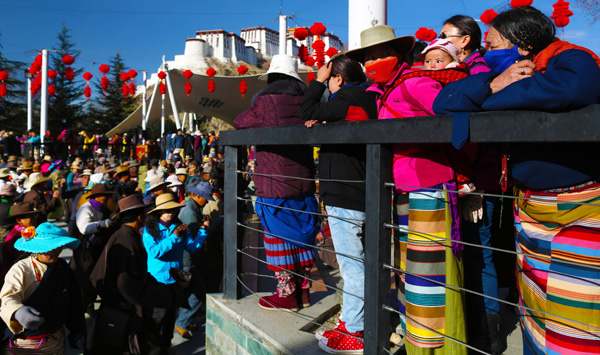
People perform the Tibetan Guozhuang folk dance in March at Zongjiaolukang Park in Lhasa, the Tibet autonomous region. Photo by Zhu Xingxin / China Daily |
Tibet's continual progress on its present path of development is an objective requirement of modern civilization. This accords with the progressive trend of human society, the prevailing conditions and the current reality in China, as well as the fundamental interests of all ethnic groups in Tibet, says the white paper, which was released by the Information Office of the State Council.
However, the report points out that there is a party that clusters around the 14th Dalai Lama, representatives of the remnants of the feudal serf owners who have long lived in exile, driven by a political goal of "Tibetan independence" and a sentimental attachment to the old theo-cratic feudal serfdom.
Having failed to instigate violence in support of their cause, they turned to the "middle way", which negates Tibet's sound development path and attempts to create a "state within a state" on Chinese territory as an interim step toward the ultimate goal of full independence.
The report accuses the Dalai group of being opportunistic in the talks with the central government.
"When they thought the situation was working to their disadvantage, they would call for contacts with the central government; when they thought the situation was in their favor, they would break off these contacts," it says.
The central government has followed a clear and consistent policy toward the Dalai Lama, it says.
"Only when he makes a public statement acknowledging that Tibet has been an integral part of China since antiquity, and abandons his stance on independence and his attempts to divide China, can he improve his relationship with the central government in any real sense," it says.
"The only sensible alternative is for the Dalai Lama and his supporters to accept that Tibet has been part of China since antiquity, to abandon their goals of dividing China and seeking independence for Tibet, and to begin to act in the interests of Tibet and the country at large," it says.
Development route
The report notes that the region first began to embrace modern civilization only after the People's Republic of China was founded in 1949.
Having gone through such important phases as peaceful liberation, democratic reform, establishment of the Tibet autonomous region and introduction of reform and opening up, Tibet has not only established a new social system, but also witnessed a leap forward in its economy and embarked on the path of socialism with Chinese characteristics.
The majority of Tibetans have shaken off the poverty that had dogged them for centuries, to enjoy a relatively comfortable life.
In 2013, the gross regional product of Tibet reached 80.8 billion yuan ($13.2 billion) while the per capita net income of rural Tibetans was 6,578 yuan and the per capita disposable income of urban ones was 20,023 yuan.
Tibet's population rose to 3.12 million in 2013, triple the figure in the early 1950s.
Violent incidents
The report presents a rich collection of evidence to prove that the Dalai Lama and his supporters have never abandoned the use of violence to promote their ultimate goal of "Tibetan independence".
According to the report, during the armed rebellion in Tibet in the late 1950s, the US Central Intelligence Agency not only sent agents to help the 14th Dalai Lama flee Tibet, but also trained militants to support his forces and airdropped a large quantity of weapons.
Since the 1980s, the Dalai Lama and his supporters have been behind a series of violent incidents in Tibet, including an incident on March 5, 1988, that led to 299 police and civilian casualties and the one on March 14, 2008, in which a total of 18 people were burned or hacked to death.
Since 2011, they have incited Tibetan lamas and lay followers inside China to engage in acts of self-immolation.
"For the Dalai party, 'peace' and 'non-violence' are no more than fig leaves," the report says.
Central government's efforts
Since the Dalai Lama fled abroad in 1959, the central government has exercised great restraint and done its best, the report says.
"However, he (the Dalai Lama) has repeatedly made choices that run counter to the wishes of the central government and the people of Tibet," it says.
The central government received 13 visits by private representatives of the 14th Dalai Lama between 1979 and 2002, and 10 visits from 2002 to January 2010, according to the report.
In 2011, the Dalai Lama announced his "political retirement", and his private representatives who had kept contact with the central government also "resigned".
Since then, the Dalai group has declared that it would only talk with the central government in the name of the "government-in-exile", thereby destroying any basis for contacts and negotiations, which have been halted, the report says.















