Mandarin takes root in Argentina
 |
|
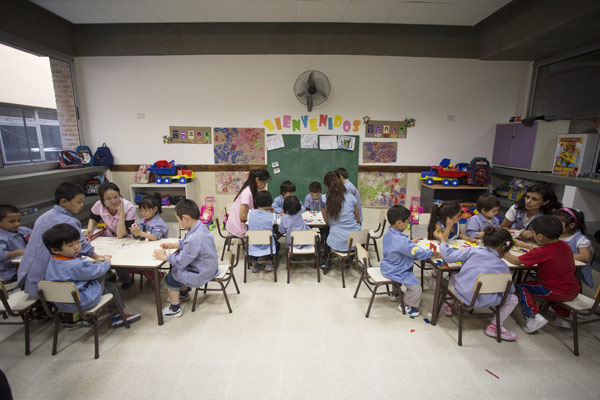
The first Chinese-Spanish educational experiment in Buenos Aires has been progressing smoothly, with the number of students doubling from 50 in 2014 to 100 in 2015, half of them Chinese. The school hopes to eventually have some 400 students. [Photo by Ye Shuhong / For China Daily] |
Argentina's capital Buenos Aires is home to the world's first Chinese-Spanish bilingual public school, an educational boon for local residents and a dream come true for thousands of Chinese immigrants in Argentina who have long worried about their children's lack of Chinese education.
Three years ago, Xue, the Chinese mother of six-year-old Maomao, struggled with the decision to send her only child back to China. "It was a tough decision, but I had no choice," she said.
By the time he reached the age of three, the Argentina-born Maomao was speaking more Spanish than Chinese, which was a problem because his mother couldn't understand him.
"I want to communicate well with my son and that would not have been possible if he had grown up here speaking only Spanish," Xue said.
Running a supermarket, 30-year-old Xue was too busy to teach her son Chinese, but believed that "as a Chinese, he should learn his mother tongue well first".
Xue is not alone among the 120,000 Chinese immigrants in this country.
About 2,000 babies of Chinese descent are born in Argentina every year, and before the Chinese-Spanish bilingual school, most parents would make the tough decision of sending their children back to China for primary school, despite the anxiety caused by the separation.
Things have changed since the bilingual school opened on March 17, 2014, thanks to a joint effort between the governments of Buenos Aires and Beijing.
Xue brought her son back to Argentina immediately at the news. "Getting a Chinese education here is a dream come true," she said.
Maomao, a member of the freshman class, has adapted well to the bilingual environment, and has made many friends among both the Chinese and Argentine children enrolled.
Over the past year, the Chinese-Spanish educational experiment has been progressing smoothly, with the number of students doubling from 50 to 100, half of them Chinese. The school hopes to eventually have 400 students.
The school has grown from initially offering only kindergarten and preschool to the first and second grades of primary school. Students study in Spanish in the morning and in Chinese in the afternoon.
Along with the fast development of Sino-Argentine relations and the growth of the Chinese immigrant community, the demand for Chinese education has also been growing.
While Chinese immigrants want their children to maintain their heritage by speaking their mother tongue well, many Argentine families want their children to learn Chinese, so they will be more competitive in the labor market as adults.
"It's a historic moment for the city's public education," Buenos Aires Mayor Mauricio Macri said at the opening ceremony. "The bilingual school will play a significant role in the fusion of different cultures."
"I believe that this immersive bilingual education will cultivate real international talent with bilingual ways of thinking," said Carlos Regazzoni, manager of the program at the city's educational bureau, who has also started to learn Chinese himself.
Chinese's popularity has been increasing as well in the world of business in pace with the development of economic relations between the two countries.
A growing number of international trade experts in Argentina are interested in learning Chinese, reflecting China's expanding role in global commerce.
To meet the demand, the Industrial and Commercial Bank of China (ICBC) foundation in Argentina will be offering a Chinese-language class for beginners starting in May.
Ezequiel Eborall, the foundation's head of strategic planning, said that China's increasingly prominent role in international trade and the interest that has been generated among companies to expand their trade ties with the Asian nation led the ICBC Foundation to offer the course as an additional tool in the training of specialists in international trade.
"There's a lot of interest in learning China's language and culture," said Yesica Rossi, head of ICBC foundation's outreach.
Learning Chinese is part of the larger process of becoming familiar with China's history and culture, which they see as "key for Argentine companies looking to enter the Asian market", Rossi said.
China is now Argentina's second-largest trade partner, after Brazil, and the second-biggest market for Argentine agro-industrial products.
"The course is designed to be more than just a traditional language learning course," said Eborall. "It aims to bring (students) closer to understanding and appreciating a different culture."
"We've seen that it is increasingly important to learn about the culture of other countries in doing international business, that's why we have given special emphasis to the training of specialists in international trade," added Rossi.
The course is divided into four modules: an introduction to the history and geography of China, and the Chinese language; the Hanyu Pinyin transcription system for phonetically writing down Mandarin using a modified Latin alphabet; basic grammar and vocabulary; and writing Chinese characters, or Hanzi.
Based on last year's experience, Eborall said he expects between 15 and 20 students to enroll in the course, "the ideal number for studying a language from the beginning".
Argentine professor Federico Youtchak, a devotee of Chinese culture and language who has studied in China, will be teaching the class.