


FDI rises 17% in Jan-Feb
Investment inflows surge from Germany, France and Saudi Arabia
China's foreign direct investment rose 17 percent year-on-year to $22.48 billion in the first two month of this year, with three countries - Saudi Arabia, France and Germany - registering the fastest growth rates, the Ministry of Commerce said on March 17.
FDI inflow from Saudi Arabia surged 873.8 percent year-on-year to $240 million, and that from France rose 366.7 percent to $280 million. Investment from Germany jumped 59 percent to $410 million.
|
The assembly line at a Daimler AG manufacturing plant in Minhou, Fujian province. Investment from Germany jumped 59 percent year-on-year to $410 million through the first two months of the year. Photos provided to China Daily |
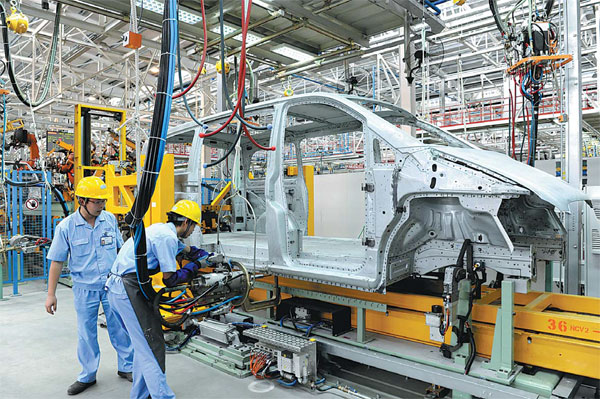
Shen Danyang, spokesman for the ministry, said the biggest investments were in big-ticket industrial projects in the automobile, power and chemical industries.
Germany's Daimler AG, Arkema Asie SAS of France and Saudi Basic Industries Co all made significant commitments in China on new projects and expansions of existing manufacturing facilities.
"As China readjusts the industrial structure of its low-end manufacturing and heavy industries and develops new growth points from services industries such as e-commerce, transportation and logistics, the service sector has become the new growth engine driving the inflow of foreign investment," said Shen.
FDI into the nation's service sector hit $13.73 billion in the first two months, a 30 percent increase from the same period a year earlier and accounting for 61 percent of total FDI during the period.
Along with the rise in the amount of FDI, the number of newly registered foreign-funded companies also jumped significantly, by 38.6 percent, in the first two months, to a total of 3,831 companies, according to the official data.
The Hong Kong Special Administrative Region, Taiwan, South Korea, Singapore and Japan were the next top five sources of investment.
Wang Zhile, a senior researcher at the Chinese Academy of International Trade and Economic Cooperation, said that even though some foreign companies had been affected by rising operating costs and the general slowdown in the Chinese economy over the past two years, on the whole their revenue growth had remained stable, and has been faster than in other regional markets since the global financial crisis of 2008.
"China is a big market with 1.36 billion consumers and is still capable of completing a lot of big-ticket infrastructure and public service projects, which still need a lot of goods and services and technical solutions from foreign manufacturers as well as service providers," said Wang.
The continued depreciation of the euro will attract more outbound direct investment from China, leaving the world's second-largest economy firmly on track to gain more advanced European technologies, assets and human capital.
Boosted by China National Petroleum Corp's $2.89 billion investment in the Netherlands in the first two months of the year, China's ODI into the European Union soared 950 percent year-on-year to $3.36 billion by non-financial companies during this period, according to the Ministry of Commerce on Tuesday.
Shen Danyang, spokesman for the ministry, said though the global demand for investment is still huge, Chinese investors are more inclined to choose Europe and the United States as these markets have well-developed industrial and infrastructure foundations, as well as a mature consumer group and legal environment.
"The depreciation of the euro has lowered Chinese companies' costs as they acquire European companies or set up overseas branches to further expand their international presence and market share," said Shen.
ODI by non-financial firms surged 51 percent to $17.42 billion in the first two months of the year, with the EU, the Hong Kong Special Administrative Region and the Association of Southeast Asian Nations being the top three investment destinations.
However, Shen said the depreciation of the euro has put more pressure on Chinese exports to the European markets, in particular high value-added products.
zhongnan@chinadaily.com.cn















