


Merck's clear vision in China
After breaking ground in jiangsu province on what is to be its second-largest pharmaceutical plant worldwide, firm expects $1 billion in medicine sales in the nation by 2020
Karl-Ludwig Kley, chairman of the executive board at Merck, says among the emerging markets that are the company's main drivers of sales growth, China is the rising star.
In the 2014 annual report for Merck, the German pharmaceutical and chemical company, sales grew by 5.5 percent to 11.3 billion euros in 2014, while total revenue rose by 3.7 percent to 11.5 billion euros.
|
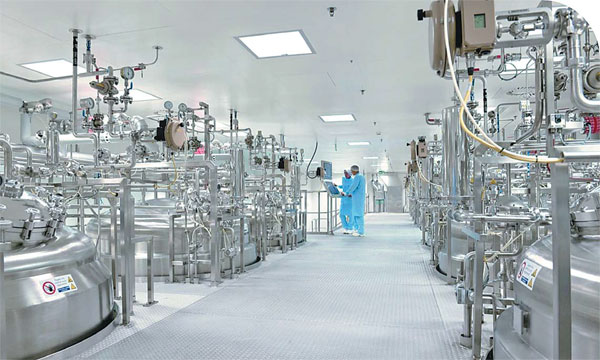
Merck Serono biotech center in Corsier-sur-Vevey, Switzerland. By 2017 Merck will complete its second-largest manufacturing site in Nantong, Jiangsu province. Provided to China Daily |
According to the report, which was released this month, sales from emerging markets accounted for 38 percent of total sales, surpassing the European market (35 percent) for the first time.
"The term 'emerging markets' is no longer accurate because they are already a reality for us," Kley says. "For example, South Korea and Taiwan are tremendously important particularly for our performance materials business; meanwhile, Turkey and Brazil are also of great importance to us."
Established in Darmstadt, Germany, in 1668, Merck operates in 66 countries with 39,000 employees. It has three major business sectors: healthcare, life sciences and high-performance materials.
The healthcare sector was the biggest contributor to the company's revenue last year, with emerging markets again playing an essential role.
Merck Serono, the company's biopharmaceutical business, recorded a 3.6 percent jump in sales in 2014.
"The business performance of marketed medicines was robust in 2014, and we set a milestone in developing our pharmaceutical pipeline by forming an immuno-oncology alliance with Pfizer. This will help us to fully exploit the potential of our anti-PD-L1 compound," says Kley, referring to the antibody compound that activates an anti-tumor cell response.
The 2014 report showed that all business units delivered returns, and the sales of liquid crystals delivered the largest contribution to total sales.
"We benefited from the strong demand for high-quality and large televisions, such as ultra-HD devices," Kley says.
"Merck is not only benefiting from the trend of digitization, but is also actively helping to shape it, such as developing energy-saving and thus battery-saving display materials," he adds.
The company declined to release its sales figures from the Chinese market, but Kley says its products are well-received in China and he is satisfied with the company's performance.
"We made a lot of investments in China in 2014, be it manufacturing, customer relations centers or R&D facilities," he says, adding that these investments will gradually deliver returns in the near future.
In August, Merck's 80 million euro manufacturing base broke ground in Nantong, Jiangsu province. It is expected to be the company's second-largest pharmaceutical manufacturing site in the world after its completion in 2017 and will produce its flagship medicines that treat diabetes as well as thyroid and cardiovascular diseases, which are prevalent in China.
Belen Garijo, then president and CEO of Merck Serono and now member of the executive board, says the company has a clear vision in China.
"By 2020, we will achieve $1 billion in sales and during this process we will keep bringing new medicines to the country."
For the time being, the United States is still the most important market in the pharmaceutical sector, Kley says.
He says the overall sales of medicines in the US account for 35 percent of the global pharmaceutical market and companies in the US are continuing to heavily invest in research and development in bioscience and life science technologies.
Nevertheless, over the long term, the emerging market will make more contributions, he says.
Merck has a number of divisions in China besides its pharmaceuticals.
In the healthcare sector, its Allergopharma unit researches, produces and distributes medicines for allergies. In the high-performance materials sector, it has display and integrated circuit materials. And its life sciences unit Merck Millipore provides customized lab and process solutions and applications for Chinese customers.
Unlike many multinationals, Merck says it will not agree to a joint venture in China to accelerate expansion.
"What we bring to markets are not only products but also solutions, so local partners can only participate in a limited sense. That's why we don't usually have joint ventures. This is our approach in China," Kley says.
He says the company's Chinese clients are "very demanding" and have highly technical requests.
"The Chinese biotech industry is developing very rapidly and local biomedical companies are very specific on what kind of support they want from our Millipore unit and in the materials sector. Chinese manufacturers are looking for reliable suppliers to build their products to meet global standards."
Every country has specific needs, and China is no exception, he adds.
"In the pharmaceutical sector, for instance, certain thyroid diseases are more prevalent in China than people think, and we want to help the Chinese government to be aware that there is such a disease and we can do something about it."
Globally, the company is currently working to consolidate its immuno-oncology alliance with Pfizer and to complete an acquisition of US life science and high-tech company Sigma-Aldrich.
In the Chinese market, the company has pledged to continue its involvement in the nation's medical reforms, especially in providing essential medicines.
"The challenge of medical reform is enormous," Kley says. "Currently China has price controls for every essential medicine, and actually, 99 percent of countries in the world have price control mechanisms. I personally don't think a price-control mechanism is an effective way to benefit the people worldwide. It is more important to provide access to medicines by insurance, by government policies and by initiatives from pharmaceutical companies."
"A price mechanism can only work to a limited extent. A more effective way would be to institute a mature reimbursement system for essential drugs so that the medical rights of the poor could be guaranteed," he says.
The economic slowdown in China has not weakened Merck's confidence in the market, Kley says.
"China still has good growth momentum, which we would love to have in Europe. Even if we have a single digit growth in China, the overall growth in the country is still over-proportional. In a word, we will stay committed to China."
Kley says the company is undeterred by the Chinese government's antitrust probes of multinationals last year.
"Every country has its own rules, so if you are a global company, it's our companies' job to deal with different laws and regulations, and we are going to support the political regime where we are and we will have dialogue with the government if we need to."
wangchao@chinadaily.com.cn















