


Tech giant in Beijing air quality drive
Ten-year research project will tackle capital's dire air pollution problems
IBM, the technology and consulting firm, has teamed up with the Beijing government on a smart city initiative to coordinate efforts for pollution reduction in China.
Green Horizon, a 10-year research program, sets out to leap beyond current global practices in three areas critical to China's sustainable growth: air quality management, renewable energy forecasting and energy optimization for industry.
The collaboration will leverage some of IBM's most advanced technologies such as cognitive computing, optical sensors and the internet of things all based on big data and analytics platform and drawing on IBM's deep experience in weather prediction and climate modeling.
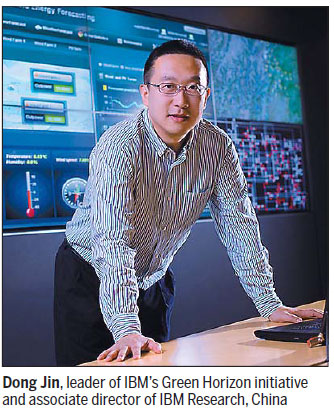
"IBM has a long history in technology. Based on our capability, we can support Beijing and other cities in China to address their pressing needs of reducing environmental pollution," says Dong Jin, leader of IBM's Green Horizon initiative and associate director of IBM Research, China.
Dong says reducing pollution for China is particularly important for its next chapter of sustainable growth.
One focus of the Green Horizon project is forecasting air quality, and using technology to track the source of key pollutants, so that the government can use this data to tackle pollution in a focused and effective way, while at the same time minimizing the impact on economic growth.
The technology will pinpoint the type, source and level of emissions and predict air quality in the city. IBM's cognitive computing systems will analyze and learn from streams of real-time data generated by air quality monitoring stations, meteorological satellites and IBM's new-generation optical sensors - all connected by the internet of things.
By applying supercomputing processing power, scientists from IBM and the Beijing government aim to create visual maps showing the source and dispersion of pollutants across Beijing 72 hours in advance with street-scale resolution.
Led by IBM's China Research laboratory, the initiative will tap into the company's network of 12 global research labs and create an innovation ecosystem of partners from government, academia, industry and private enterprise.
One of the first partners to come on board is the Beijing government. Through a collaboration agreement, the two parties will work together to develop solutions that can help tackle the city's air pollution challenges.
Dong says such research is being done for the first time in the world, and for IBM the research output is valuable, and can be applied to other cities globally in the future.
He says this research is done in China because the Beijing government has a keen commitment to pollution reduction.
For example, Beijing will invest over $160 billion to improve air quality and deliver on its target of reducing harmful PM2.5 particles by 25 percent by 2017.
Dong says his team will be working closely with the Beijing government, refining the solution over time in cooperation.
Another key feature of the technology are "what-if" scenarios. For example, the system would model what would happen to Beijing's air quality if the manufacturing or production in surrounding areas was being reduced, so the government can make their policies accordingly.
Dong says that from a technological perspective, such a solution is innovative and challenging because it requires the collection of many different types of data and using mathematical models to determine the exact source of the pollution.
He says the data collected by the program can serve as a baseline situation, from which the Beijing government can adjust and judge many variables to achieve pollution reduction.
For example, they may set different requirements for traffic reduction, factory production reduction, and restrictions for pollutants from surrounding cities, and having the data is a helpful way to assist such decisions.
He says controlling air pollution in China is an activity that requires a systematic approach, because it is a comprehensive issue with many elements, such as energy technology, utilization of renewables, and environmental technology, and all these are areas IBM hopes to use its technology to help China with.
As such smart city initiatives are relatively new, China's commitment and investment into this field has made it a leader in this sector, Dong says.
"China is in a unique position because there is a market need to reduce pollution. China has the opportunity to lead the development of new technology, because many great technologies come from market needs," he says.
Such technology, once developed, can also be used in other international markets, and especially developing markets, which are facing the same challenge as China with environmental pollution issues resulting from rapid economic growth.
"We can better use technology to tackle these problems, and we can make societies more harmonious," he says.
IBM has been a partner to China's modernization program since the 1970s, providing computing systems and services to government, industry and scientific research. Today China is home to a number of IBM laboratories and development centers including one of its 12 global research labs.















