


Example for China in dealing with pollution
Scotland's ambitious targets for reducing its carbon emissions
China needs a set of solutions including technology, regulation and a business model to reduce air pollution in the coming years, an expert on low-carbon emissions says.
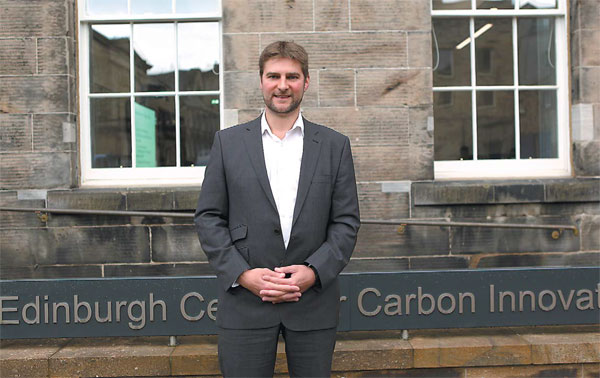
Andy Kerr, executive director of the Edinburgh Centre for Carbon Innovation, knows a lot about low-carbon policies and how they are implemented. He has used his extensive experience of working with governments, businesses and academics to drive the strategic and practical development of the center since he became its director four years ago.
|
Andy Kerr, executive director of the Edinburgh Centre for Carbon Innovation, says that China needs a set of solutions to combat air pollution. Zhang Chunyan / China Daily |
Tackling the problem of air pollution is perhaps one of the biggest challenges China faces, he says, adding that he can see the effort the government is putting into this and the changes that are occurring.
"We are seeing really big changes already if you look at the Beijing municipality's statements about not being able to use coal beyond 2020. We are already seeing quite big statements about what they intend to do."
Beijing's Municipal Environmental Protection Bureau posted the plan on its website in August, saying the city would give priority to electricity and natural gas for heating.
Coal accounted for a quarter of Beijing's energy consumption in 2012 and 22 percent of the fine particles floating in the city's air, according to official figures. Motor vehicles, industrial production and general dust also contributed to pollution in the smog-plagued capital.
Pressure is growing on China's central government to deal with environmental pollution as discontent over smog and water and soil contamination increases among the country's expanding middle class.
"From our perspective a problem like that needs two or three different solutions," Kerr says. "One is obviously technologically. There are ways of reducing particulates; there are ways of reducing pollution that is caused by different activities."
However, Kerr stresses that it is not just a technical solution but also an entrepreneurial one that is about how to find new products and services that allow people to retain the lifestyle they are accustomed to minus the pollution.
"There is a bit about how you finance it, because if you're talking about coal making up about 25 percent of the energy mix of the city, how do you replace that? Now, that will require investment. How do you have a business model that allows people to change what they are doing in a way that delivers a financial return on investment but delivers the outcome that you want?"
Kerr believes that the solution is cultural and political, and one requiring strong legislation. While many people tend to focus on the technical fix, that is only part of the solution, he says: "It's actually partly regulatory, partly what the governments do, partly consumers, how they respond, partly its financial and getting the financial models right. Partly it's about entrepreneurship and about building an entrepreneurial sense of new products or services coming in to replace those that are not fit for purpose.
"It is when you've got all of those in one place that you'll start to see cities changing fairly radically."
He cites Britain in the 1950s, "where we had horrible smog and pollution, even in Edinburgh, that required very strong legislation, which simply said we are not going to have any open fires or coal fires in houses".
So China needs strong regulations, he says, adding that technical fixes exist, good business models allow communities to change the way domestic and industrial energy is generated, and that a combination of all these will deliver the desired results over four or five years.
Before Kerr joined the carbon innovation center, he had worked with companies to develop both strategic and practical management responses to emerging opportunities and legislation.
His public policy work has focused on developing effective national and regional policy frameworks that support reducing dependence on fossil fuels and greenhouse gas emissions.
Now the Edinburgh Centre for Carbon Innovation is acting as a place that can bring people together to talk about solutions, some of which will work in some places but not others.
"Look at how many countries, how many regions, how many cities around the world have a desire to try to reduce their greenhouse gas emissions, reduce or manage their energy consumption. And yet if you look around the world the evidence is that everyone has struggled to do it; every country has found it hard to deliver on the ground."
One of the problems has been that everyone has been working alone, businesses have talked to businesses, and governments have tended to talk among themselves, as have academics.
So the center is arguing that the only way to solve this problem is to bring all these different people with many good ideas together to find solutions.
Looking at how Scotland can work with China in the low-carbon area, he says: "It's not saying, 'We did it this way in the 50s so you should follow it.' It's a completely different scenario, so we can allow different ideas and models and say, 'This is what they did in Germany, this is what they did in Mexico, this is what they did in Scotland. Perhaps you can try your best brain and tweak bits and try different things. They really focused on the policy; they really focused on technology; they really focused on the economic models; each had failures.'
"That's what we're trying to do, to look at these. We did not have a lock on the good ideas but we hope we're acting as a broker for those ideas, and we're very willing to share."
Kerr says the center was set up where it is because Scotland has very ambitious targets, wanting to reduce greenhouse gas emissions by 42 percent by 2020, and by 80 percent by December 2050.
"It has been agreed by the Parliament that there is now a legal mandate to make that happen. If you think about the changes that are required in order to do that, within a generation we cannot be driving cars which use petrol and diesel, you can't be generating energy in a power station from coal, oil or gas, unless you're using carbon capturing storage, and still hit those targets.
"You can't heat homes with natural gas and still hit that target. The Parliament has mandated absolutely radical changes to the ways in which we produce and use energy."
The critical thing is how to pay for such changes, get communities to buy into them and create the regulations to make them happen.
One of Scotland's goals is for all its electricity to come from renewable sources by 2020.
"We are not going to get to 100 percent but we should get pretty close, like 80-90 percent of our electricity from renewable by 2020."
In China, as talk of the air quality index has become a national pastime, and as air-quality apps have become a staple of smartphones, the government has listed environmental protection as one of the top criteria by which leaders will be judged.
"It's perfectly achievable but it does require engagement across all the related pieces," Kerr says.
Carolynn Look contributed to this story.
zhangchunyan@chinadaily.com.cn















