New FTZs a signal to Shanghai
China's State Council has decided to set up three new free trade zones in Guangdong, Tianjin and Fujian to explore new reforms together with the first FTZ created last year in Shanghai.
Shanghai FTZ's main achievements are making business registration easier and promoting "negative list" models to restrict government power, which is disappointing given its mission as an explorer of key reforms for the nation in crucial areas, such as finance, trade and governance.
The three new FTZs exposed the central government's dissatisfaction with Shanghai FTZ's performance, and the central government's confidence with the FTZ model, a de facto experiment to control the possible risks of piloting new practices.
Unlike the Shenzhen special economic zone set up by China's former leader Deng Xiaoping in the early 1980s, which was to test whether to abolish the planned economy, the FTZs today test how to build a market economy better fitting China's domestic situation and international status.
Shenzhen received dividends from Pareto improvement, which benefited almost all parties involved. What the Shenzhen officials needed to overcome was the dogmatism developed before the end of the "cultural revolution" (1966-76).
Yet, it takes more to run FTZ, as the past year of Shanghai FTZ indicates. The FTZ administrators must have the ability to coordinate department interests, one of the main obstacles for deepening reforms.
According to Premier Li Keqiang, setting up the FTZ is to balance the relations between government and the market, opening up and development as well as exploring new reforms in important areas.
Six months ago, the central authority turned down the applications from dozens of cities to set up new FTZs, saying FTZs will not enjoy tailor-made preferential policies, to cool down local governments' passion and make them aware of the difficulty of running an FTZ.
The central government's dissuasion paid off. Last month, only Shandong, Zhejiang, Jiangsu, Guangxi and the three final winners insisted in applying for setting up FTZs, whose ambitions may partially stem from Shanghai FTZ's lackluster record and their unique positions in China's economy and foreign trade.
Shandong is the most popular destination for investment from South Korea in China.
Jiangsu and Zhejiang are the two largest manufacturing centers in China having global connections.
Guangxi is the front line in China's cooperation with Southeast Asia.
Guangdong's advantage is its close connection with Hong Kong and Macao.
Fujian is a neighbor with Taiwan.
Tianjin's financial sector is stronger than Shandong's, and can serve as a strong foothold in China's trade with Northeast Asia.
Shanghai FTZ will continue its exploration in general reforms in financial, trade and governance sectors. The three new FTZs will implement Shanghai FTZ's new fruits in their trade with respective trade partners, and also explore possible reforms in the aforementioned key areas as a competitor with Shanghai.
Guangdong, Jiangsu, Shandong, Zhejiang and Fujian's combined economy accounts for about 40 percent of China now, which is made up of more than 30 provincial regions.
According to the applicants' plan, the three new FTZs are much larger than Shanghai FTZ, which is 28.78 square kilometers. Tianjin FTZ is 260 sq km, Fujian FTZ can be as big as 550 sq km, and Guangdong FTZ covers an area of 940 sq km.
Apart from the explosion of size, some changes are predictable. It will be easier to invest and trade in the FTZs. More foreign capital will enter China through these FTZs, and vice versa.
Shanghai FTZ will continue its exploration in general reforms in financial, trade and governance sectors. The three new FTZs will implement Shanghai FTZ's new fruits in their trade with respective trade partners, and also explore possible reforms in the aforementioned key areas as a competitor with Shanghai.
liyang@chinadaily.com.cn
|
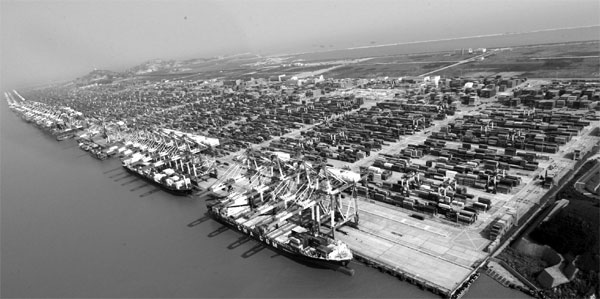
Yangshan port in the Shanghai Free Trade Zone in September, at the first anniversary of the FTZ. Fan Jun / China Daily |