


Sino-US climate deal 'signal to the rest'
Surprise accord has created mood of optimism ahead of key paris conference next year
United Nations environment chief Achim Steiner says China's climate deal with the United States is not an excuse for other nations to "sit around" and do nothing.
The world's two biggest economies announced a negotiated deal to reduce their greenhouse carbon emissions at November's APEC (Asia-Pacific Economic Cooperation) gathering in Beijing.
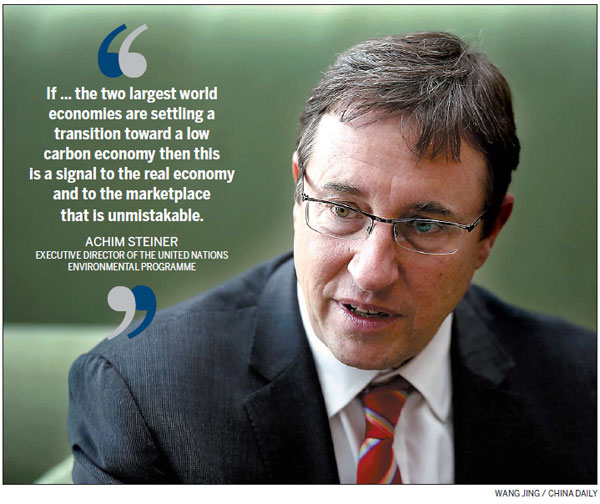
"Even China and the United States cannot solve the climate problem alone. If that was possible, it would just be the case of these two countries agreeing and we all sitting around," he says.
Steiner, the popular and urbane 53-year-old executive director of the United Nations Environment Programme, or UNEP, was speaking in the lobby of the Diaoyutai State Guest House in Beijing.
The lake and the tranquil landscaped gardens outside might suggest the Chinese capital did not have any environmental problem.
Despite Steiner's caution, the surprise APEC accord has created a new mood of optimism about an overarching deal on climate change being reached.
After the Lima Climate Change Conference (which concluded on Dec 12) all eyes are now on next year's key Paris Conference, the first major climate summit since Copenhagen 2010, which ended in a failure to reach agreement, particularly one that China and the United States would sign up to.
Steiner says the problem with Copenhagen was trying to go too fast too soon.
"Copenhagen in a strange sort of way was an ambitious attempt to bring the world to a common place faster than we perhaps could.
"People often criticize the United Nations and the climate change negotiation process but forget the fact it is only 22 years old. You are essentially trying to reconcile 193 nations that have contrasting economies and societies at different stages of development. That is an almost unprecedented historical project."
Steiner was in Beijing in his role as vice-chair of the China Council for International Cooperation on Environment and Development, or CCICED, which was holding its annual general meeting.
He says the China-US deal in which both countries have agreed to reduce their greenhouse gas emissions does remove a major obstacle to progress.
"It has sent an enormously important signal because for many countries the China-US impasse was an excuse not to act. That reason has now shifted," he says.
"If also the two largest world economies are settling a transition toward a low carbon economy then this is a signal to the real economy and to the marketplace that is unmistakable."
Steiner is confident Beijing, which did experience clear blue skies during the APEC meeting in November when much of the city's industry was shut down and half the cars taken off roads, could have relatively clean air itself by 2030.
"I think that is the intention and ambition of China today. We certainly have far greater technological opportunities (open to us). One of the super critical power stations I visited yesterday in Beijing is now the standard for those being constructed and commissioned in China."
Steiner, who holds both Brazilian (having been born in the country) and German nationality and who had a classical English public school education, is almost a United Nations project in his own right.
After degrees at Oxford and the School of Oriental and African Studies, University of London, he began his career with the GTZ, Germany's overseas aid government department.
He has held a series of environmental and development posts such as dealing with conservation issues in southern Africa and being chief technical adviser at the Mekong River Commission in Vietnam in the 1990s.
Before taking up his current role in 2006, he was director-general of the IUCN (International Union for the Conservation of Nature).
Now based in Nairobi, where UNEP has its headquaters, he is a veteran of the machinations of climate change talks.
Steiner says the debate has moved on from a decade ago when going green meant adopting a hair shirt mentality by reducing your carbon footprint by giving up your car and flying - the latter certainly difficult for any United Nations official.
"That was the level of debate 10 years ago and there will be still those who would make us go back into huts and not use electricity, a monastic agenda. There are those that still take this ideological stance."
He says that with advances in renewable energy it is possible for countries like China, India and the African continent to become developed without the planet being destroyed.
"The argument that this can't happen in many respects is now irrelevant. Countries can now develop and provide for the needs of their citizens by essentially decoupling their economic growth from the environmental costs we have seen in the past.
"There are countries now that are producing 40, 50 or 60 percent of their electricity with renewables. We know that in the middle of the second half of the century we have to reach a point of zero net emissions because we can only emit as much as the planet will reabsorb."
He believes that within 50 years the politics of energy will have been transformed.
"We have fought wars for well over two centuries over access to energy but renewables turn that all upside down. This is an epochal change."
Steiner says that although many African countries have a close relationship with China they do not want to repeat the environmental damage caused by its rapid economic development.
He points to Kenya, in particular, that is tripling its energy infrastructure over the next 5 to 7 years with new capacity that is 98 percent thermal, wind or solar power.
"This may surprise you but Africa actually was one of the first continents to engage in green economy discussions. About two years before the Rio summit (in 1992) a number of African leaders invited UNEP to engage with them. I think there was an early recognition that their economies significantly depend on their ecological wealth, whether it is agriculture, their extraordinary national parks, wildlife and coastlines that generate tourism."
One major concern for UNEP is illegal ivory trade, which was one of the major issues discussed at a high level meeting of environment ministers in Nairobi in June. It is estimated that some 30,000 to 40,000 elephants have been killed in the last few years and that China remains a major market for illegal ivory.
Steiner says the work of Chinese actress and singer Li Bingbing in her role as UNEP goodwill ambassador has been influential in this area.
"Many people still think you can extract ivory from an elephant and it just walks off.
"We can work with governments and customs authorities but at the end of the day it is the Chinese public who will make ivory something you will not buy. If you take the current numbers of killed poached elephants and compare it to the 450,000 to 600,000 elephants left in Africa we are in a serious situation. If you take the white rhino the population is now less than 20,000."
On wider environmental issues, Steiner is impressed by China's efforts to deal with the environmental degradation caused by its rapid development over the past 30 years.
"The tension being played out in China is one between economic progress and environmental sustainability and whether they can be reconciled or continue to be at cross-purposes," he says.
"I think it is often not well appreciated by those who don't spend time in China that the way it is addressing its environmental legacy is among the most ambitious and rapid policy shifts ever attempted."
Jiao Xiaoli contributed to this story.
andrewmoody@chinadaily.com.cn















