Businesses cite biggest barriers in Africa
|
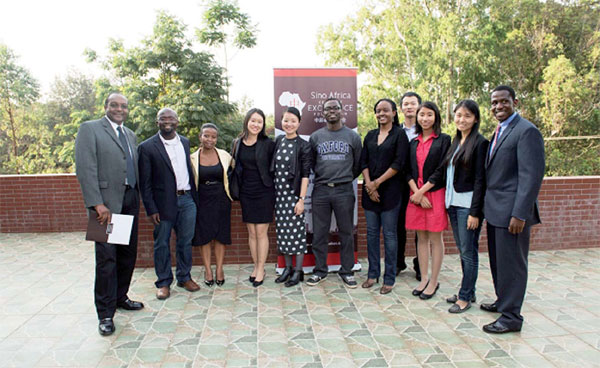
The team of the Sino-Africa Center of Excellence Foundation in Kenya. Provided to China Daily |
foundation conducts survey to eliminate the obstacles future investors in kenya must deal with
Chinese investors and potential investors have long regarded a good China-African relationship as a solid basis on which they can build success. But often when the uninitiated finally step onto African soil they realize how simplistic the term "China-Africa relationship" really is.
They then become aware of how extremely diverse African countries are in their business practices, culture, language, legal systems and politics. They then have to ask themselves how they are going to meet the challenges that are peculiar to whatever country or countries they want to deal with.
The answers to many of their questions are likely to prove elusive, particularly given that answers specific to many African countries are hard to come by, and given that Chinese investors come to the task with their own particular habits and demands.
The Sino-Africa Center of Excellence Foundation is set to publish a report on the characteristics and challenges for Chinese companies as they relate to Kenya and hopes to bring out reports relating to other African countries in the future.
The Business Perception Index Survey-Kenya, conducted by the SACE Foundation in Kenya, was developed to give people an understanding of the characteristics of Chinese companies in the country, to help them understand the business and investment climate Chinese companies face, and to give them an idea of how these conditions affect productivity and growth of Chinese companies in the country.
"For a long time, Chinese enterprises' obstacles to doing business in Africa have never been clearly pointed out or evaluated," says Wang Yuan, researcher for the project.
"So we are doing this to give a pointer to future investors in Kenya, doing what we can to lower barriers or get rid of them."
Fifty-three percent of the 75 Chinese companies sounded out in the survey said corruption is "a very significant obstacle" to doing business in Kenya, and 15 percent said it is "a significant obstacle". Sixty-three percent of respondents said crime, theft, disorder and personal safety were significant or very significant obstacles.
Sixty percent of the companies reported losses related to theft, robbery, vandalism or arson, even though 71 percent of the companies had employed security services last year.
For the survey the organizers contacted 184 Chinese private and state-owned enterprises by telephone and e-mail, of which 75 agreed to take part.
Thirty-eight of the enterprises are in manufacturing and construction and the rest in the services sector, Wang says.
A report published by Ernst and Young last month said Kenya's private sector had been listed among the world's most corrupt, the Kenyan newspaper Business Daily reported. One in three Kenyan companies surveyed said they had paid bribes to win contracts.
"More than a quarter, or 27 percent, of the chief executives, financial controllers and internal auditors surveyed in Kenya cited high levels of fraud in their companies, only lower than 44 percent in Egypt, 30 percent in Nigeria and 28 percent in Namibia," the paper said.
"Their actions are mainly driven by pressure to perform and achieve set targets," Miriam Gaituri, an associate director at Ernst and Young, was quoted as saying.
Peter Kahi, an Ernst and Young partner, was quoted as saying: "We found that when someone wants a bribe they delay services and so you feel you have to grease their hands for things to move faster."
Up to 90 percent of the interviewees said they had never been asked for a bribe directly, Kahi was quoted as saying.
But for Wang, she says corruption in a wider range didn't pose such a huge challenge to other international investors in Kenya, referring to a survey done by the World Bank indicating the average percentage of dissatisfaction toward corruption by international players was lower than that of Chinese companies.
"So Chinese companies need to be made more aware of bribery and information about business-related regulations and rules needs to be more widely disseminated. More training on Kenyan laws and regulations would help Chinese companies better identify their own flaws and deal with any false allegations by government officials."
Informal channels for disseminating information, such as nongovernmental Chinese organizations, are vital, she says, because they can help advise Chinese companies on how they should act in relation to tax, labor laws and intellectual property.
In a World Bank survey in 2012 that focused on foreign direct investment in Ethiopia, 69 Chinese enterprises doing business in the country answered 95 questions, including ones on the obstacles they faced in doing business in the country.
Trade regulations and inefficient customs clearance were considered the top impediments to smooth business in the country. Such problems were ranked as the sixth most serious in the Kenyan survey. Foreign exchange rate risks ranked second in the Ethiopian list, and physical safety did not get a mention.
Among other barriers on both lists, tax administration and workforce education were all listed as major obstacles.
Improving the education of workers is something that can be done through collaboration between employers and various institutions, says Lu Jinghao, project manager of the SACE Foundation.
"We are trying to establish mechanisms to connect Chinese employers and local schools, to see if it is possible to transfer skills from Chinese companies to local talent in a larger and more systematic way. The ideal thing would be for local students to receive proper, tailored skill and technology education and then to find a job after graduating."
The first stage of the Business Perception Index Survey-Kenya took about five months to complete, beginning in February, the manager says.
"The second stage is due to be completed next year, in Angola, Ghana, Nigeria, South Africa and Tanzania, before spreading to other African countries in the third stage."
The five countries were chosen because of the heavy presence of Chinese business activity, and they are also the next target markets for a SACE Foundation program that aims to bring more young talented Chinese to Africa to work as interns.
The plan is to carry out the survey in each of the six countries once every two years.
lilianxing@chinadaily.com.cn