Xinjiang shifts into top gear with high-speed rail
Sun Jiding will never forget the first time he traveled from Lanzhou, capital of Gansu province, to Urumqi, capital of the neighboring Xinjiang Uygur autonomous region, in 1983.
He was trapped in the train for 54 hours during the journey that covered nearly 2,000 km. "I looked out at the seemingly endless Gobi Desert and said to myself 'Xinjiang is just too far away'.
"But Xinjiang finally has a high-speed railway, which has brought us closer to the rest of the country and, most important, to Beijing."
Born in Lanzhou, the 52-year-old has since settled in Urumqi.
On Nov 6, when tickets for the new service between Urumqi and Hami city on the Lanzhou-Xinjiang high-speed railway were being sold for the first time, Sun excitedly checked the timetable at the Urumqi South railway station.
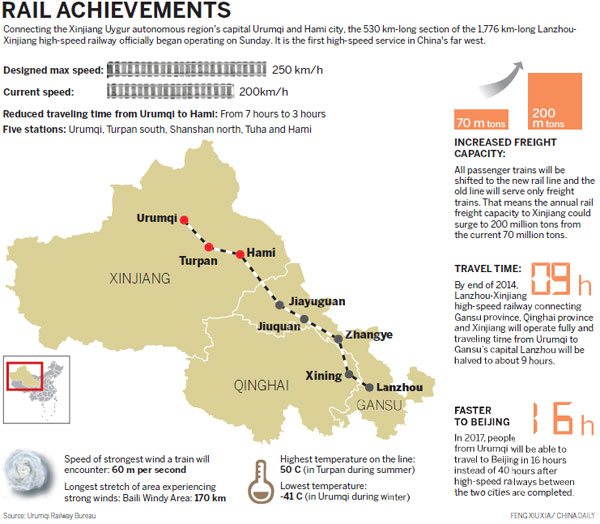
The 530 km service between Urumqi and Hami started on Sunday. It is the first high-speed service in China's far west and halves the seven-hour traveling time. First-class seats cost 196 yuan each and second-class seats 163.5 yuan each.
But Sun really wanted to find out when the whole 1,776-km Lanzhou-Xinjiang high-speed railway, which also passed through Qinghai province, would be in full operation.
"I was told by railway staff that it will take only nine hours to Lanzhou from Urumqi once the whole high-speed railway is running at the end of this year," he said.
"It's just unbelievable, compared with that 54 hour-journey I first took," he said, while sending a text message to his wife to tell her the good news.
"For many people, Xinjiang seems like a faraway and mysterious region at the western end of the country. Some still believe that we ride camels to work," Sun said.
"The long distance between the region and the rest of China has created communication problems and even misunderstandings."
"For visitors, the cost of traveling to Xinjiang, which accounts for about one-sixth of China's land area and boasts rich tourist resources, is their main concern. Due to the long distances involved, plane tickets are expensive and train journeys can be very long," said Hui Xinru, manager of the Xinjiang Kanghui Daziran international travel agency.
By 2017, train passengers from Beijing will be able to reach Urumqi in 16 hours instead of the current 40 hours after all high-speed rail links between the two cities are completed.
Once the Lanzhou-Xinjiang high-speed railway rolls out, the region expects more than 40 percent of its tourists to arrive on the new trains, which will help drive the development of regional tourism, said Ma Rui, deputy inspector of Xinjiang's tourism bureau.
The high-speed rail will shorten the traveling time between Xinjiang and other provinces, with people having more time to experience Xinjiang rather than spend most of the time on the road, Ma said.
"They are welcome to stay with the locals and have a better understanding of Xinjiang people."
Sun himself is thinking about taking a day trip to Turpan, which is one of the stops on the high-speed railway and takes less than an hour to get to from Urumqi.
Turpan is famous for its grape plantations, and local Uygurs still use traditional methods to make raisins. It is also known for its ancient irrigation system made up of wells linked by underground canals that channel mountain runoff to reduce the evaporation of water resources in the hot and arid area.
Tourism is one of the prefecture's pillar industries, and Turpan has received 3 million visitors so far this year.
The new railway is expected to draw 30 percent more tourists to Turpan. The local government has decided to offer discounts on tourist sites for visitors like Sun who take the high-speed rail, said Chen Shuguo, director of the prefecture's tourism bureau.
"A 'high-speed rail' fever has hit Turpan residents. We have been constantly thinking about the possibilities brought by it," Chen said.
Ma from the regional tourism bureau said the regional government will take advantage of high-speed rail to make tourism income account for 10 percent of the region's annual GDP, from the current 8 percent.
The surge in tourism will boost labor-intensive industries such as the services and handicraft sectors and generate more jobs.
Increased capacity
Zhang Tianshun stood patiently outside the Yolchilar blacksmith workshop in Urumqi's Erdaoqiao area.
He was waiting for workshop owner Bayiaji to inspect a traditional cooking grill, before shipping the order to southern China's Shenzhen city by railway.
"Bayiaji's grill is the best and all his products customized for buyers around China are transported by railway," said Zhang, manager of the Tianshun railway logistics company in Urumqi.
The Lanzhou-Xinjiang high-speed railway is expected to have a major impact on his and Bayiaji's business, the 47-year-old said.
When the high-speed railway starts, all passenger trains will gradually be shifted to the new line. The old line, which was opened in the early 1960s and runs lower-speed trains, will serve only freight trains. That means the annual rail freight capacity to Xinjiang could surge to 200 million metric tons from the current 70 million tons, said Ma Liangyuan, director of the transportation department of the regional development and reform commission.
"Increased freight capacity could lower the shipment cost, which will bring more business to me and make the price of Bayiaji's products more competitive," Zhang said.
Xinjiang residents have a common complaint - online stores often exclude them from free nationwide shipping because the costs are too high. But Zhang believes the high-speed link could change that.
The old Lanzhou-Xinjiang railway is the only rail link to ship goods to and from Xin - jiang. Its capacity has reached its limit and can no longer meet the surging demand, said Yan Hailong, deputy director of the regional development and reform commission's regional economies research institute.
During peak seasons, people face difficulties in shipping Xinjiang's agricultural products and other resources. That also affects the planned relocation of some industries from the country's coastal areas to the west, he said.
Zhang said his orders include large quantities of Xinjiang's famous dried fruit such as raisins, dates and apricots.
"I have no problem shipping dried fruit but I have to turn down orders of fresh fruit because I cannot guarantee they can arrive at their destinations before they begin to rot."
There will be fewer such interruptions after the old Lanzhou-Xinjiang railway is reserved for freight and he plans to try delivering fresh fruit by then, Zhang said.
Xinjiang is rich in coal and oil reserves. The cost and time taken to ship its coal to other parts of China will also be lower, which could contribute to China's energy security, Yan said.
In September last year, President Xi Jinping proposed during a visit to Kazakhstan that China and other countries build a modern Silk Road Economic Belt to boost cooperation and essentially revive the ancient trade route linking China and Europe that dates back more than 2,000 years.
To that effect, the latest high-speed rail development could help plug the gaps in connectivity and transport infrastructure.
"The increased freight capacity could significantly help to boost trade with neighboring countries and countries on the Silk Road Economic Belt, making Xinjiang a trade hub," Ma said.
"The high-speed railway will facilitate economic and social development in the autonomous region."
cuijia@chinadaily.com.cn