


GM food faces hurdle of fears
|
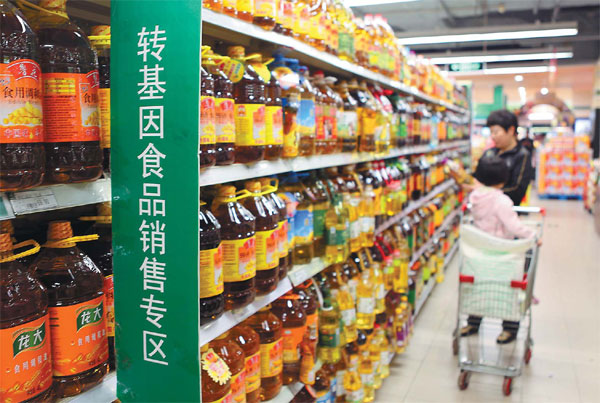
One product in China sold with genetically modified beans is oil. Provided to China Daily |
President calls for well-considered, cautious development of Genetically modified organisms
Chinese have long regarded them as hongshui-mengshou, literally severe floods and savage beasts, or the scourge of all scourges. But the recent publication of a speech by President Xi Jinping suggests that genetically modified organisms will finally be accepted in China.
In the speech, to the Central Rural Work Conference in Beijing about 10 months ago, Xi said the technology should be allowed to develop in the country so long as the right caution is exercised. Xi's comments were revealed last month when a collection of government documents was made public.
Compared with the United States and many South American countries that have adopted GM technologies freely, China has shown a marked reluctance to do so. Though most Chinese know little about these technologies, they seem overwhelmingly to regard them with great suspicion.
Many of the most outspoken critics in the country are celebrities, such as national TV presenter Cui Yongyuan, and their high profile has helped the campaign against GM organisms gain strong resonance. International organizations such as the World Wildlife Fund have also voiced their opposition to GM foods.
The controversy over GM organisms is unsurprising given the novelty of GM technology, Xi said, but as a new industry it has huge potential. Two things need to be guaranteed as GM technologies are developed, he said: safety and innovation.
"The study should be bold, but its promotion needs to be careful."
China needs to develop its own cutting-edge GM technologies, in the absence of which multinationals will control the market, he said.
Varying interpretations of the speech have been given, but the consensus is that the government is sending out a message that GM technologies need to be developed because they are important to China's food security.
Huang Dafang, chief scientist of the National Basic Research Program of China, says that for years the government held back on whether to develop GM technologies, and that is one reason why the United States has built such dominance in the field.
The public generally knows very little about GM technologies, he says.
"When talking about GM products, people usually relate them to foods, but in reality the technology is much more widely used, for example in trees and in growing flowers and cotton."
China's approval process for GM organisms is among the most stringent in the world, Huang says. Only seven GM plants have obtained security clearance, he says: pest-resistant cotton; pest-resistant poplar; virus-resistant papaya; long-storage tomatoes; virus-resistant tomatoes; virus-resistant green peppers and chili peppers; and petunias with changing colors.
There has been no approval for using GM technologies with any major crop such as corn, rice or wheat, Huang says.
However, of the plants that have been given approval, it is only with cotton, poplar and papaya that the use of GM technologies has been widely applied commercially.
Policies on imported GM organisms are equally stringent. Only three GM products are allowed to enter China: corn, canola and soybeans. They are mostly used as animal feed, with a small portion used to make cooking oil and tofu products.
The resistance of Chinese consumers to any food product with the slightest hint of genetic modification has amounted to a virtual boycott, but that has not stemmed the tide of such products as they threaten to flood the market, largely because of how cheap they are. In 2012, the imported volume of GM soybeans exceeded 60 million tons, six times China's production that year.
However, on Sept 26, Reuters reported that the importation of one type of genetically modified soybeans had been suspended as a result of "low public acceptance". On Oct 17, a Ministry of Agriculture spokesman, Kou Jianping, while not confirming whether the Reuters report was true, said that in dealing with GM food imports, the ministry takes into account "social, and trade factors and public opinion".
Huang says he understands public concerns, but "in a huge amount of scientific research there is no evidence that GM crops harm human health or the environment
"GM crops and non-GM crops are equally safe."
Given that reality, he says, Chinese may no longer be able to turn their back on the technology.
Ministry of Agriculture figures show that China still faces big food security challenges because domestic production can satisfy only 80 percent of the country's demand for food, the rest being imported.
"In recent years, the amount of arable land has shrunk sharply," Huang says.
"More importantly, as other countries develop these technologies even as China ignores them, we stand to lose out competitively."
Xi said in his speech: "Even though we buy grain on the international market, it is not enough for six months. We need to fill our bowls with grains that we have grown ourselves."
GM organisms are generally adopted by countries that have pressing problems with the availability of food, or major livestock breeding countries. Apart from the US, major adopters of GM technologies include Argentina, Australia, India and Mexico.
PG Economics Ltd, a British advisory and consultancy services provider to agriculture and other natural resource-based industries, evaluated the global impact of biotech crops' economic and environmental effects between 1996 and 2012 worldwide. It reckoned that the use of pesticides fell about 9 percent, and that global farm income rose $116.6 billion (91 billion euros), or 6 percent. It attributed this largely to GM crops being adopted.
Graham Brookes, an agricultural economist and consultant with PG Economics, says the highlight is the gain in farm incomes. Brookes has 28 years' experience in examining issues relating to agriculture and food worldwide.
"The benefit is equal to adding value to global production of these four crops of 6 percent, and the income is shared by developed and developing countries 50:50," he says.
"If no GM crops had been adopted during this period, 49.4 million extra hectares of land would be needed to grow soybeans, 47 million hectares to grow corn, and 23.6 million hectares to grow cotton, across the world."
Farm gains in China are mainly the result of transgenic, insect-resistant cotton, PG Economics says. Between 1996 and 2012 Chinese cotton farmers benefited to the tune of $15.3 billion by using this insect-resistant cotton developed in China, it says.
In the 1990s Chinese scientists added an insecticidal crystal protein gene to cotton, creating a cotton highly resistant to one of the main killers in cotton fields, the bollworm.
By the end of 2012, this cotton accounted for more than 90 percent of the total crop in China, and in some major production areas such as Shandong and Hebei provinces, GM cotton accounted for all of it.
According to the study, since the introduction of GM cotton crops in China in the 1990s, the use of pesticides in cotton growing has fallen by about 70 percent.
Other benefits are seen as indirect. As some GM crops tolerate herbicides, farmers do not need to till the land, and in South America a second crop can be sown in a season after the first harvest.
As with China, regulations in the European Union on genetically modified organisms are stringent. The EU requires that on food labels, manufacturers show any GM ingredients. Many food producers, keen not to risk losing sales, choose to use more expensive non-GM ingredients.
Brookes says this is frustrating. "Now everybody has some connection with GM foods. It is a myth that EU people don't consume any genetically modified foods. For instance, in some high-end foods such as chocolate, there can be GM soybeans, although a small amount."
Worldwide, refusing any GM foods is unrealistic, he says.
"I see costs rising because only non-GM ingredients are used, and the bad thing is Asian countries are looking to the EU as a role model and it has nothing to do with safety."
Research in GM organisms in China began in the 1980s as part of a government program called the 863 Plan, and some achievements have even overshadowed some of those in the US, such as insect-resistant GM cotton.
China can catch up quickly once the government decides to support these technologies, Huang says.
"We can be confident in this area because China is one of only two countries to have developed GM cotton that performs well, and we have a lot of people working in this area."
wangchao@chinadaily.com.cn















