


MBA doesn't always spell success
Parents who compel children to study business are causing an oversupply in some cases, whereas good jobs are opening up in many fields as China changes
Every year hundreds of thousands of young Chinese go abroad to study. In the United Kingdom alone there are about 84,000 in higher education, more than half are studying business, finance, accounting, marketing or economics.
One reason for choosing these subjects is the hope that they will lead to well-paying jobs. Many families in China borrow money to pay for foreign education and then find themselves under pressure to pay back the debt.
|
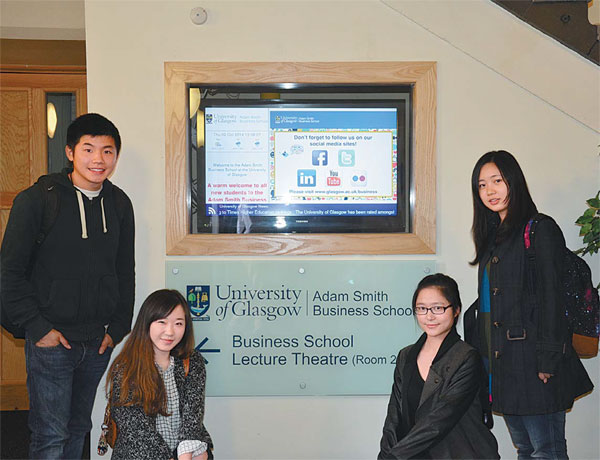
Chinese students at Glasgow University Adam Smith Business School. Provided to China Daily |
Chinese students are often strongly advised by their parents about what to study. Sometimes parents fill in the application form for them, and the children are scarcely even asked what they want to do.
A business degree and a job in a bank sounds like it would be secure, but, as economics students should know, things may change if there is an oversupply.
"There are far more business graduates than the industry needs, and, anyway, banks are now recruiting people from many different subject areas, and not just business students," says Catherine Li, who studied in the UK before getting a job with?Standard Chartered in China.
A customer manager at China's Bank of Communications in Chengdu made a similar point, noting that it is very difficult to get a promotion in a bank because there are too many highly qualified people. "Most of the graduates start at the bottom as front-line staff. There are very many of them, but there are few positions in management. Even the most capable people struggle to advance their careers."
Even some people who have rocketed to the top concede there is a problem. Yiyang Zhang works for a Wall Street hedge fund company, where he is CEO for China. He is also a member of China Young Angel Investor Leader Association. Zhang returned to China after studying in Australia four years ago, and says his annual salary is $200,000. But he is aware of the difficulties that business graduates face, partly because of problems in the economy, and also because the opportunities for success are limited. "The global economy is not very good at the moment. Domestically, business is not that great. Other people I know also back from Australia are mostly working in banks, being paid 7,000 to 8,000 yuan ($1,140-$1,300) a month. Those are the ones who are doing well. I'm really an exception. I'm lucky, I work hard, and I have a nice boss. People like me are very rare."
Paradoxically, as China's economy and domestic consumption grows, and its middle class expands, there will be an expansion of jobs in a wide range of other areas such as advertising, public relations, journalism, design and other creative industries, including work for artists, writers, sports and leisure professionals, and workers in all manner of public services.
Jieyu Liu, deputy director of the China Institute at London University's School of Oriental and African Studies, says: "As China's economy grows, it needs more diversified skills and talents, and China will move from just receiving the model and doing basic production of commodities to more innovative activities, such as research, design and branding. As China's middle class grows, consumption is a symbol of status, so there will be an expansion of the service sector."
Helena Huang of Chatham House, London's Royal Institute of International Affairs, agrees. She says the creative industry in China is in its infancy and will prosper in the coming decade.
"It takes time for China to rebalance its economic structure, and gradually it will switch into a more consumption-driven economic growth model, where the service sector has a bigger role to play. It will need a more diversified talent pool to beef up the growth in China's tertiary sector.
"China's middle class is growing. These consumers enjoy learning golf and attending cultural activities. It will be translated into an increasing demand for a more diversified lifestyle. There lies the future boom for the creative industry."
This happened in Japan as its economy grew and diversified. The comparison with what Japanese students study is striking.
Only 19 percent of them are business students, compared with 53 percent from China. Less than 5 percent of Chinese students in the UK study creative arts and design. Japanese students are more than three times as likely to study in these areas.
"I have seen Chinese people doing very well in the UK in creative industries, for instance, start-ups specializing in Chinese contemporary arts and the equine industry," Huang says.
The insistence on young people studying finance and banking means that many are forced into it when they would really like to be doing something else.
Huaxin Li, a finance student at Glasgow University, had studied piano in China and wanted to be a musician. But her parents insisted that she study business. "I am trying to find inside me a love of banking," she says.
Of course some people really do like finance, and for the few who succeed in areas like hedge fund management, the rewards are great. However, it is now possible to achieve success in many different ways in China, whether in designing clothes or being a musician.
Yuan Wang, a musician doing a doctorate in the UK, wants to set up the first courses in popular music studies at Chinese universities. He is typical of the new China, and is excited by the possibilities of innovating in an area yet to be explored. "I want to bring back to China all of the different ideas that I learned in the UK, to be a role model and show young people that it is possible to do things differently, and that this is the way to find personal happiness."
In the 1960s the West went through its own period of cultural innovation with an explosion of fashion, music and alternative ideas. It also included a new spirit of individual fulfillment expressed in the slogan, "Do your own thing". In China, many are now starting to do just that.
The names of students and bank employees who requested anonymity have been changed.
For China Daily















