


Vice-premier praises Sinology's global role
|
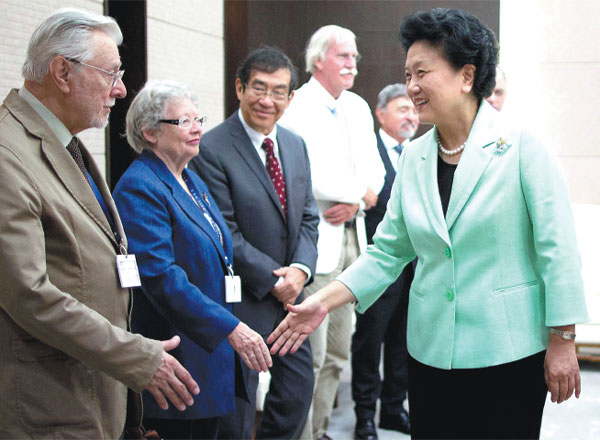
Vice-Premier Liu Yandong (right) meets with scholars before the opening ceremony of the two-day Fourth World Conference on Sinology in Beijing on Saturday. Mao Yanzheng / China Daily |
Academic approaches to studies of China are flourishing overseas
Vice-Premier Liu Yandong has hailed Sinology as the "window for the world" to better understand China, while expressing her wishes for the age-old academic study to evolve with more exchanges and diversified approaches.
"Since originating in the late 16th century, Sinology has opened a window for the world to observe and study China. It also boosted the academic and cultural exchanges between China and the world in all walks," Liu said.
She was speaking at the fourth World Conference on Sinology, held at Renmin University of China on Saturday and Sunday.
Boasting more than 400 years of study of China-related subjects, Sinology has brought groups of overseas scholars to China, while deepening mutual understanding, Liu said at the opening ceremony.
Jointly staged by Hanban, the Confucius Institute headquarters, and Renmin University, the conference had the theme "The Exchange and Learning Between 'East' and 'West': 400 Years in Retrospect".
More than 120 international Sinology scholars from 39 countries and regions, as well as 80 Chinese researchers, gathered at the two-day conference.
Hosting the conference also marked the 10th anniversary of the Confucius Institutes, which are nonprofit institutions affiliated with the Ministry of Education in which Chinese culture and language curricula are offered at joint facilities at overseas universities.
The expansion of Confucius Institutes offers convenient access for overseas Sinologists to learn about China and to promote traditional Chinese culture globally, Liu said.
"For hundreds of years, mathematics, sociology and the sciences of astronomy and geography from the West have broadened the cognitive borders of the Chinese, and Chinese philosophy, literature and arts have also deeply influenced counterparts in the West," she said.
"Without inheriting and developing cultural civilization, the Chinese Dream couldn't be realized. Sinology research should be further promoted as China is embracing an open and inclusive manner to interact with international communities," Liu said.
Ezra F. Vogel, former director of the Fairbank Center for East Asian Research at Harvard University, who is author of the biography Deng Xiaoping and the Transformation of China, said: "Sinologists are largely responsible for boosting the exchanges between China and the world. China's opening-up offers more access for Sinology studies."
Still, Liu said modern Sinology should evolve by expanding cross-field cooperation and deepening people-to-people exchanges.
To offer young foreign scholars more insights of China, Hanban launched the Confucius China Studies Program - a talent-fostering initiative - during the last Sinology World Conference in 2012.
The program provides funding and logistical support for international graduate students and young scholars to conduct research and studies in humanities at 14 universities in China.
Hend Abdelhalim, a graduate of Suez Canal University in Egypt who studied the Chinese language for two years at Sun Yat-sen University in Guangzhou, said the program opened the door to the variety of Chinese culture to her.
"We had very limited resources of Chinese-language studies back in Egypt. Being able to visit China and learn Mandarin from native speakers helped a lot," she said.
The rapid expansion of Confucius Institute branches also offers Sinology study resources.
The Confucius Institute opened its first branch in Seoul in 2004. The institute now has 458 branches in 122 countries and regions, with almost 1 million international students registered for its curricula. It also has built 710 classrooms aimed at secondary education worldwide.
The Confucius Institute will celebrate the inaugural Global Day on Sept 27 by opening its headquarters to visitors and hosting activities at overseas branches.
sunxiaochen@chinadaily.com.cn















