A dream to build a new Zimbabwe
|
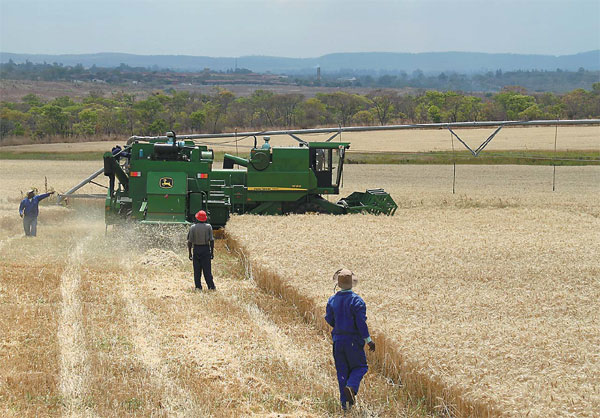
Zimbabwean workers reap wheat on a farm under the Zim-China Wanjin Agricultural Development Co Ltd. Photos provided to China Daily |
Confronted with development challenges, country puts out call for investment
Zimbabwe is attempting to bolster its economy by inviting Chinese investors to participate in its ailing but recovering agricultural sector and to help get its light industry off the ground.
Once considered the breadbasket of Africa, the former British colony has suffered recurring food shortages for years since its independence from Britain in 1980.
Food insecurity has been dire because "about 70 percent of the population depend on agriculture for sustenance", says Major General Douglas Nyikayaramba, in the country's Ministry of Defense, during an investment conference in Hefei, capital of East China's Anhui province.
"Linkages between agriculture and manufacturing are particularly strong, with the agricultural sector supplying more than 60 percent of raw materials to the manufacturing sector in Zimbabwe," Nyikayaramba says.
Zimbabwe's Ministry of Defense took the leadership role in spearheading joint venture projects and established the Zim-China Wanjin Agricultural Development Co Ltd in the country with its Chinese partner, Anhui Provincial State Farms Group, in 2010.
The joint venture now leases seven large farms, or 10,000 hectares of land, in Chinhoyi city, mostly in wheat, maize and soybeans, as well as some tobacco. The leases run for as long as 99 years.
The company expects to have 50,000 hectares under cultivation by next year, according to the development plan of the Anhui farms group.
The Wanjin project calls for investment of about $240 million, including rent, infrastructure and machinery, says APSFG, which provides all the capital.
"The project serves as an example of the economic cooperation between the two countries", says Nyikayaramba, who is also the deputy chairman of the joint venture.
The country desperately needs such cooperative enterprises.
A United Nations report in 2012 took note of improvements in the country's economy, but noted continuing challenges.
"Zimbabwe is recovering from a decade of economic decline that led to rising levels of poverty, unemployment and underemployment. The country is confronted with major developmental challenges, manifested by high unemployment, rising poverty levels and inequality, low savings and investment rates and a decaying infrastructure."
The recent investment conference, organized by the state-owned Anhui farms enterprise, aims to attract more Chinese firms to invest in a country where conditions are difficult, but the needs are so great that opportunities are plentiful.
A Zimbabwean delegation to the conference was comprised of Ministry of Defense officials and China-based diplomats and scholars from the Chinhoyi University of Technology in Zimbabwe.
The primary opportunities still lie in crop production, since food security remains the authorities' top concern and the foundation of other industries.
A vast area of idled fields is waiting for cultivation, and land in crops needs to be modernized to raise production capacity.
Money to make those changes has been scarce due to long-running economic sanctions imposed by some Western countries and organizations.
After the country's independence, the new government launched a land reform program to help the black majority win back land from the white colonial-era settlers, who "occupied about 80 percent of arable land", Nyikayaramba said.
After former British prime minister Tony Blair took office in 1997, the relationship between Britain and its former colony tensed, especially around 2000 as whites who owned and managed large farms were evicted.
"The British response to the land reform was the imposition of economic sanctions on Zimbabwe in order to frustrate and sabotage the program," Nyikayaramba says. The country's officials primarily blame the sanctions and a series of droughts for the food shortages.
"A hungry nation is an angry nation, hence we need to fight the illegal economic sanctions and avert a potential conflict among the people," Nyikayaramba says.
With the Wanjin joint venture lighting the path for further cooperation, more and more Anhui-based investors are now showing interest in the country.
The provincial government has encouraged businesses to extend a hand to the continent, and last year, Anhui-based enterprises invested a total of $580 million in Africa. The money accounted for more than 10 percent of the total invested by all Chinese investors in Africa that year, officials say.
In the past five years, investments in Zimbabwe from Anhui totaled more than $4 million, says Zhang Wuyang, deputy secretary-general of Anhui's provincial government.
In June last year, the Cooperative Association of Anhui Enterprises for Developing in Zimbabwe, backed by the Anhui provincial government and headed by APFSG, was established in Hefei. Member enterprises climbed from 27 last year to 37 recently.
The cooperative association organizes potential investors to visit Zimbabwe every year, in an effort to give them more detailed knowledge of the investment environment there.
After a visit in 2013, Yi Shutong, chairman of Anhui Tianrui Environmental Technology Co Ltd, decided he should choose farms larger than 700 hectares for investment since it is so costly to cultivate idled cropland.
Yi's company established a Zimbabwe-based subsidiary, Zim-China Wanjin Tianrui Food Processing (Private) Limited, in July 2013. Yi's company has invested more than $30 million in Zimbabwe through the subsidiary. The company, established by buying a bankrupt Zimbabwean food processing company, is initially engaged in maize processing but has plans to diversify.
A total of more than 3,200 hectares are now under its cultivation, while the total area is expected to hit about 5,000 hectares this year.
During the association's visit to the country this year, Fan Hengjin decided to invest in Zimbabwean farming.
Fan is chairman of Anhui Hengjin Agricultural Development Limited, which leases more than 2,000 hectares of agricultural land in China. Fan planned to lease land in Russia, but after the visit to Zimbabwe he realized that natural conditions there are more suitable for growing crops.
Some business executives, including Fan, still worry about whether the country's infrastructure, including the power supply and irrigation facilities, can meet their needs. But Nyikayaramba said Zimbabwe is seeking investors to help them with nearly all their agriculture-related sectors.
"Crop production is by no means a single process of sowing and reaping. It brings even more opportunities," Nyikayaramba says.
The country now has only about 15,000 tractors on its farms, but plans call for boosting the number to 100,000 in 10 years. There is a similar gap in reaping machines.
Most of the agricultural machines used at the Wanjin company farms were imported from China. Nyikayaramba says he would like to see the country manufacture them in the future.
"Zimbabwe not only enjoys an excellent geographical location but also maintains friendly relations with neighboring countries. Machines produced here can easily be sold in our country and exported to other nations."
Other opportunities in the country include food processing; manufacturing of herbicides, pesticides and fertilizers; and the construction and manufacturing of elements of agricultural infrastructure such as irrigation facilities, dams, canals, piping, and storage and distribution facilities.
"Our country is also faced with huge shortages of beef and dairy products, so the livestock sector can also offer you many opportunities," Nyikayaramba says.
While now focused on crop production, Wanjin Agricultural Development plans to diversify its operations into multiple businesses in a bid to build a comprehensive overseas agricultural economic zone in Zimbabwe.
The zone, expected to become home to multiple businesses, would include crop production, processing of agricultural products, logistics and storage businesses. It is planned as a major step toward a more complete industry chain.
"During my visit in the country, I was impressed by the abundant natural pastures there. As the first step toward the livestock sector, a new project for raising 200 cattle is now going on smoothly," says Yi, whose company has already set foot in crop production, food processing and timber processing.
Nyikayaramba says Zimbabwe's "abundant mining and tourism resources are also available to Chinese investors", adding that there is now a need to establish a Chinese bank in Zimbabwe for financial transactions, given the high level of Chinese investment in the country.
Yi says he is satisfied with the progress.
"As long as the country's political situation is stable, we are confident of our investment in Zimbabwe."
zhulixin@chinadaily.com.cn