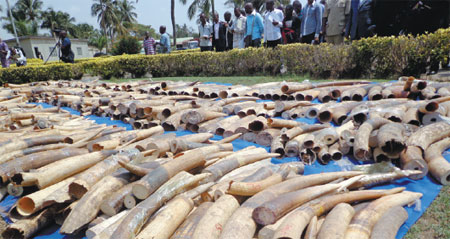
Africa surpasses Asia in smuggled ivory seizures
Several African countries have made great strides in clamping down on ivory smuggling, with large seizures for the first time exceeding those made in prime destination Asia, UN wildlife regulator CITES said Friday.
Until recently, seizures of half a metric ton or more of ivory were rarely if ever made before the illegal, precious material left Africa. That changed just over a year ago, according to the Convention on International Trade in Endangered Species of Wild Fauna and Flora.
Two-thirds of the 76 such seizures made since 2009 have been in Asia, where demand for tusks for decorative purposes and use in traditional medicines has fueled a multi-billion-dollar illicit trade.
But since March 2013, for the first time, "more large-scale seizures were made in Africa than in Asia", CITES said in a report on elephant poaching and the illegal ivory trade.
Eighty percent of the African seizures were made in three countries - Kenya, Tanzania and Uganda - which happen to figure among the eight nations ordered by CITES last March to create National Ivory Action Plans to tackle the problem.
The shift in where seizures are taking place is hugely significant, according to Ben Janse van Rensburg, a former South African police officer who heads CITES' enforcement support unit.
"These large consignments up until now, ... managed to leave the African continent without being detected at all," he said.
"Now they are being detected, which actually shows that these countries have started to implement measures to combat this illegal trade," he said.
'Encouraging signals'
The shift hints at what can be achieved with a "strong, coordinated, collective" effort to fight elephant poaching and ivory smuggling along the whole value chain, he added.
"You can't fight this only from one side of the chain," Janse van Rensburg said.
There is still a long way to go, however.
The CITES report found that more than 20,000 elephants were poached across Africa last year alone.
While the number is staggering, it actually signals a leveling off after a decade of skyrocketing poaching - fueled by organized criminals eager to reap massive profits at very low risk, and is also believe to fund insurgencies in Africa.
In 2011, some 25,000 of the world's largest land mammals were killed, and the number was around 22,000 in 2012.
"Due to the collective efforts of so many, we also see some encouraging signals," CITES chief John Scanlon said in a statement.
He stressed though that "Africa's elephants continue to face an immediate threat to their survival".
While poaching declined dramatically in some places, like Chad, last year, it also swelled elsewhere, like in the Central African Republic, the report said, adding that some elephant populations remained on the verge of local extinction.
"There are still more animals being killed than animals being born, so even if it stabilizes at this current level it will lead to a decline in the elephant population," Janse van Rensburg said.
"We're definitely not there yet. There's still a lot of hard work to be done," he added.
At the beginning of the 20th century, there were some 10 million elephants roaming across Africa.
That number fell to 1.2 million by 1980 and to about 500,000 currently, according to conservation groups.
Ivory trade was banned in 1989 under the Convention on International Trade in Endangered Species of Wild Fauna and Flora.
CITES and other animal protection groups have warned that as many as 20 percent of the continent's elephants could disappear within a decade if current poaching rates are not tackled.
|
A stock of seized ivory is piled on the ground in Lome's autonomous port on Feb 4. Several African countries have made strides in clamping down on ivory smuggling. Emile Kouton / Agence France-Presse |