


Cofco takes a bite out of nation's food insecurity
After spending the past decade and more than $200 billion acquiring mines and oilfields from Australia to Argentina, China's attention is turning to food.
The world's most populous nation is confronting a harsh reality: For every additional bushel of wheat or pound of beef the world produces, China will need almost half of that to keep its citizens fed.
In acknowledgment that it can't produce enough grain and meat domestically, mainland Chinese and Hong Kong-listed firms spent $12.3 billion abroad on takeovers and investments in food, drink or agriculture last year, the most in at least a decade, data compiled by Bloomberg show.
|
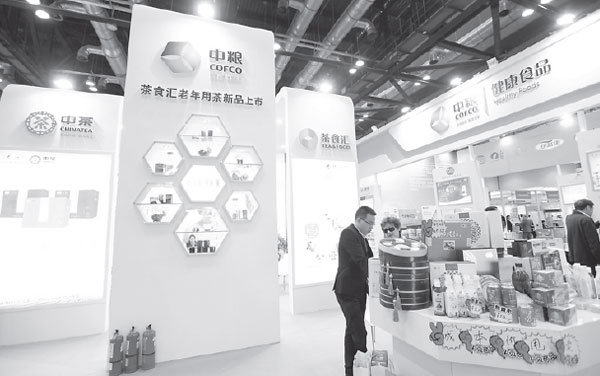
Cofco Group's display at a trade show in Beijing. Cofco will be "a powerful global agricultural trader and able to procure directly around the world," Fitch Ratings Ltd said in an April 3 report. Provided to China Daily |
Those purchases included the largest Chinese takeover of a US company when Shuanghui International Holdings Ltd. bought Smithfield Foods Inc for $7 billion including debt. They are likely to be followed by overseas forays into beef, mutton and grain assets, according to the National Australia Bank Ltd.
"These deals have been bound to happen, and I'm actually surprised it didn't happen sooner," said Paul Conway, vice-chairman of Cargill Inc, one of the four companies that now dominate world food trade. "China will be more integrated into the global commodities system on the agriculture side than they have ever been."
During the country's explosive economic growth in recent decades, it's been a pattern of the government to use State-owned enterprises as national champions to lead a charge into strategic industries.
This is what happened with energy security when PetroChina Co went on a global, decade-long $40 billion-plus spending spree to acquire oil assets.
China's emerging champion in food security is Cofco Corp, which controls 90 percent of China's wheat imports and has made two acquisitions this year.
It bought controlling stakes in Dutch trader Nidera Holdings BV and Noble Group Ltd's agribusiness in the space of two months, paying about $2.8 billion in total.
With Noble's agribusiness, Cofco gained grain elevators in Argentina and sugar mills in Brazil, as well as oilseed-crushing plants in China, Ukraine and South Africa. The Nidera purchase gives Cofco a strong platform to produce grain in Brazil, Argentina and central Europe, the Chinese firm said in February.
Cofco's role
Cofco will be "a powerful global agricultural trader and able to procure directly around the world," Fitch Ratings Ltd said in an April 3 report.
The numbers show why. China has 21 percent of the world's population with just 9 percent of its arable land, and an even smaller percentage of fresh water, according to Jefferies Group LLC. Rising incomes are driving demand for more protein-rich food, while domestic output is close to its limits, Abhijit Attavar, an analyst with Jefferies in Singapore, said in an April 15 report.
In the task of feeding China, Cofco will have plenty of competition.
Archer-Daniels-Midland Co, Bunge Ltd and Cargill of the US, as well as France's Louis Dreyfus Holding BV - known collectively as the A-B-C-Ds - control more than 70 percent of global grain trade, according to Tokyo-based Continental Rice Corp.
Others sensing big opportunities in food include Japan's Mitsui & Co. The trading house has built a farming and trading network almost from scratch since 2007 and can tap assets on five continents.
Japan's trading houses have ventured into assets as diverse as Brazil soybean plantations to Thai shrimp farms and US corn silos. The world's biggest oil trader Vitol Group last year expanded into grains trading by setting up a Singapore desk.
"We're seeing that driven by SOEs, private enterprises and trading companies from other countries are looking to create supply chains that go from Australia into China and, indeed, from the Americas," said Patrick Vizzone, regional head of food and agribusiness at National Australia Bank.
Vizzone, who also sits on the board of Cofco unit China Agri-Industries Holdings Ltd, said he sees the potential for Chinese ventures and acquisitions in the grain, oilseed, mutton and beef industries.
There also may be bigger options.
Preparing for the future
Margarita Louis-Dreyfus, chairman of her namesake company, has said the commodities unit will be reorganized to prepare itself for a possible stake sale or an initial public offering. That won't happen in the immediate future, but the company wants to be ready, she said in April.
Cofco had no comment on acquisitions, a woman in the company's media relations office, who asked not to be identified citing company policy, said by phone. Yin Jianhao, Cofco's official spokesman, didn't answer numerous calls to his mobile phone.
"Food security must include imports, and without that, the global food system doesn't work," said Franz Fischler, former EU commissioner of agriculture. "The idea of self-sufficiency is almost an archaic fear, and China is realizing this."
Cofco was formed through a series of mergers of State food and animal husbandry companies in the 1950s and is now China's biggest food company with 60,000 employees. Chairman Ning Gaoning holds an MBA from the University of Pittsburgh and also serves as Cofco's Communist Party Secretary.
Today, the company operates China's biggest grain storage facilities and owns ports that can process 100 million tons of grain a year.
Outside food, Cofco runs commercial and residential property units, tourist resorts and financial services that include a commodity futures brokerage, a regional bank and an insurance venture with London-based Aviva Plc. It has seven listed units.















