Searching for Chinese roots in Africa
Mozambique's Confucius Institute connects generations. Wang Chao and Andrew Moody report.
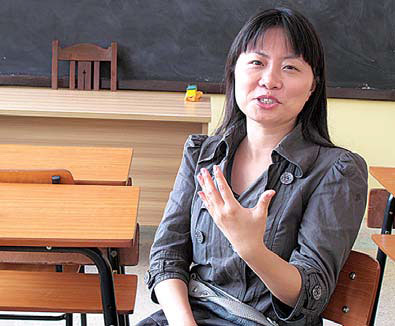
Xie Hong could have hardly imagined the Confucius Institute in Mozambique's capital Maputo, where she teaches Chinese, would be an important link for local overseas Chinese to trace their roots.
But for many like Mei Mei, 50, a Maputo native, the center is an important link to, and living testimony of, their history and ancestors. Mei says her father was Chinese and her mother Mozambique. Mei says she remembers very little of China and her childhood in Guangzhou.
"All I remember is the vague image of a tall longan tree in the yard and the name that my late father used to call me, which sounded something like 'may-may'," she says.
When Xie taught her how to write her name in pinyin, she burst into tears and has since then insisted on being called "Mei Mei" rather than by her Portuguese name because it connects her to China.
"Many who come here are of Chinese descent but can hardly speak a single word of Chinese," Xie says, adding that they are nevertheless proud of their rich heritage.
It's such experiences that make the long walks for groceries, lack of authentic Chinese food and the absence of the endless chatter of her 7-year-old daughter back in China less painful, she says.
"I would say it (Mozambique) has been a rewarding experience."
Xie comes across like many others from Southwest China's Sichuan province, with a round face, fair skin and the gift of gab. She has also inherited the bold traits of the people from Sichuan, accentuated by her extensive trips to several African countries and her not-yet-perfect Portuguese.
Before coming to Africa, Xie studied and worked at Zhe-jiang Normal University for more than 10 years. In October 2012, she was deputed by the school to start and teach at the Confucius Institute at Eduardo Mondlane University in Maputo.
Before the Mozambique institute was established, there were already institutes and classrooms in such countries as Cameron, Tanzania and Madagascar. Unlike such countries as Nigeria and Ethiopia, there were very few Chinese in Mozambique as a result of the civil war, which ended in 1992. So Xie assumed there would be few people interested in learning Chinese.
But the results have been quite different, she says with a smile.
"When the first term started, we had more than 270 people registered for the classes. Most of the students were local workers from Chinese companies who wanted to improve their language skills so they could get higher-paid posts, and overseas Chinese who were in Africa for most of their lives," Xie says.
Though culture and better job prospects are the prime motivators, affordability and China's growing engagements in Africa have also sparked interest in language classes.
"The tuition fee in most cases is just symbolic - 500 to 1,000 meticais (about $19 to $38) for the three-month term - and barely enough to cover the textbook and printing costs. The China National Office for Teaching Chinese as a Foreign Language, or the Hanban, pays our salaries," Xie says.
The first classroom was on the first floor of an old Portuguese-style building, owned by the Chinese community in Maputo, she says. On the ground floor of the building was a club teaching kung fu. It was not uncommon for the shouts of the kung fu students to mingle with the noise of the students in the Chinese-language classroom.
"We were apprehensive in the initial days that we would not be able to attract enough students," Xie says.
"We had even contemplated taking out huge advertisements in local newspapers and putting up posters to attract students on a continuous basis. Our worries were unfounded, as we found that students were flocking to the classes more on referrals and on being told about it by friends, neighbors and well-wishers."
Once the school was well known, Xie and her team decided to set up a second campus in a local university. They recently opened a class for 80 soldiers from the local army and another class for 20 immigration officers at Maputo International Airport, who, from time to time, encounter Chinese people who don't speak Portuguese.
The institute has four teachers and eight volunteers, all from Zhejiang Normal University. Before joining the Hanban, the team had to learn Portuguese for at least a year and be vetted, which included completing a psychological test, to ensure they could adapt to their new surroundings.
Xie says she was initially reluctant to come to Africa. She declined an offer in 2011 because her family opposed the idea.
Destiny, however, had other plans.
She had to take up the assignment the following year, as the project was short-staffed.
"I was apprehensive as I considered Africa to be a land filled with famine and wars. But the situation on the ground is far different from what I imagined," she says.
"Although the development is unbalanced across the country, Maputo is a civilized place. And the most valuable thing is that, unlike the coastal regions in Southeast China, the town is relatively quiet. This really gives me great peace of mind."
Mozambique is an ethical country, where doctors and teachers are shining examples, she says.
"Though the international airport is strict in checking foreigners' suitcases in case they transport ivory or rhino horns, I was never asked to open my suitcase after I showed my name card to the customs officials," Xie says.
Activities in the Confucius Institute are not limited to teaching Chinese. During major traditional Chinese festivals, Xie and her colleagues organize Spring Festival and Mid-Autumn Festival galas, featuring Chinese dances and songs.
"Usually a much bigger crowd than the students would turn up - mostly local people who know nothing about China but are curious about its language and culture."
Teaching Chinese in Mozambique gives Xie a perspective totally different from her teaching experience in China. She says they have to keep the time slots relatively flexible because few students show up on time.
"But they are amazing students. They seem to have the genes to imitate the pronunciation and are very quick in reading and listening," Xie says.
Confucius Institute graduates are also in great demand in the local job market, especially among the Chinese companies in Maputo. Some Chinese companies come to book students with good Chinese skills. A private company recently reached an agreement with the school to train 400 local workers.
Another major Chinese company in Maputo also plans to sponsor about 100 local workers to study in China. Before they go, they'll study basic Chinese at the Confucius Institute, Xie says.
When Xie arrived two years ago, she'd planned to file an application to return after two years. But she has decided to stay for the full term of three years.
"I wish we could expand the school further and open more branches in other provinces of Mozambique," she says.
Contact the writers through wangchao@chinadaily.com.cn
|
China's growing engagement in Africa has sparked interest in Chinese-language learning, Xie Hong says. Wang Chao / China Daily |