The China-Africa virtuous circle of growth
|
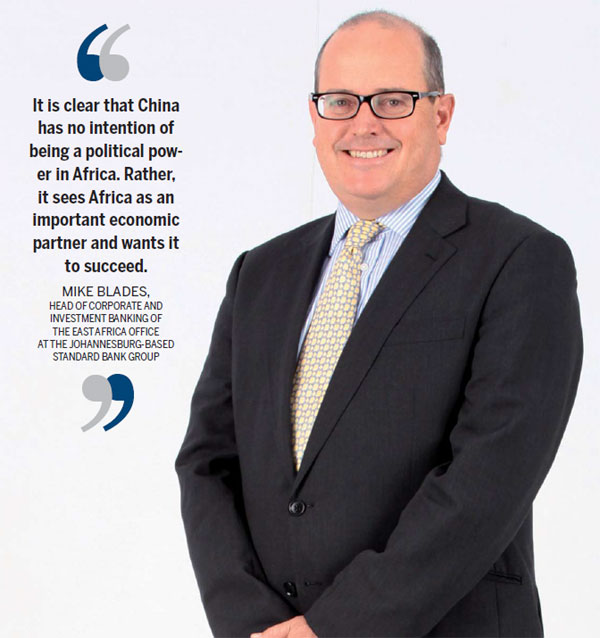
Mike Blades, head of corporate and investment banking of the East Africa office at the Johannesburg-based Standard Bank Group, says China is creating infrastructure that is vital for Africa's economic growth. Provided to China Daily |
Closer ties between the country and the continent can generate huge economic dividends, says banker
Consolidated partnerships that benefit infrastructure creation and technology transfer should be the main plank of Sino-Africa financial cooperation, says Mike Blades, head of corporate and investment banking of the East Africa office at the Johannesburg-based Standard Bank Group.
Most of the African countries do not have the required financial or technological resources to cater to their growing infrastructure requirements, he says.
"Financing has always been a major issue with infrastructure projects in Africa. African lenders do not have the required financial muscle to fund many of the big-ticket projects."
Chinese lenders, on the other hand, have surplus funds to lend, and that too at tenors that are suitable for most of the African countries. "Though this represents an ideal situation, its real success, however, depends on how well Africa understands China and its financial system."
In this regard, he cites the experience of Standard Bank and how it gained from its association with the Industrial and Commercial Bank of China.
ICBC bought a 20 percent stake in Standard Bank, Africa's largest bank by assets, in 2008 to become the largest shareholder in the South African lender. Blades says Standard Bank was one of the first African lenders to realize that having a representative office in China would be beneficial in the long run.
Though he spent more than five years in China before coming to Kenya in 2013, he says it has been a huge learning experience.
"Initially we had a five-member team in Beijing and our job was to scout for opportunities that could come through our association with ICBC," he says.
However, the experience of understanding China gave Blades and his team insights and fresh perspectives on how to gain business.
"It was an eye-opener as we learnt several helpful tips on how to do business with Chinese people and companies. The most important thing that we learnt is that to be successful it is important to have a flexible approach.
"We had created a business plan for our Chinese operations based on the preconceived understandings that Standard Bank had about China and our new shareholder. But we soon realized that it would be of no use in China.
"The main problem with the old plan was that it hinged on talent coming from Johannesburg to Beijing. What we realized is that to succeed in China it is important to have people who can understand the local culture and also have a local presence," he says.
"Chinese people like to deal with Chinese people. Though I was there to guide the initial strategy, I realized that not knowing the local language was a major handicap. So we changed tack and started hiring more people locally (Chinese). This helped us gain valuable insights on the various cultural nuances.
"I am not saying that the Chinese did not want to deal with us. On the other hand, it is the Chinese people who taught us the importance of adding a local flavor to business transactions. Instead of hiring highly skilled people from either inside or outside the bank, we started looking for such talent locally."
Blades says another lesson he learnt was that Chinese businesses are built on trust and relationships, and it is important to invest more in such relationships for tangible results.
"What really helped us in China was the fact that we had ICBC as our shareholder. In a sense, it gave us Chinese credentials. The fact that we had a Chinese shareholder made us, I guess, more legitimate and capable of handling Chinese clients."
Standard Bank's aim in China was not to do business with China itself but to deal with Chinese corporate customers in other markets outside of China and specifically Africa, especially with those who have already established businesses in Africa or had an interest in doing so either by being their bankers or by providing investment banking-related services.
After weighing the various options, the bank decided to focus on three sectors in China, he says.
"The first is the oil and gas sector as we felt that a number of Chinese companies are looking for oil and gas opportunities in Africa. Power and infrastructure is another major sector that the Chinese are strong in and something that Africa desperately needs.
"The third sector is something that Standard Bank has core expertise in the mining and metals sector, which of course the Chinese are interested in.
"Obviously we don't have the resources to specialize in all sectors, so we focussed on the ones which are most relevant to Africa and China.
"In making investment decisions, Chinese investors often look for strategic perspectives. Investment decisions are based on 50-year or 100-year outcomes, as opposed to the Western notion of accounting for the current or immediate reporting period.
"They (the Chinese) are strategic in actions and keen on long-term results." Blades says. Chinese generally believe that Africa has lots of natural resources that are essential for its economic growth.
"They (the Chinese) also realize that to get these resources out of the ground and on to a port or a boat to China, you actually need to develop the infrastructure," he says, adding that the Chinese solution is to build infrastructure at relatively lower costs than what these countries would be able to do.
Arguing against the notion that the Chinese are in Africa to exploit its natural resources, Blades says it is creating infrastructure that is vital for Africa's economic growth.
"The Chinese believe that if you continue to invest in infrastructure by building roads, bridges, power stations and so on, you generate more economic growth. By creating that economic growth, China is also creating a market for its goods," he says.
Transferring skills and technologies to African countries is another characteristic of Chinese investment in Africa, he says.
"Transferring skills to African countries generates more wealth and a ready-made market for finished products. I call it the virtuous circle," he says. "You invest in it, transfer skills and create infrastructure. Economic growth follows along with the emergence of people who can afford Chinese goods and services."
He says that Chinese motives in Africa are mostly economic and not political.
"You could term it positive or negative, depending on which side of the fence you are sitting on. It is clear that China has no intention of being a political power in Africa. Rather, it sees Africa as an important economic partner and wants it to succeed."
China also knows that for Africa to succeed it needs to look for long-term growth in a sustainable manner.
"It know sustainability is important, and that is why it is taking steps to ensure that Africa does not fail economically."
lilianxing@chinadaily.com.cn