Riding the rails in Ethiopia
|
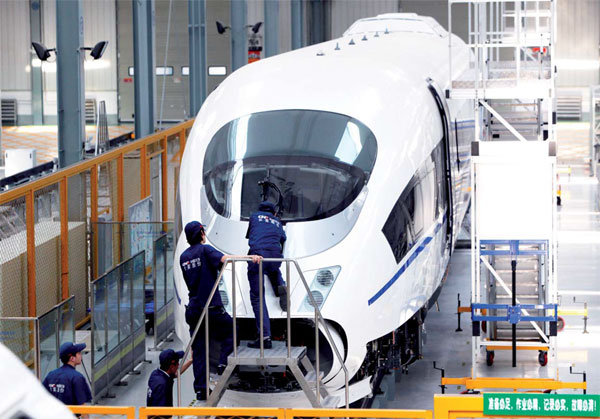
Staff of China CNR Corporation check a locomotive at a workshop in Changchun. Photos provided to China Daily |
CNR Changchun turns to embedded technology transfer for growth in Africa
As dusk falls on Addis Ababa, it is easy to spot the shadows of the giant cranes that are busy laying the rails for Ethiopia's ambitious light rail transit system.
The $475 million project, being executed by China Railway Engineering Corporation, will soon have Chinese-made trams carrying passengers across the length and breadth of the Ethiopian capital.
However, the tramcar order won by China CNR Changchun Railway Vehicles, a division of China CNR Corporation, in November is much more than just the supply of 41 trams. It marks a major milestone in the shipping of products with real, embedded technology to Africa, sources say.
"It is a milestone for us as it gives us a breakthrough in the dynamic African market," says Liu Gang, deputy director of the international division of CNR Changchun Railway.
Liu says the first batch of trams will be delivered in August for test operations of the light train system, which is due to open this year. "It is also our first major order from Africa," he says.
CNR is one of the two major tram manufacturers in China along with CSR. Both were part of the erstwhile China National Railway Locomotive & Rolling Stock Industry Corporation and were created as separate entities in 2000.
The company started exporting trams in 1995 and now has customers spread across Australia, Brazil, Southeast Asia and the Middle East.
Liu says international trade was not significant before 2004. "Until then, our overseas business was worth less than $500 million."
Last year the company bagged overseas orders worth $900 million and exported more than 100 trams with a cumulative value of more than $4.5 billion.
"Africa has contributed $100 million in the first year of our business here," Liu says.
Talking about the tramcar order, Liu says the first big order came from China Railway Engineering Corporation, the main contractor of the Addis Ababa light train project. The project, designed with horizontal and vertical railway lines passing through Addis Ababa, is expected to reduce traffic congestion in the city.
"It was an important order for us as it was also the first big order that we got from a Chinese construction company for an overseas project," Liu says. The agreement covers not only the supply of tramcars but also maintenance services, he says.
The collaboration between the two Chinese companies goes back to the 1970s, when some of the locomotives built by CNR were used in the Tanzania-Zambia Railway project.
At the same time, the Chinese company is also banking on winning more tramcar orders in Africa through direct bidding. However, the Ethiopian order is a challenging task as it calls for trams that come with additional built-in features.
"Addis Ababa is 2,400 meters above sea level so the carriages need to be able to withstand the harsh effects of ultra-violet rays," Liu says.
"Moreover, Ethiopia has a long rainy season, which makes it imperative for the carriages to be extremely water and lightning proof.
"We also have to do tests to make sure these trams operate normally even during the worst flood days."
Li Bo of the company's technology department says the technology used for the Ethiopian train project is different from that in China. "Here they are low-floor trams, which means the floor of the trams is about 0.33 meters above the ground, while the high-floor trams are about 1.1 meters," Li says.
"By using low-floor trains we can eliminate the need for platforms and ensure that trains can travel side by side with buses. Such an approach will also significantly lower the overall project costs."
Most trams around the world are low-floor, as they are cheaper and more convenient, Liu says. "The big drawback is that they carry fewer passengers than high-floor tramcars. So for crowded cities with dense population, they are not suitable."
After the light train project is finished, CNR will keep 50 Chinese technicians in Addis Ababa to offer training and support services.
The Chinese company is also supplying 30 coaches that will run on the new Addis Ababa-Djibouti railway line. The project is expected to connect the Ethiopian capital to the nearest port, in Djibouti, and spur economic activity. The existing line, built by the French in 1917, is no longer used and has been abandoned due to wear and tear.
The CRN order includes supply of 20 hard-seat coaches with designed speed of 120 km/h, eight sleeping coaches and two dining cars.
The Ethiopian government has recently announced that it plans to expand its railway network to 2,600 km, which translates into demand for 130 to 260 trams, the company says.
With an eye on future orders, the company has already teamed up with a local factory in Ethiopia, which used to make military products, to jointly develop trams.
"If there are suitable opportunities, we will consider setting up a unit that is solely funded by CNR," Liu says.
The company is also using the Ethiopian project as a springboard to central and northern Africa.
"Nigeria, Egypt, Algeria, Kenya and Tanzania are all major destinations for us," Liu says.
As a company that is closely related to infrastructure projects, CNR finds potential customers two ways. It scouts for projects in African countries that are enjoying strong economic growth and in need of large-scale infrastructure, such as Egypt and South Africa. It also looks to work as a sub-contractor for projects undertaken by Chinese construction companies in central African countries.
"We have to admit that we did not pay enough attention to Africa earlier," Liu says, adding that the company was focusing on Southeast Asia, the Middle East and South America.
"These regions have big populations, and the local economies are developed enough to trigger more demand for machinery and construction materials. It is also a good opportunity to establish our brand."
The company has realized, too, that establishing the brand name in Africa is important. "The drawbacks we mention, such as lack of technicians and local manufacturers, turn out to be big opportunities for us," Liu says. In fact, the multinationals have detected the opportunities as well.
"Hyundai, Alstom, Siemens and Bombardier have already got some physical presence, but not as deep as in other developed markets.
"Only when the market is not developed can we seize the opportunities before our traditional competitors do."
Contact the writers through wangchao@chinadaily.com.cn
Han Junhong contributed to the story.